On Constructive Connectives and Systems
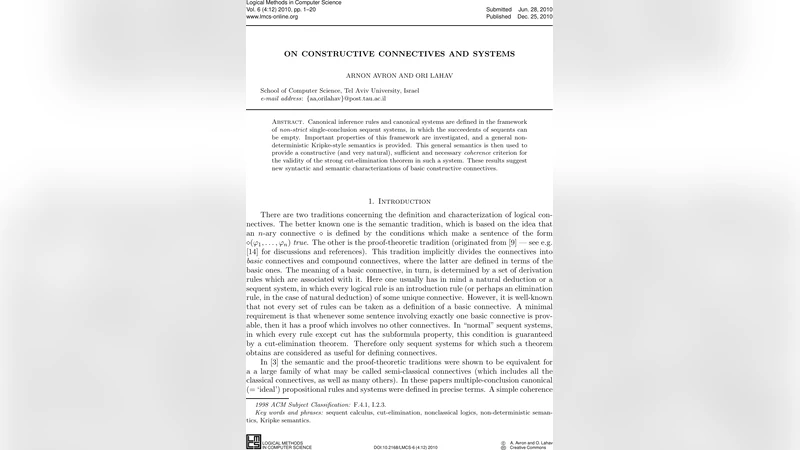
Canonical inference rules and canonical systems are defined in the framework of non-strict single-conclusion sequent systems, in which the succeedents of sequents can be empty. Important properties of this framework are investigated, and a general non-deterministic Kripke-style semantics is provided. This general semantics is then used to provide a constructive (and very natural), sufficient and necessary coherence criterion for the validity of the strong cut-elimination theorem in such a system. These results suggest new syntactic and semantic characterizations of basic constructive connectives.
💡 Research Summary
The paper introduces a novel framework for studying constructive logical connectives within a non‑strict single‑conclusion sequent calculus, where the succedent of a sequent may be empty. This seemingly modest relaxation has far‑reaching consequences for both the syntactic structure of proofs and their semantic interpretation.
First, the author formalises non‑strict single‑conclusion sequents. In the traditional Gentzen‑style calculus a sequent has exactly one formula on the right‑hand side; here the right‑hand side is allowed to be the empty multiset, which naturally captures intuitionistic notions of falsity (⊥) and negation (¬) without the need for auxiliary rules. Within this setting, inference rules are split into pre‑premises (the usual antecedent formulas) and post‑premises (formulas that may appear on the empty succedent). This bifurcation yields a clean definition of canonical rules and canonical systems that are stable under the addition or removal of empty succedents.
Second, the paper supplies a general non‑deterministic Kripke‑style semantics. Worlds are partially ordered as in classic Kripke models, but truth assignments are not single‑valued; instead each world may admit a set of possible truth values for each formula. This non‑determinism is essential to model the flexibility of empty succedents: a formula can be “forced” in a world either because every extension forces it (as usual) or because there exists an extension that validates the post‑premise. The semantics is shown to be sound and complete for the class of canonical systems defined above.
The central technical contribution is a coherence criterion that characterises exactly when a canonical system enjoys the strong cut‑elimination theorem. Coherence is defined semantically: a set of canonical rules is coherent if, for every world in every Kripke model, whenever all pre‑premises of a rule are forced, at least one of its post‑premises is forced as well. The author proves two directions:
- If a system is coherent, then any proof containing cuts can be transformed into a cut‑free proof that preserves the end‑sequent (strong cut‑elimination).
- Conversely, if strong cut‑elimination holds for a system, the system must be coherent.
Thus coherence is both necessary and sufficient. This result replaces the traditional syntactic cut‑reduction arguments with a single semantic check, dramatically simplifying the verification of cut‑elimination for new constructive connectives.
Finally, the framework is applied to basic constructive connectives. Classical intuitionistic connectives (∧, ∨, →, ¬) are re‑examined under the non‑strict sequent calculus and the non‑deterministic Kripke semantics. The paper shows that a connective is “constructive” precisely when it can be introduced by a coherent set of canonical rules; equivalently, its meaning is fully determined by the relationship between pre‑premises and post‑premises in every Kripke world. This yields a unified syntactic‑semantic characterisation that subsumes earlier, more ad‑hoc definitions. Moreover, the author demonstrates how to extend the language with novel connectives (e.g., a “strong disjunction” or a “conditional negation”) by providing coherent rule schemes, thereby illustrating the expressive power of the approach.
In summary, the article makes three major advances: (1) it broadens the sequent‑calculus setting to accommodate empty succedents, (2) it supplies a flexible non‑deterministic Kripke semantics that is sound and complete for this setting, and (3) it identifies coherence as the exact semantic condition guaranteeing strong cut‑elimination. These contributions not only deepen our theoretical understanding of constructive logic but also provide practical tools for designing and verifying new logical connectives in proof assistants and type‑theoretic languages.
Comments & Academic Discussion
Loading comments...
Leave a Comment