The complexity of linear-time temporal logic over the class of ordinals
We consider the temporal logic with since and until modalities. This temporal logic is expressively equivalent over the class of ordinals to first-order logic by Kamp's theorem. We show that it has a
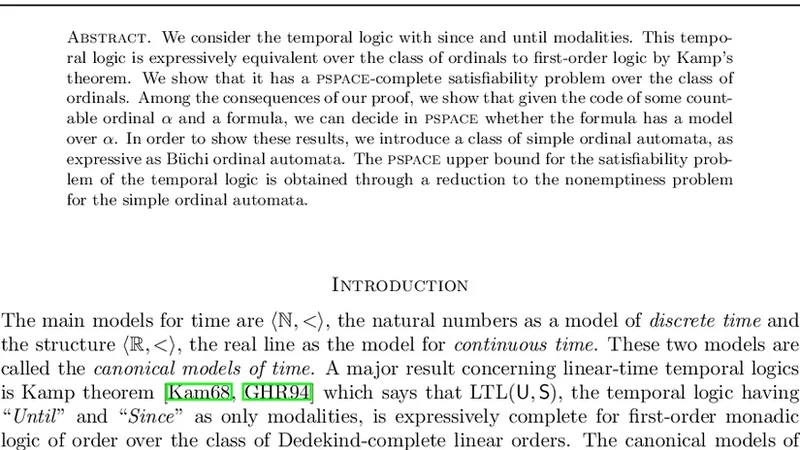
We consider the temporal logic with since and until modalities. This temporal logic is expressively equivalent over the class of ordinals to first-order logic by Kamp’s theorem. We show that it has a PSPACE-complete satisfiability problem over the class of ordinals. Among the consequences of our proof, we show that given the code of some countable ordinal alpha and a formula, we can decide in PSPACE whether the formula has a model over alpha. In order to show these results, we introduce a class of simple ordinal automata, as expressive as B"uchi ordinal automata. The PSPACE upper bound for the satisfiability problem of the temporal logic is obtained through a reduction to the nonemptiness problem for the simple ordinal automata.
💡 Research Summary
The paper investigates the computational complexity of linear‑time temporal logic (LTL) equipped with both “since” and “until” modalities when interpreted over the class of all ordinals. While Kamp’s theorem guarantees that this modal logic is expressively equivalent to first‑order logic on linear orders, the authors focus on the algorithmic question of satisfiability: given an LTL formula, does there exist a model whose underlying time domain is an ordinal?
The authors first reaffirm the expressive equivalence by extending Kamp’s theorem to the full ordinal setting, showing that any first‑order property of a linear order can be captured by an LTL formula using the two modalities, and vice‑versa. This establishes a solid logical foundation for the subsequent complexity analysis.
The technical core of the paper is the introduction of a new automaton model called simple ordinal automata. These automata are as expressive as Büchi ordinal automata (which accept infinite words indexed by ordinals), but they have a restricted transition structure that separates “initial” and “limit” phases of an ordinal. A state of the automaton corresponds to a sub‑formula of the LTL input, and transitions encode the semantics of the “since” and “until” operators. Acceptance is defined in the usual Büchi style: an infinite run is accepting if it visits a designated set of states infinitely often, even when the run passes through limit ordinals.
The paper proves two crucial results about simple ordinal automata: (1) the non‑emptiness problem (does the automaton accept some ordinal‑indexed word?) can be solved in PSPACE, and (2) any LTL formula can be translated into an equivalent simple ordinal automaton of size polynomial in the formula’s length. The translation proceeds by enumerating all sub‑formulas, creating a state for each, and adding transitions that reflect the temporal constraints imposed by “since” and “until”. The construction respects the ordinal structure by explicitly handling limit steps: a “since” transition may require that a predecessor state holds at all earlier points, while an “until” transition ensures that a target condition will eventually hold at some later point.
Because the translation is polynomial and the non‑emptiness test is PSPACE‑bounded, the satisfiability problem for LTL over ordinals is in PSPACE. PSPACE‑hardness follows from the classic reduction for LTL over ω‑words, which already yields PSPACE‑hardness and remains valid when the underlying order is any ordinal. Consequently, the authors establish that LTL satisfiability on the class of ordinals is PSPACE‑complete.
A notable corollary is that, given an effective code for a countable ordinal α (for example, a Cantor normal form) and an LTL formula φ, one can decide in PSPACE whether φ has a model whose time domain is exactly α. The algorithm incorporates the code of α into the automaton construction, restricting the initial segment of the run to match α’s structure, and then runs the PSPACE non‑emptiness test.
The paper concludes with a discussion of implications and future work. Simple ordinal automata provide a promising framework for extending automata‑theoretic techniques to other logics over ordinals, such as CTL* or the μ‑calculus. Moreover, the authors suggest investigating the complexity landscape for uncountable ordinals (e.g., ω₁) and exploring practical model‑checking tools that exploit the space‑efficient PSPACE algorithm derived here. Overall, the work bridges a gap between logical expressiveness on well‑ordered time domains and concrete computational bounds, delivering a clear PSPACE‑complete classification for a rich temporal logic over the entire class of ordinals.
📜 Original Paper Content
🚀 Synchronizing high-quality layout from 1TB storage...