Refinement Types for Logical Frameworks and Their Interpretation as Proof Irrelevance
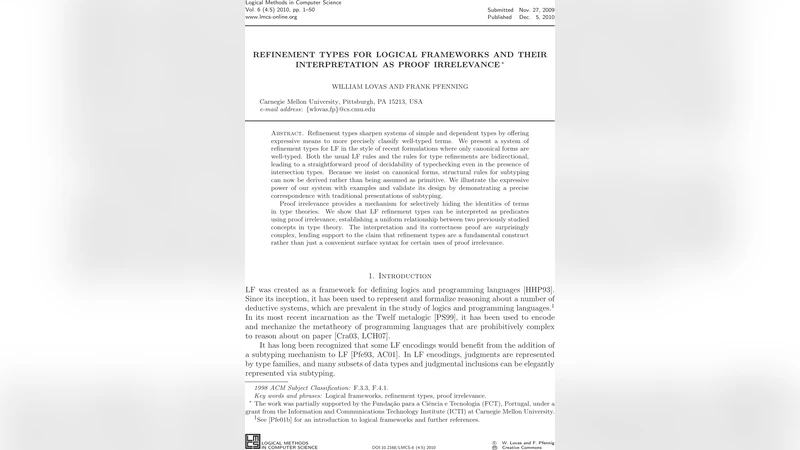
Refinement types sharpen systems of simple and dependent types by offering expressive means to more precisely classify well-typed terms. We present a system of refinement types for LF in the style of recent formulations where only canonical forms are well-typed. Both the usual LF rules and the rules for type refinements are bidirectional, leading to a straightforward proof of decidability of typechecking even in the presence of intersection types. Because we insist on canonical forms, structural rules for subtyping can now be derived rather than being assumed as primitive. We illustrate the expressive power of our system with examples and validate its design by demonstrating a precise correspondence with traditional presentations of subtyping. Proof irrelevance provides a mechanism for selectively hiding the identities of terms in type theories. We show that LF refinement types can be interpreted as predicates using proof irrelevance, establishing a uniform relationship between two previously studied concepts in type theory. The interpretation and its correctness proof are surprisingly complex, lending support to the claim that refinement types are a fundamental construct rather than just a convenient surface syntax for certain uses of proof irrelevance.
💡 Research Summary
The paper introduces a refinement‑type discipline for the Logical Framework (LF) and shows how these refinements can be interpreted as predicates under proof‑irrelevance. The authors begin by recalling that LF, as a dependently‑typed λ‑calculus, already supports a simple and a dependent type layer, but it lacks the ability to express fine‑grained constraints on values. To fill this gap they add refinement types, which are predicates attached to existing LF types, and they require that only canonical (β‑η‑normal) terms are ever assigned a type. This canonical‑form restriction enables a fully bidirectional typing discipline: checking mode verifies that a term conforms to a given refinement, while inference mode computes the most precise refinement for a term. Because every well‑typed term has a unique normal form, type checking is decidable even when intersection types are present.
A central technical contribution is that subtyping for refinements, including the usual structural rules (weakening, strengthening, transitivity) and the interaction with intersection, is not taken as a primitive set of axioms. Instead, the authors derive all subtyping judgments from the core LF rules together with the canonical‑form property. In practice this means that a refinement A ∧ B is a subtype of both A and B, and any term that inhabits A ∧ B automatically inhabits each component, without needing an external subtyping lattice.
The second major contribution is a semantics that maps refinement types into LF predicates equipped with proof‑irrelevance. Proof‑irrelevance is the principle that the identity of a proof is irrelevant; only its existence matters. The authors construct a two‑stage translation. First, each refinement R on a base type T is turned into a predicate P_R : T → type. Second, the predicate is placed under a proof‑irrelevant modality so that any two proofs of P_R t are considered equal. This translation is carefully defined to respect the canonical‑form discipline and to preserve typing judgments. The authors prove a series of lemmas culminating in a theorem that the original refinement‑type system is isomorphic to the proof‑irrelevant predicate system: every well‑typed term in the refinement system corresponds to a term inhabiting the translated predicate, and vice‑versa.
The paper also establishes a precise correspondence with traditional presentations of subtyping. The derived subtyping relation coincides with the usual rules for intersection, function, and dependent types, confirming that the refinement approach does not introduce any exotic behavior. Moreover, because the subtyping derivations are obtained from LF’s core typing rules, the system enjoys the same meta‑theoretic properties as LF, such as subject reduction and decidability.
Through examples the authors demonstrate the expressive power of their system: they encode even‑number constraints on natural numbers, well‑formedness conditions on abstract syntax trees, and security‑level annotations for information‑flow control. In each case the refinement type succinctly captures the intended property, while the proof‑irrelevant interpretation shows how the same property could be expressed using ordinary LF predicates, albeit with more boilerplate.
In conclusion, the work shows that refinement types are not merely syntactic sugar for proof‑irrelevant predicates; they constitute a fundamental extension of LF that can be given a clean, decidable typing discipline and a mathematically rigorous semantics. This bridges two previously separate strands of type‑theoretic research and provides a solid foundation for future proof assistants and programming languages that wish to combine expressive refinements with the elegance of LF.
Comments & Academic Discussion
Loading comments...
Leave a Comment