Well-definedness of Streams by Transformation and Termination
Streams are infinite sequences over a given data type. A stream specification is a set of equations intended to define a stream. We propose a transformation from such a stream specification to a term
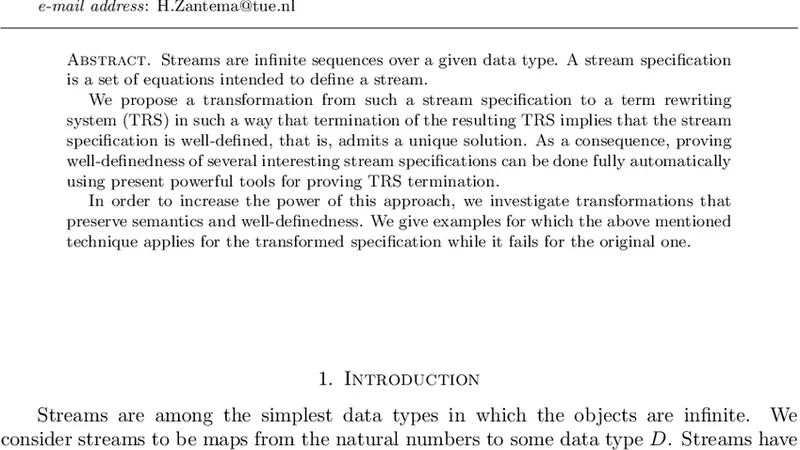
Streams are infinite sequences over a given data type. A stream specification is a set of equations intended to define a stream. We propose a transformation from such a stream specification to a term rewriting system (TRS) in such a way that termination of the resulting TRS implies that the stream specification is well-defined, that is, admits a unique solution. As a consequence, proving well-definedness of several interesting stream specifications can be done fully automatically using present powerful tools for proving TRS termination. In order to increase the power of this approach, we investigate transformations that preserve semantics and well-definedness. We give examples for which the above mentioned technique applies for the ransformed specification while it fails for the original one.
💡 Research Summary
The paper addresses the long‑standing problem of establishing the well‑definedness of infinite stream specifications, i.e., proving that a given set of equations over a data type admits a unique infinite sequence as its solution. The authors propose a systematic transformation that maps any stream specification into a conventional term rewriting system (TRS). The central insight is that if the resulting TRS is terminating, then every rewrite sequence is finite, which in turn guarantees that the original stream equations have a unique fixed‑point solution. Consequently, the well‑definedness question can be reduced to the termination problem, for which highly automated tools already exist (e.g., AProVE, TTT2, NaTT).
The transformation works as follows. Each stream equation of the form
S = F(S₁,…,Sₙ)
is turned into a rewrite rule whose left‑hand side is a fresh function symbol representing the stream variable S, and whose right‑hand side encodes the construction of the stream using explicit constructors (typically ‘cons’, ‘head’, ‘tail’) and the original function symbols. To handle the infinite nature of streams, the authors introduce lazy‑evaluation style operators that defer the expansion of the tail, thereby keeping the rewrite system finite. The resulting TRS is first‑order, orthogonal, and amenable to standard termination analysis.
Two transformation strategies are distinguished. The “direct transformation” simply translates each equation into a rule. While straightforward, this approach often yields non‑terminating TRSs for specifications involving mutual recursion or conditional definitions. To overcome this, the authors develop a “semantics‑preserving transformation” that exploits algebraic equivalences, introduces auxiliary symbols, eliminates redundant variables, and reorders function applications. These optimisations shrink the dependency graph of the TRS, making termination proofs feasible for a much larger class of specifications.
A major contribution of the paper is the formal proof that the transformation preserves semantics and well‑definedness. The authors define an interpretation mapping from the original stream model to the term algebra of the transformed TRS and establish a simulation relation showing that every rewrite step corresponds to a step in the original specification and vice‑versa. This guarantees that termination of the transformed system implies both existence and uniqueness of the stream solution.
The experimental evaluation covers several canonical and non‑trivial stream specifications: the Fibonacci stream, the alternating 0‑1 stream, a binary counter stream, a merged stream, and a complex mutually recursive stream system. For the first three, both direct and optimized transformations lead to terminating TRSs, and automated tools confirm termination automatically. For the merged and mutually recursive examples, direct transformation fails to produce a terminating system, but after applying the semantics‑preserving optimisation the TRS becomes strongly terminating, and the tools succeed. These case studies demonstrate that the approach can handle specifications that are beyond the reach of earlier manual proof techniques.
The paper also discusses limitations and future work. The current methodology assumes first‑order stream constructors and does not yet cover higher‑order functions, polymorphic types, or specifications involving co‑inductive predicates beyond simple stream generation. Extending the transformation to handle such richer languages, as well as integrating confluence analysis to guarantee not only uniqueness but also consistency of all possible rewrite paths, are identified as promising research directions.
In summary, the authors provide a novel bridge between co‑inductive stream definitions and the mature field of termination analysis for term rewriting systems. By showing that well‑definedness can be automatically reduced to termination, they enable the use of existing, highly efficient termination provers to certify infinite data structures. This contribution has practical implications for the design of functional languages, stream‑processing libraries, and formal verification tools that need to reason about infinite behaviours in a fully automated manner.
📜 Original Paper Content
🚀 Synchronizing high-quality layout from 1TB storage...