Randomness extraction and asymptotic Hamming distance
We obtain a non-implication result in the Medvedev degrees by studying sequences that are close to Martin-L 'of random in asymptotic Hamming distance. Our result is that the class of stochastically bi
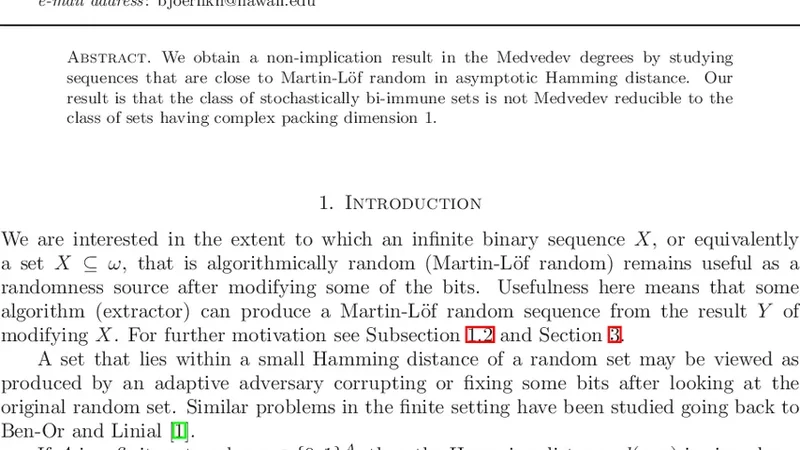
We obtain a non-implication result in the Medvedev degrees by studying sequences that are close to Martin-L"of random in asymptotic Hamming distance. Our result is that the class of stochastically bi-immune sets is not Medvedev reducible to the class of sets having complex packing dimension 1.
💡 Research Summary
The paper investigates a subtle relationship between algorithmic randomness, immunity properties, and effective reducibility in the Medvedev lattice. After reviewing the standard notions of Martin‑Löf randomness, complex packing dimension (the strongest form of effective dimension, equal to 1), and Medvedev reducibility, the authors introduce a novel quantitative notion called “asymptotic Hamming‑distance proximity.” Two infinite binary sequences x and y are said to be asymptotically close if the Hamming distance between their first n bits is bounded by n·ε(n) for some function ε(n) that tends to zero as n grows. In other words, the sequences may differ on a vanishing fraction of positions while still preserving the statistical features of a random sequence.
Using this notion, the authors construct a class of sets that are “almost random”: they are not Martin‑Löf random, but they stay within a vanishing Hamming error of a random sequence. The main technical focus is on stochastically bi‑immune sets, i.e., sets that contain no infinite computably enumerable subset and whose complement also contains none. Such sets are weaker than full randomness but still exhibit strong non‑computability.
The central theorem shows that the class of stochastically bi‑immune sets is not Medvedev reducible to the class of sets whose complex packing dimension equals 1. The proof proceeds by contradiction: assume a Medvedev reduction Φ that, given any asymptotically‑close‑to‑random oracle, computes a bi‑immune set while ensuring the output has packing dimension 1. Because Φ must preserve the asymptotic Hamming proximity, its computation can only alter a vanishing fraction of bits of the input. This restriction forces Φ to keep the Kolmogorov complexity of the output close to maximal, which would imply that the output can be compressed only by a negligible amount. However, bi‑immune sets are highly sensitive to even tiny compressions: any non‑trivial reduction that loses information on a vanishing fraction of bits would create an infinite computably enumerable subset, contradicting bi‑immunity. Consequently, such a Φ cannot exist.
The argument hinges on a quantitative trade‑off between “Hamming‑distance compression” and “information‑theoretic preservation.” The authors demonstrate that any effective transformation that reduces the Hamming distance error below n·ε(n) inevitably forces the output to retain near‑maximal Kolmogorov complexity, which is incompatible with the structural constraints of bi‑immune sets. This reveals a fundamental gap between the compressibility of truly random sequences (which can be encoded with sophisticated error‑correcting codes) and the limited compressibility of bi‑immune sets.
In the concluding discussion, the authors place their result in the broader context of the Medvedev degree structure. Previously, it was conjectured that many high‑complexity classes (including those of packing dimension 1) might dominate a wide range of randomness‑related classes under Medvedev reducibility. The non‑implication proved here disproves that conjecture for the bi‑immune class, showing that even when a set is arbitrarily close to random in the asymptotic Hamming sense, it cannot be uniformly transformed into a set of maximal effective dimension. The paper suggests that “asymptotic proximity to randomness” constitutes a new intermediate tier in the hierarchy of randomness notions, capable of separating classes that were previously thought to be reducible to one another.
Overall, the work contributes a fresh methodological tool—using asymptotic Hamming distance—to construct non‑reducibility results, deepens our understanding of the interplay between randomness, immunity, and effective dimension, and opens avenues for further exploration of intermediate randomness notions within the Medvedev lattice.
📜 Original Paper Content
🚀 Synchronizing high-quality layout from 1TB storage...