Expressiveness and Closure Properties for Quantitative Languages
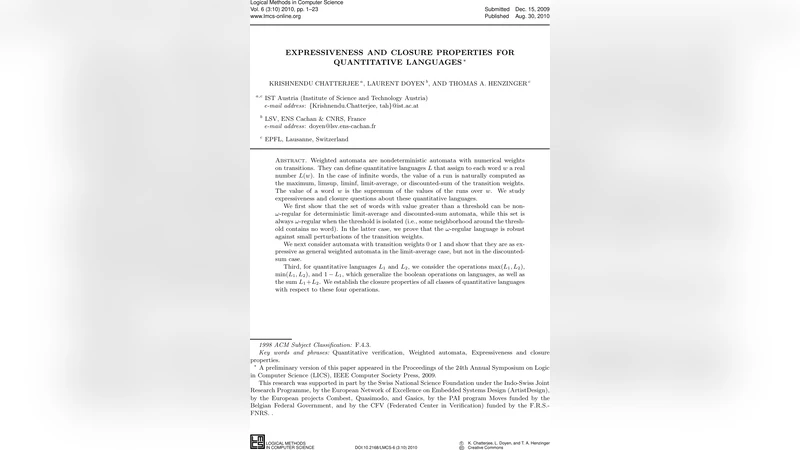
Weighted automata are nondeterministic automata with numerical weights on transitions. They can define quantitative languages~$L$ that assign to each word~$w$ a real number~$L(w)$. In the case of infinite words, the value of a run is naturally computed as the maximum, limsup, liminf, limit-average, or discounted-sum of the transition weights. The value of a word $w$ is the supremum of the values of the runs over $w$. We study expressiveness and closure questions about these quantitative languages. We first show that the set of words with value greater than a threshold can be non-$\omega$-regular for deterministic limit-average and discounted-sum automata, while this set is always $\omega$-regular when the threshold is isolated (i.e., some neighborhood around the threshold contains no word). In the latter case, we prove that the $\omega$-regular language is robust against small perturbations of the transition weights. We next consider automata with transition weights Weighted automata are nondeterministic automata with numerical weights ontransitions. They can define quantitative languages~$L$ that assign to eachword~$w$ a real number~$L(w)$. In the case of infinite words, the value of arun is naturally computed as the maximum, limsup, liminf, limit-average, ordiscounted-sum of the transition weights. The value of a word $w$ is thesupremum of the values of the runs over $w$. We study expressiveness andclosure questions about these quantitative languages. We first show that the set of words with value greater than a threshold canbe non-$\omega$-regular for deterministic limit-average and discounted-sumautomata, while this set is always $\omega$-regular when the threshold isisolated (i.e., some neighborhood around the threshold contains no word). Inthe latter case, we prove that the $\omega$-regular language is robust againstsmall perturbations of the transition weights. We next consider automata with transition weights $0$ or $1$ and show thatthey are as expressive as general weighted automata in the limit-average case,but not in the discounted-sum case. Third, for quantitative languages $L_1$ and~$L_2$, we consider the operations$\max(L_1,L_2)$, $\min(L_1,L_2)$, and $1-L_1$, which generalize the booleanoperations on languages, as well as the sum $L_1 + L_2$. We establish theclosure properties of all classes of quantitative languages with respect tothese four operations.$ or $ and show that they are as expressive as general weighted automata in the limit-average case, but not in the discounted-sum case. Third, for quantitative languages $L_1$ and~$L_2$, we consider the operations $\max(L_1,L_2)$, $\min(L_1,L_2)$, and -L_1$, which generalize the boolean operations on languages, as well as the sum $L_1 + L_2$. We establish the closure properties of all classes of quantitative languages with respect to these four operations.
💡 Research Summary
The paper conducts a systematic study of quantitative languages defined by weighted automata, focusing on their expressive power and closure properties under several natural operations. A weighted automaton assigns real-valued weights to transitions and, for infinite words, evaluates a run by one of five aggregation functions: maximum, lim sup, lim inf, limit‑average, or discounted‑sum. The value of a word is the supremum of the values of all runs over that word.
The first major contribution shows that for deterministic limit‑average (DLA) and deterministic discounted‑sum (DDS) automata, the set of words whose value exceeds a given threshold θ can be non‑ω‑regular when θ is not isolated—that is, when arbitrarily close values exist on both sides of θ. Conversely, if θ is isolated (there exists ε > 0 such that no word has value in (θ − ε, θ + ε)), the “greater‑than‑θ” language is always ω‑regular. Moreover, in the isolated case the resulting ω‑regular language is robust: small perturbations of transition weights do not change the language. This robustness is crucial for applications where weights are subject to measurement error or rounding.
The second line of investigation concerns 0‑1 weighted automata, where each transition weight is either 0 or 1. For the limit‑average semantics, 0‑1 automata are as expressive as arbitrary weighted automata; any real‑valued quantitative language can be simulated using only binary weights. In contrast, for discounted‑sum semantics the restriction to binary weights reduces expressive power: certain discounted‑sum values cannot be realized without allowing arbitrary real weights, because the discount factor λ ∈ (0,1) interacts with the precise magnitude of the weights.
The third contribution examines four operations on quantitative languages: pointwise maximum, pointwise minimum, complement (1 − L), and pointwise sum. The authors establish a detailed closure table for all classes considered (deterministic vs. nondeterministic, limit‑average vs. discounted‑sum). The results can be summarized as follows:
- Maximum, minimum, and complement are closed for all classes; the resulting language can be represented by an automaton of the same type.
- Pointwise sum is closed for limit‑average automata (both deterministic and nondeterministic) but not for discounted‑sum automata; a counterexample shows that the sum of two DDS languages may require a different discount factor or non‑binary weights, which falls outside the original class.
- Deterministic limit‑average automata are not always closed under sum, whereas their nondeterministic counterparts are.
These findings delineate precisely where quantitative automata can be safely combined or transformed without leaving the chosen model. They have immediate implications for quantitative verification, synthesis, and game theory: average‑based specifications can be built from simple 0‑1 components, while discounted‑sum specifications demand richer weight domains and careful handling of algebraic operations. The paper thus provides both theoretical insight and practical guidelines for the design and analysis of systems modeled by weighted automata.
Comments & Academic Discussion
Loading comments...
Leave a Comment