Interactive Learning-Based Realizability for Heyting Arithmetic with EM1
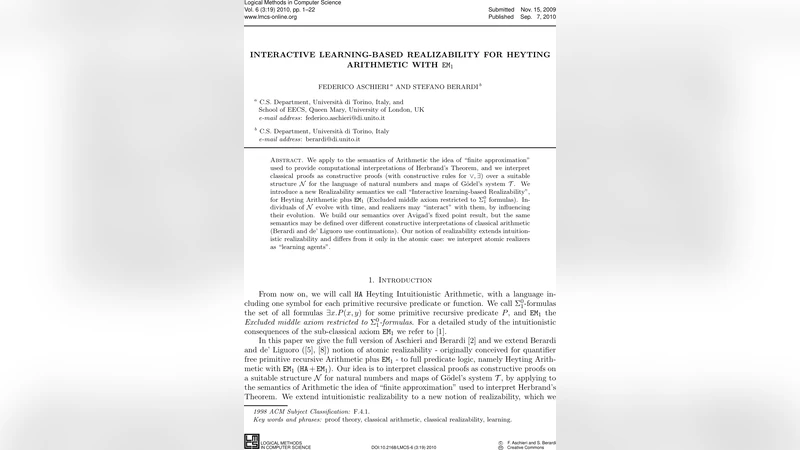
We apply to the semantics of Arithmetic the idea of finite approximation'' used to provide computational interpretations of Herbrand's Theorem, and we interpret classical proofs as constructive proofs (with constructive rules for $\vee, \exists$) over a suitable structure $\StructureN$ for the language of natural numbers and maps of G\"odel's system $\SystemT$. We introduce a new Realizability semantics we call Interactive learning-based Realizability’’, for Heyting Arithmetic plus $\EM_1$ (Excluded middle axiom restricted to $\Sigma^0_1$ formulas). Individuals of $\StructureN$ evolve with time, and realizers may interact'' with them, by influencing their evolution. We build our semantics over Avigad's fixed point result, but the same semantics may be defined over different constructive interpretations of classical arithmetic (Berardi and de' Liguoro use continuations). Our notion of realizability extends intuitionistic realizability and differs from it only in the atomic case: we interpret atomic realizers as learning agents’'.
💡 Research Summary
The paper introduces a novel realizability semantics called “Interactive Learning‑Based Realizability” (ILR) for Heyting Arithmetic extended with the Σ⁰₁‑restricted excluded middle axiom (EM₁). Building on the finite‑approximation technique used in computational interpretations of Herbrand’s theorem, the authors construct a structure 𝔑 that contains the natural numbers together with all higher‑type functionals of Gödel’s System T. In 𝔑 each individual is equipped with a mutable “state” that can evolve over time. Realizers are ordinary System T programs for logical connectives and quantifiers, but for atomic formulas they are interpreted as learning agents: functions Lₚ : State → (Bool × State) that, given the current state, either confirm the atom or produce a counterexample and simultaneously update the state.
The semantics is grounded in Avigad’s fixed‑point theorem for HA + EM₁, which guarantees that the iterative interaction between a learner and the evolving state converges to a stable fixed point after finitely many steps. The ILR definition therefore consists of three layers: (1) the standard intuitionistic clauses for ∧, →, ∀; (2) constructive rules for ∨ and ∃ that explicitly depend on the current state; (3) the learning‑agent clause for atomic predicates.
Three main results are proved. First, a Soundness Theorem: every theorem of HA + EM₁ possesses an ILR‑realizer in 𝔑. The proof proceeds by structural induction on HA‑derivations, handling the EM₁ rule by invoking the learning agent’s ability to revise its belief when a counterexample is discovered. Second, a Completeness Theorem: any formula that admits an ILR‑realizer is provable in HA + EM₁. This uses Avigad’s fixed‑point construction to extract a finite proof from the convergent learning process. Third, a Fixed‑Point Convergence Theorem: the learning interaction always reaches a fixed point in a finite number of steps, thanks to a monotonicity property of the state space and the finiteness of the approximations involved.
The authors compare ILR with the continuation‑based realizability of Berardi and de’ Liguoro. While both approaches handle EM₁, ILR does not rely on continuity assumptions; instead it models computation as explicit state transitions, offering a more concrete operational picture. The paper also presents illustrative examples, such as the EM₁ instance for a Σ⁰₁ formula ∃x P(x), showing how a learner initially uncertain about the existence of a witness can, upon discovering a concrete witness, update the state and thereby realize the existential claim.
In conclusion, Interactive Learning‑Based Realizability bridges classical and intuitionistic reasoning by interpreting classical proofs as constructive processes enriched with learning dynamics. It opens avenues for extending the method to stronger fragments of classical arithmetic (e.g., full EM or PA) and for integrating the semantics into proof assistants or automated theorem provers where learning agents could actively guide proof search.
Comments & Academic Discussion
Loading comments...
Leave a Comment