Domain Representable Spaces Defined by Strictly Positive Induction
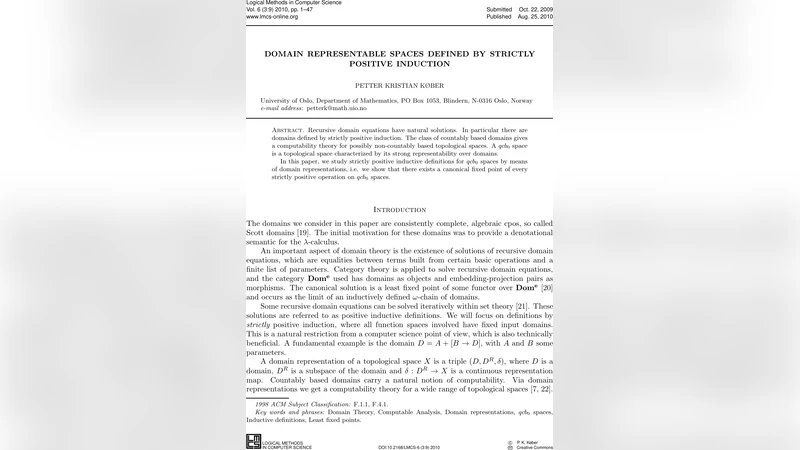
Recursive domain equations have natural solutions. In particular there are domains defined by strictly positive induction. The class of countably based domains gives a computability theory for possibly non-countably based topological spaces. A $ qcb_{0} $ space is a topological space characterized by its strong representability over domains. In this paper, we study strictly positive inductive definitions for $ qcb_{0} $ spaces by means of domain representations, i.e. we show that there exists a canonical fixed point of every strictly positive operation on $qcb_{0} $ spaces.
💡 Research Summary
The paper investigates the existence of canonical fixed points for strictly positive operations on qcb₀ spaces by means of domain representations. A qcb₀ space is a topological space that can be presented as a continuous surjection from a countably based domain; such a representation is called admissible and provides a strong link between domain theory and topology. The authors begin by formalising “strictly positive operations” – constructors that use only covariant positions (finite sums, finite products, function space formation, and recursive type constructors) and never place the domain variable in a contravariant (function‑argument) position. This restriction guarantees that when the operation is lifted to the level of domains it becomes a continuous map on an ω‑complete dcpo.
The core construction proceeds in two stages. First, for each input qcb₀ space Xᵢ a strong representation (Dᵢ, δᵢ) is fixed, where Dᵢ is a countably based domain and δᵢ : Dᵢ → Xᵢ is admissible. The strictly positive operation F is then interpreted as a domain‑level operator F̂ : Π Dᵢ → D that is continuous because all constituent constructors preserve continuity and ω‑completeness. Second, the classical Kleene fixed‑point theorem is applied to F̂, yielding its least fixed point d* = supₙ F̂ⁿ(⊥). Since each iteration is admissible, the limit d* is also admissible. Mapping d* back to the topological world via the surjection δ : D → X gives a qcb₀ space X* = δ(d*) that serves as a fixed point of the original operation F.
A substantial part of the paper is devoted to proving that this fixed point is canonical: any two choices of strong representations for the same input spaces lead to homeomorphic fixed points. The argument relies on the uniqueness of the least fixed point in the domain setting and on the fact that admissible representations are unique up to continuous equivalence. Consequently, the construction does not depend on any form of the axiom of choice.
The authors also verify that the resulting fixed point inherits the essential topological properties of qcb₀ spaces—namely, strong representability, completeness, and, when applicable, metrizability. They treat several prototypical strictly positive constructors in detail:
- Finite sum (X ⊕ Y) – constructed by the disjoint sum of the underlying domains and the obvious combined surjection.
- Finite product (X × Y) – obtained from the product domain D_X × D_Y with the product of the surjections.
- Function space (X → Y) – represented by the exponential domain D_X ⇒ D_Y, which consists of continuous functions between the underlying domains; admissibility of the evaluation map guarantees that the induced topology coincides with the usual function‑space topology.
- Recursive type μF – for a strictly positive functor F, the least fixed point of F̂ in the domain category yields a domain D_μF; the associated qcb₀ space μF = δ(D_μF) is shown to satisfy the expected recursion equation μF ≅ F(μF).
Each example is worked out explicitly, confirming that the constructed spaces satisfy the defining equations up to homeomorphism and that they retain computability properties inherited from the domain representations.
In the concluding discussion, the paper emphasizes the significance of extending the well‑known computability theory of countably based domains to a broader class of topological spaces that may not be countably based themselves. By establishing that strictly positive inductive definitions always have canonical solutions in the qcb₀ setting, the authors provide a robust framework for modeling recursive data types, higher‑order function spaces, and other sophisticated constructs in a setting that supports both topological reasoning and effective computation. This opens avenues for future work on semantics of functional programming languages, verification of programs involving infinite or continuous data, and the development of a unified theory of computability that bridges domain theory and general topology.
Comments & Academic Discussion
Loading comments...
Leave a Comment