Bifinite Chu Spaces
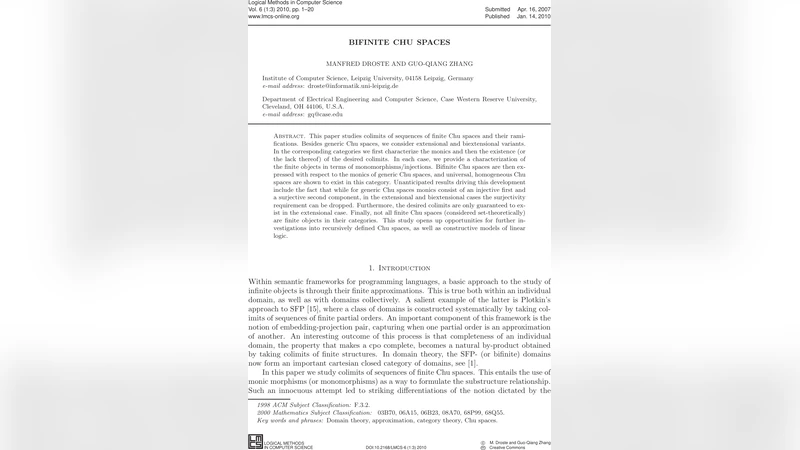
This paper studies colimits of sequences of finite Chu spaces and their ramifications. Besides generic Chu spaces, we consider extensional and biextensional variants. In the corresponding categories we first characterize the monics and then the existence (or the lack thereof) of the desired colimits. In each case, we provide a characterization of the finite objects in terms of monomorphisms/injections. Bifinite Chu spaces are then expressed with respect to the monics of generic Chu spaces, and universal, homogeneous Chu spaces are shown to exist in this category. Unanticipated results driving this development include the fact that while for generic Chu spaces monics consist of an injective first and a surjective second component, in the extensional and biextensional cases the surjectivity requirement can be dropped. Furthermore, the desired colimits are only guaranteed to exist in the extensional case. Finally, not all finite Chu spaces (considered set-theoretically) are finite objects in their categories. This study opens up opportunities for further investigations into recursively defined Chu spaces, as well as constructive models of linear logic.
💡 Research Summary
The paper investigates the categorical properties of Chu spaces, focusing on the construction of colimits of sequences of finite Chu spaces and the resulting notion of “bifinite” Chu spaces. Three categories are considered: the generic Chu spaces (C), the extensional Chu spaces (Ext), and the biextensional Chu spaces (Biext). An object in any of these categories is a triple (A, X, r) where A and X are sets (points and observations) and r : A × X → K is a relation valued in a fixed set K (often a two‑element set). Morphisms are pairs (f, g) with f : A → B and g : Y → X satisfying r_A = g ∘ r_B ∘ f.
Monomorphisms.
In the generic category C a morphism (f, g) is monic iff f is injective and g is surjective. The injectivity of f guarantees that distinct points remain distinct after mapping, while the surjectivity of g guarantees that every observation of the codomain is represented in the domain, preserving the relational structure. In contrast, for Ext and Biext the surjectivity requirement on g can be dropped: because extensionality already forces distinct points to be distinguished by their observation sets, any g (not necessarily surjective) together with an injective f still yields a monic. This observation overturns the naïve belief that monics in Chu categories are always “injective‑first, surjective‑second”.
Colimits of finite chains.
The authors examine directed sequences (C₀ → C₁ → C₂ → …) where each bonding map is a monomorphism. In C, the presence of a surjective second component can obstruct the existence of a colimit: the limit would require a compatible family of observation maps that may not exist when the g‑components force new observations at each stage. In Ext, however, the situation improves dramatically. Since only the first component needs to be injective, the directed system can be glued together by taking the set‑theoretic union of the point sets and the appropriate quotient of the observation sets; the resulting object satisfies the universal property of a colimit. Thus, colimits of ω‑chains of finite Chu spaces are guaranteed to exist in Ext (and consequently in Biext, which inherits Ext’s structure).
Finite objects.
A categorical “finite object” is one that has only finitely many morphisms into any directed colimit. The paper shows that in C not every set‑theoretically finite Chu space is finite in the categorical sense, because the surjectivity condition on g can be violated by embeddings into larger objects. Conversely, in Ext and Biext the categorical notion of finiteness coincides with set‑theoretic finiteness: any Chu space with finite A and X is a finite object, and any finite object must have finite underlying sets.
Bifinite Chu spaces.
Using the monics of the generic category C, the authors define a subcategory of “bifinite” Chu spaces: objects that can be expressed as colimits of ω‑chains of finite Chu spaces (with monic bonding maps). This mirrors the classical notion of bifinite domains in domain theory, but now situated in the Chu setting. Within this subcategory they prove the existence of a universal homogeneous Chu space U. U contains an isomorphic copy of every finite Chu space, and any isomorphism between finite sub‑Chu spaces of U extends to an automorphism of U. The construction follows a Fraïssé‑type amalgamation argument adapted to Chu morphisms. The existence of U provides a canonical “generic” model for the theory of finite Chu spaces and opens the door to constructive models of linear logic, where Chu spaces serve as semantics for the multiplicative‑additive fragment.
Unexpected findings and implications.
- The monic characterization differs sharply between the generic and the extensional variants, highlighting the subtle role of extensionality in preserving information without requiring surjectivity on observations.
- Colimits of finite chains are not generally available in C, but they are guaranteed in Ext, making Ext the natural setting for recursive constructions of Chu spaces.
- The divergence between set‑theoretic finiteness and categorical finiteness in C underscores that categorical size notions can be more delicate than naïve cardinality arguments.
- The universal homogeneous bifinite Chu space furnishes a concrete, highly symmetric object that can serve as a “prime model” for various logical theories interpreted in Chu semantics.
Future directions.
The authors suggest several avenues: (i) extending the bifinite framework to recursive definitions of infinite Chu spaces, (ii) exploring constructive (intuitionistic) versions of the universal homogeneous space, (iii) applying these results to session‑type systems and linear‑logic programming languages, and (iv) investigating connections with other categorical models of linear logic such as *-autonomous categories and game semantics.
In summary, the paper delivers a thorough categorical analysis of finite Chu spaces, clarifies the exact nature of monomorphisms across different Chu categories, establishes the existence (or failure) of colimits for finite chains, and introduces bifinite Chu spaces together with a universal homogeneous object. These contributions deepen our understanding of Chu semantics, provide new tools for domain‑theoretic constructions, and lay groundwork for constructive models of linear logic.
Comments & Academic Discussion
Loading comments...
Leave a Comment