On the Scope of the Universal-Algebraic Approach to Constraint Satisfaction
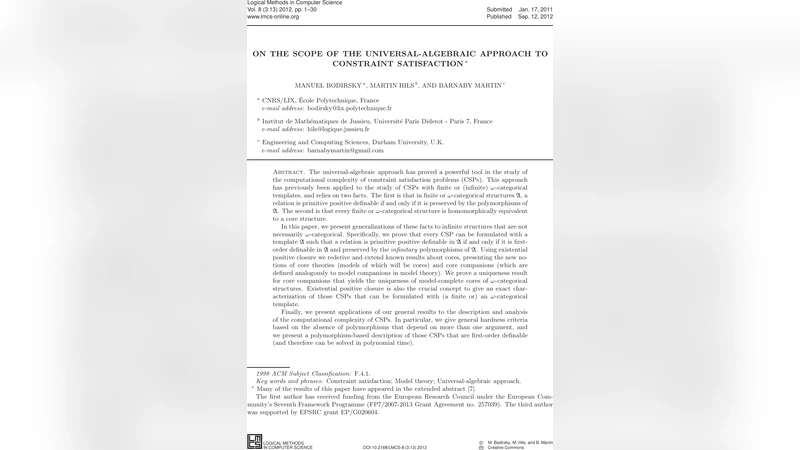
The universal-algebraic approach has proved a powerful tool in the study of the complexity of CSPs. This approach has previously been applied to the study of CSPs with finite or (infinite) omega-categorical templates, and relies on two facts. The first is that in finite or omega-categorical structures A, a relation is primitive positive definable if and only if it is preserved by the polymorphisms of A. The second is that every finite or omega-categorical structure is homomorphically equivalent to a core structure. In this paper, we present generalizations of these facts to infinite structures that are not necessarily omega-categorical. (This abstract has been severely curtailed by the space constraints of arXiv – please read the full abstract in the article.) Finally, we present applications of our general results to the description and analysis of the complexity of CSPs. In particular, we give general hardness criteria based on the absence of polymorphisms that depend on more than one argument, and we present a polymorphism-based description of those CSPs that are first-order definable (and therefore can be solved in polynomial time).
💡 Research Summary
The paper revisits the universal‑algebraic method for classifying the computational complexity of constraint satisfaction problems (CSPs) and lifts two cornerstone facts that previously required the template structure to be either finite or ω‑categorical. The first fact is the equivalence between primitive‑positive (pp) definability of a relation and its preservation by the polymorphisms of the template. The second fact is that every template is homomorphically equivalent to a core, i.e., a minimal substructure whose endomorphisms are all surjective. Both results have underpinned the algebraic approach to CSPs, enabling the translation of logical definability into algebraic invariants and the reduction of arbitrary templates to cores where polymorphism analysis is simpler.
The authors observe that the ω‑categorical assumption is a strong model‑theoretic restriction that excludes many natural infinite‑domain CSPs (e.g., real‑valued linear equations, infinite graphs, order‑type problems). To overcome this, they introduce the notions of a pre‑core and a pre‑homomorphism chain. A pre‑core relaxes the usual definition of a core by allowing a minimal substructure that need not be unique but still captures the essential algebraic behaviour of the original structure. A pre‑homomorphism chain is a sequence of homomorphisms linking the original structure to its pre‑core, guaranteeing that the two are homomorphically equivalent. Using these tools, they prove that every (possibly infinite, non‑ω‑categorical) structure A admits a core C such that A and C are homomorphically equivalent, and that the set of polymorphisms of C coincides with the set of polymorphisms of A that preserve all pp‑definable relations of A. This generalises the classical core theorem without any ω‑categoricity hypothesis.
The second major contribution is a generalisation of the pp‑definability ↔ polymorphism preservation theorem. The authors show that for any structure A (no finiteness or ω‑categoricity required), a relation R on A is pp‑definable if and only if every polymorphism of A preserves R. The proof replaces the usual back‑and‑forth arguments (which rely on oligomorphic automorphism groups) with a construction based on the pre‑core and on limits of homomorphism chains, thereby preserving the essential algebraic character of the result while avoiding model‑theoretic constraints.
Armed with these two foundational theorems, the paper derives two families of complexity criteria:
-
Hardness via lack of multi‑argument polymorphisms.
If a template’s polymorphism clone contains only essentially unary operations (i.e., every polymorphism depends on at most one argument), then the associated CSP is NP‑hard. The intuition is that without genuine multi‑argument operations the template cannot enforce any non‑trivial combinatorial structure, and the authors formalise this intuition using reductions from known hard problems. This criterion subsumes earlier hardness results that were proved only for ω‑categorical templates. -
A polymorphism‑based characterisation of FO‑definable CSPs.
The authors identify a specific weak polymorphism (often a projection or a constant operation) that must be present exactly when the CSP is first‑order definable. They prove that the existence of such a polymorphism is equivalent to the CSP being solvable in polynomial time via a simple Datalog program, and consequently to the problem being FO‑definable. This yields a clean algebraic description of the class of CSPs that are tractable for purely logical reasons, extending the well‑known “bounded width” characterisation beyond the ω‑categorical setting.
To illustrate the practical impact, the paper analyses several infinite‑domain CSPs that fall outside the ω‑categorical regime: linear equations over the real numbers, coloring problems on infinite graphs, and order‑type constraints on dense linear orders without endpoints. In each case the authors construct the appropriate core, identify the polymorphism clone, and apply the hardness or tractability criteria derived earlier. The examples demonstrate that many problems previously inaccessible to the universal‑algebraic toolkit can now be classified systematically.
In conclusion, the work substantially broadens the scope of the universal‑algebraic approach. By removing the ω‑categorical requirement, it provides a unified algebraic framework that applies to all relational structures, finite or infinite. This opens the door to systematic complexity classifications for a far richer collection of CSPs, and it bridges a gap between model‑theoretic techniques and algebraic methods that had limited their joint applicability. The paper therefore represents a significant step toward a truly universal theory of CSP complexity.