RPO, Second-order Contexts, and Lambda-calculus
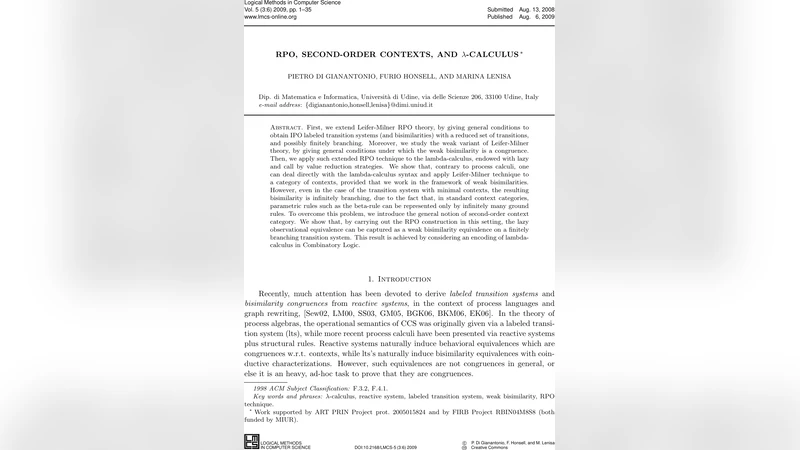
First, we extend Leifer-Milner RPO theory, by giving general conditions to obtain IPO labelled transition systems (and bisimilarities) with a reduced set of transitions, and possibly finitely branching. Moreover, we study the weak variant of Leifer-Milner theory, by giving general conditions under which the weak bisimilarity is a congruence. Then, we apply such extended RPO technique to the lambda-calculus, endowed with lazy and call by value reduction strategies. We show that, contrary to process calculi, one can deal directly with the lambda-calculus syntax and apply Leifer-Milner technique to a category of contexts, provided that we work in the framework of weak bisimilarities. However, even in the case of the transition system with minimal contexts, the resulting bisimilarity is infinitely branching, due to the fact that, in standard context categories, parametric rules such as the beta-rule can be represented only by infinitely many ground rules. To overcome this problem, we introduce the general notion of second-order context category. We show that, by carrying out the RPO construction in this setting, the lazy observational equivalence can be captured as a weak bisimilarity equivalence on a finitely branching transition system. This result is achieved by considering an encoding of lambda-calculus in Combinatory Logic.
💡 Research Summary
The paper revisits the Leifer‑Milner framework for deriving labelled transition systems (LTS) from reaction rules and extends it in several directions to make it applicable to higher‑order languages such as the λ‑calculus. The original theory builds an LTS by constructing initial‑transition objects (IPOs) and reactive‑transition objects (RPOs) from a category of contexts; the resulting bisimilarity is a congruence when the category satisfies certain push‑out properties. However, in the λ‑calculus the β‑rule is parametric: a single rule must be instantiated for every possible argument term. In a standard first‑order context category this leads to infinitely many ground rules, and consequently the IPO‑based LTS becomes infinitely branching, which defeats the purpose of a compact operational semantics.
The authors first provide a set of general sufficient conditions under which the IPO construction can be performed with a reduced set of transitions. By identifying a minimal family of contexts that still generates all observable behaviours, they obtain an LTS that is finitely branching whenever the underlying category admits suitable push‑outs and pull‑backs. This result already improves the situation for many process calculi, but it does not solve the λ‑calculus problem because the β‑rule still requires infinitely many ground instances.
To address this, the paper introduces a “weak” variant of the Leifer‑Milner theory. Weak bisimilarity abstracts away internal τ‑steps, and the authors give categorical conditions (weak push‑out stability, closure under weak composition, etc.) that guarantee the weak bisimilarity is a congruence. This extension is crucial for functional languages where evaluation steps that are not observable (e.g., internal β‑reductions) should be hidden.
The core technical contribution is the definition of a second‑order context category. In this setting, contexts are allowed to contain not only holes but also higher‑order placeholders that can be instantiated by whole terms, effectively turning a parametric rule into a single higher‑order transition. For the λ‑calculus, the β‑rule can be represented by a single second‑order context of the form App(·,·), eliminating the need for an infinite family of first‑order contexts. The authors prove that the required push‑out constructions exist in this enriched category, so the IPO construction yields a finitely branching LTS.
Because handling bound variables and α‑conversion directly in a second‑order category is cumbersome, the paper adopts an encoding of λ‑terms into Combinatory Logic (CL). The encoding replaces abstractions with combinations of the S and K combinators, thereby removing variable binding from the syntax. In CL the β‑reduction becomes a simple, ground rewrite rule, and the second‑order contexts can be applied uniformly. By combining the CL encoding with the second‑order IPO construction, the authors obtain a weak bisimulation that exactly coincides with the lazy observational equivalence of the original λ‑calculus. In other words, two λ‑terms are lazily observationally equivalent iff their CL encodings are weakly bisimilar in the finitely branching LTS derived from second‑order contexts.
The paper’s structure is as follows. Section 1 reviews the standard Leifer‑Milner construction and identifies the limitations when applied to higher‑order languages. Section 2 presents the generalized conditions for minimal IPO generation and proves finiteness of the resulting transition system under those conditions. Section 3 develops the weak theory, defines weak RPO/IPO, and establishes congruence of weak bisimilarity. Section 4 introduces second‑order context categories, proves the existence of the necessary categorical limits, and shows how parametric rules become finite. Section 5 describes the CL encoding, demonstrates how the encoding interacts with second‑order contexts, and proves the main theorem: lazy observational equivalence = weak bisimilarity on the constructed LTS. Finally, Section 6 discusses related work, potential extensions to call‑by‑value evaluation, and future research directions such as applying the framework to other higher‑order rewriting systems or integrating it into automated proof assistants.
In summary, the paper makes four major contributions: (1) a set of categorical criteria that guarantee IPO‑based LTSs can be built with a reduced, possibly finite, set of transitions; (2) a weak version of the Leifer‑Milner theory that ensures weak bisimilarity is a congruence; (3) the introduction of second‑order context categories that collapse infinitely many ground rules into a single higher‑order rule; and (4) an application to the λ‑calculus via a combinatory‑logic encoding, yielding a finitely branching transition system whose weak bisimilarity captures the standard lazy observational equivalence. These results bridge the gap between process‑calculus‑oriented bisimulation techniques and the semantics of functional languages, opening the way for more scalable formal analyses of higher‑order computational systems.
Comments & Academic Discussion
Loading comments...
Leave a Comment