Explicit fairness in testing semantics
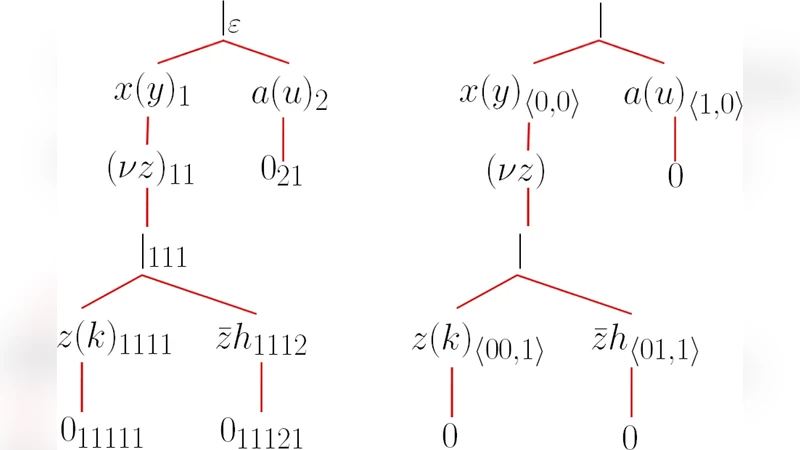
In this paper we investigate fair computations in the pi-calculus. Following Costa and Stirling’s approach for CCS-like languages, we consider a method to label process actions in order to filter out unfair computations. We contrast the existing fair-testing notion with those that naturally arise by imposing weak and strong fairness. This comparison provides insight about the expressiveness of the various `fair’ testing semantics and about their discriminating power.
💡 Research Summary
The paper addresses the problem of defining and reasoning about fairness in the π‑calculus, a process algebra that models mobile concurrent systems. Building on Costa and Stirling’s labeling technique for CCS, the authors introduce a systematic way to attach unique identifiers (labels) to each action of a π‑process. These labels are propagated through name passing, channel creation, and α‑conversion, allowing the construction of labeled execution traces. By filtering traces according to the presence and recurrence of labels, the authors formalize two distinct notions of fairness: weak (or “weak fairness”) and strong (“strong fairness”). Weak fairness requires that any action whose label appears infinitely often must be given at least one chance to fire; strong fairness strengthens this requirement by demanding that such actions actually fire infinitely often.
Using the labeled traces, the paper defines three testing preorders: the traditional fair‑testing preorder (as introduced by De Nicola and Hennessy), a weak‑fairness‑testing preorder, and a strong‑fairness‑testing preorder. The relationships among them are proved: the strong‑fairness preorder is strictly contained in the weak‑fairness preorder, which in turn is strictly contained in the original fair‑testing preorder. Consequently, each successive preorder distinguishes more processes, providing a finer granularity of behavioral equivalence.
The authors substantiate their theoretical results with a suite of canonical π‑calculus examples: infinite buffers, deadlock‑prone protocols, preemptive schedulers, and systems that dynamically generate channels. In each case they show how weak fairness may admit executions that are ruled out by strong fairness, and how both are more discriminating than the original fair‑testing approach. For instance, an infinite buffer that can indefinitely postpone output is considered fair under weak fairness but not under strong fairness, while the original fair‑testing semantics would still deem it acceptable.
A substantial portion of the paper is devoted to the technical challenges of label management in a calculus with name mobility. The authors present precise rules for label propagation, duplication (when a name is transmitted), and renaming (to avoid capture). They prove that the labeled semantics is congruent with the standard unlabeled semantics, ensuring that no new behaviours are introduced solely by the labeling mechanism.
Finally, the paper discusses the practical implications of the proposed framework. The labeling scheme can be automated, making it amenable to tool support for model checking or testing of concurrent systems. Moreover, by selecting the appropriate fairness level—weak or strong—engineers can tailor verification criteria to the guarantees required by a given application, whether it be a safety‑critical protocol that must avoid starvation (strong fairness) or a more relaxed system where occasional postponement is tolerable (weak fairness).
In summary, the work contributes a clear, formal method for expressing explicit fairness in π‑calculus testing semantics, demonstrates that weak and strong fairness yield strictly more expressive and discriminating testing preorders than the traditional fair‑testing approach, and provides a foundation for future tool development and verification methodologies that need to reason about fairness in mobile concurrent systems.
Comments & Academic Discussion
Loading comments...
Leave a Comment