The Derivational Complexity Induced by the Dependency Pair Method
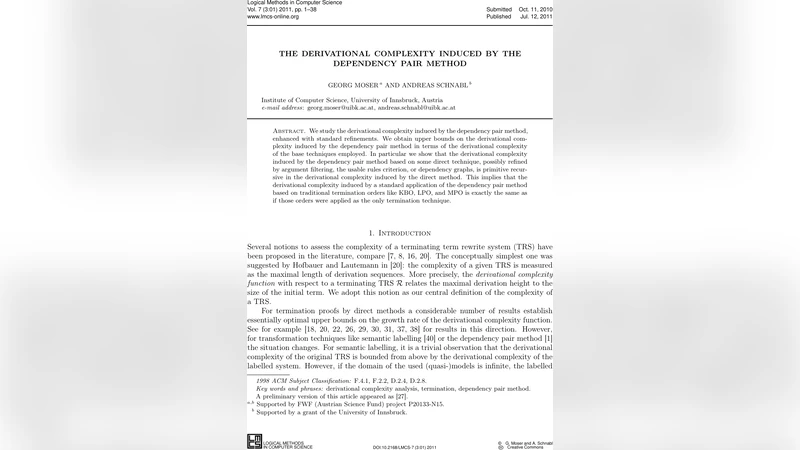
We study the derivational complexity induced by the dependency pair method, enhanced with standard refinements. We obtain upper bounds on the derivational complexity induced by the dependency pair method in terms of the derivational complexity of the base techniques employed. In particular we show that the derivational complexity induced by the dependency pair method based on some direct technique, possibly refined by argument filtering, the usable rules criterion, or dependency graphs, is primitive recursive in the derivational complexity induced by the direct method. This implies that the derivational complexity induced by a standard application of the dependency pair method based on traditional termination orders like KBO, LPO, and MPO is exactly the same as if those orders were applied as the only termination technique.
💡 Research Summary
The paper investigates how the Dependency Pair (DP) method, when equipped with its standard refinements, influences the derivational complexity of term rewriting systems (TRSs). Derivational complexity measures the maximal length of rewrite sequences as a function of the size of the initial term. Traditional direct termination techniques—such as Knuth‑Bendix Order (KBO), Lexicographic Path Order (LPO), and Multiset Path Order (MPO)—provide well‑understood upper bounds on this complexity, ranging from polynomial to exponential or primitive‑recursive levels.
The DP method transforms the original rewrite rules into pairs that capture recursive calls, and it builds a dependency graph that reflects how these pairs may invoke each other. This transformation enables the analysis of potentially infinite rewrite chains by studying finite graph structures. The authors focus on three widely used refinements: argument filtering, the usable‑rules criterion, and the decomposition of the dependency graph into strongly connected components (SCCs).
For each refinement the paper proves a “preservation” theorem: the refinement does not increase the asymptotic derivational complexity beyond a primitive‑recursive function of the complexity already induced by the underlying direct technique. Argument filtering merely removes irrelevant arguments, leaving the core recursive structure unchanged; usable‑rules restriction discards rules that cannot be applied in any DP‑chain, again without inflating the complexity bound; and graph decomposition allows the overall bound to be expressed as the sum of the bounds for individual SCCs, each of which is governed by the same direct technique used on that component.
The central result is that the derivational complexity induced by a DP‑based termination proof is primitive recursive in the complexity induced by the base direct method. Consequently, when the DP method is combined with classic orders such as KBO, LPO, or MPO, the overall derivational complexity of the TRS remains exactly the same as if the order alone had been used. In other words, the DP framework adds no extra asymptotic cost in terms of rewrite‑sequence length, while dramatically increasing the power of the termination proof.
Beyond the theoretical contribution, the paper discusses practical implications for automated termination tools. Since the DP method does not raise the complexity class, tools that employ DP together with standard orders can guarantee that any generated proof will respect the same time‑ and space‑complexity expectations as proofs based solely on the underlying order. This assurance is crucial for applications where termination proofs are used as part of resource‑analysis pipelines, program verification, or compiler optimizations.
The authors also outline future research directions, such as extending the analysis to more sophisticated refinements (e.g., modular DP frameworks, higher‑order rewriting) and integrating the complexity results directly into termination‑analysis software to provide users with explicit complexity guarantees alongside termination certificates. Overall, the work bridges a gap between termination proving power and complexity control, showing that the DP method can be safely employed without compromising the derivational complexity bounds established by traditional termination orders.
Comments & Academic Discussion
Loading comments...
Leave a Comment