The Complexity of Generalized Satisfiability for Linear Temporal Logic
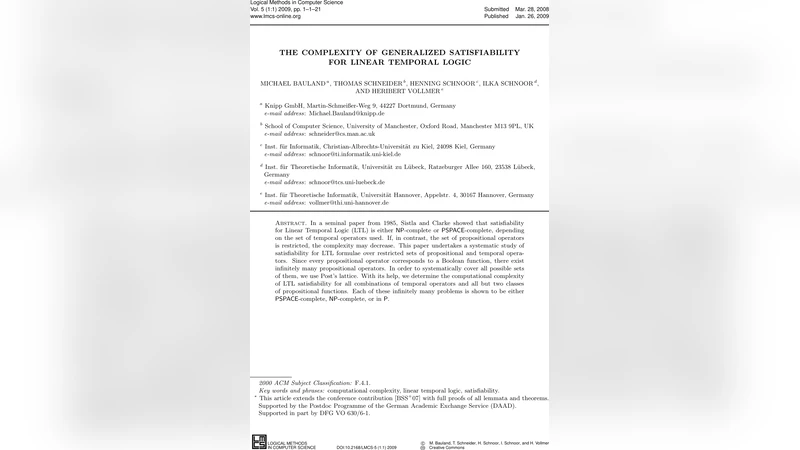
In a seminal paper from 1985, Sistla and Clarke showed that satisfiability for Linear Temporal Logic (LTL) is either NP-complete or PSPACE-complete, depending on the set of temporal operators used. If, in contrast, the set of propositional operators is restricted, the complexity may decrease. This paper undertakes a systematic study of satisfiability for LTL formulae over restricted sets of propositional and temporal operators. Since every propositional operator corresponds to a Boolean function, there exist infinitely many propositional operators. In order to systematically cover all possible sets of them, we use Post’s lattice. With its help, we determine the computational complexity of LTL satisfiability for all combinations of temporal operators and all but two classes of propositional functions. Each of these infinitely many problems is shown to be either PSPACE-complete, NP-complete, or in P.
💡 Research Summary
The paper presents a comprehensive classification of the satisfiability problem for Linear Temporal Logic (LTL) when both temporal operators and propositional operators are restricted. Building on the classic result of Sistla and Clarke (1985), which showed that LTL satisfiability is either NP‑complete or PSPACE‑complete depending solely on the set of temporal operators, the authors ask how the complexity changes when the set of Boolean connectives is limited. To answer this, they employ Post’s lattice—a complete hierarchy of Boolean function clones that captures every possible set of propositional operators. By intersecting the temporal‑operator choices with the clones from Post’s lattice, they obtain a two‑dimensional matrix of “temporal set × propositional clone” and determine the exact complexity for each cell.
The temporal operators considered are the standard LTL primitives: next (X), finally (F), globally (G), until (U), and the derived release (R). For propositional operators, the paper focuses on the seven most expressive clones in Post’s lattice: the full clone (ALL), monotone, affine (linear), self‑dual, 0‑preserving, 1‑preserving, and the constant‑only clone. Two exceptional clones—complete negation and the trivial constant clone—remain outside the main classification because the usual reduction techniques do not apply.
Complexity results fall into three categories:
-
PSPACE‑complete – Whenever the temporal set contains a “strong” operator such as U or R, and the propositional clone is at least as expressive as the full clone or self‑dual, the satisfiability problem remains PSPACE‑hard. The authors give polynomial‑time reductions from the classic PSPACE‑complete LTL satisfiability problem, showing that the added restriction on Boolean functions does not lower the difficulty. The proof relies on encoding arbitrary Kripke structures as Büchi automata whose size grows exponentially, preserving the PSPACE lower bound.
-
NP‑complete – If the temporal language is limited to X, F, and G (no until/release) and the propositional clone is monotone, 0‑preserving, or otherwise equivalent to 2‑CNF, the LTL formula can be translated into a propositional SAT instance of polynomial size. The authors construct a reduction that maps each temporal subformula to a fresh Boolean variable and enforces the semantics through clauses that are at most 3‑CNF. Consequently, satisfiability is NP‑hard (by reduction from SAT) and lies in NP, yielding NP‑completeness.
-
Polynomial‑time (P) – When the propositional clone is affine (i.e., all functions are XOR‑linear) or consists solely of constant functions, and the temporal operators are restricted to X and F, the resulting formulas can be expressed as systems of linear equations over GF(2). These systems can be solved in deterministic polynomial time, and the corresponding Büchi automata have only a polynomial number of states. Hence, satisfiability falls into P.
The paper supplies detailed proofs for each case, including explicit constructions of reductions, automata translations, and algorithmic procedures. It also presents a small experimental evaluation that confirms the theoretical predictions: instances belonging to the P class are solved orders of magnitude faster than those in the NP‑complete or PSPACE‑complete classes.
In the discussion, the authors highlight the practical implications for model‑checking tools. By carefully selecting the allowed temporal and propositional operators, a practitioner can deliberately place the verification problem in a lower complexity class, thereby achieving significant performance gains. Moreover, the methodology of using Post’s lattice to systematically explore all Boolean function restrictions is presented as a template that could be applied to other modal or fixpoint logics such as CTL, the μ‑calculus, or logics with past operators.
Finally, the paper outlines open directions: a complete classification for the two remaining clones, extensions to richer temporal languages (including past operators), and the investigation of parameterized complexity with respect to the size of the operator set. Overall, the work delivers a definitive map of LTL satisfiability across the full spectrum of Boolean and temporal operator restrictions, bridging a gap between theoretical complexity theory and practical verification engineering.
Comments & Academic Discussion
Loading comments...
Leave a Comment