Bootstrapping Inductive and Coinductive Types in HasCASL
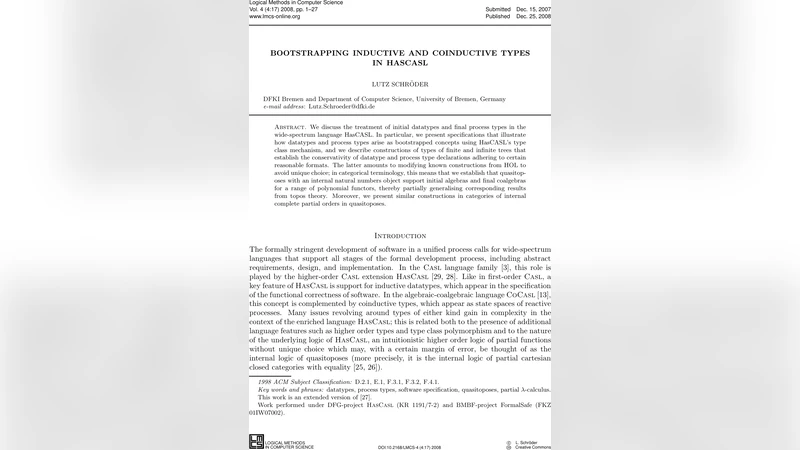
We discuss the treatment of initial datatypes and final process types in the wide-spectrum language HasCASL. In particular, we present specifications that illustrate how datatypes and process types arise as bootstrapped concepts using HasCASL’s type class mechanism, and we describe constructions of types of finite and infinite trees that establish the conservativity of datatype and process type declarations adhering to certain reasonable formats. The latter amounts to modifying known constructions from HOL to avoid unique choice; in categorical terminology, this means that we establish that quasitoposes with an internal natural numbers object support initial algebras and final coalgebras for a range of polynomial functors, thereby partially generalising corresponding results from topos theory. Moreover, we present similar constructions in categories of internal complete partial orders in quasitoposes.
💡 Research Summary
The paper investigates how the wide‑spectrum specification language HasCASL can internally generate (bootstrap) both inductive datatypes and coinductive process types, eliminating the need for external meta‑theoretic proofs of their existence. HasCASL extends the algebraic specification language CASL with higher‑order features and a powerful type‑class mechanism, enabling modular reuse of definitions and proofs.
The authors first introduce two central type classes: Inductive, which encapsulates the constructors and induction principle of an initial algebra, and Coinductive, which captures the observers and coinduction principle of a final coalgebra. By parameterising these classes over polynomial functors, any datatype or process type that can be expressed as a polynomial functor can be declared simply by making the corresponding type an instance of the appropriate class. This automatically supplies the usual algebraic laws (e.g., fold/unfold equations) without additional proof obligations.
To show that these declarations are conservative extensions of the underlying HasCASL theory, the paper constructs concrete models of finite and infinite trees. Finite trees are built recursively using the internal natural numbers object (NNO), while infinite trees are obtained as limits of approximations via a coalgebraic fixed‑point operator. Crucially, the construction avoids the use of the unique‑choice principle that is standard in higher‑order logic (HOL) treatments of initial algebras and final coalgebras. By providing explicit tree models, the authors demonstrate that adding an Inductive or Coinductive declaration does not introduce new theorems about existing symbols, thereby establishing conservativity.
From a categorical standpoint, the work is framed in terms of quasitoposes—categories that share many properties of elementary topoi but need not satisfy the full axiom of choice. The presence of an internal NNO in a quasitopos guarantees that for any polynomial functor F, both the initial algebra μF and the final coalgebra νF exist. This result generalises classic topos‑theoretic theorems (which typically assume a full topos) to the weaker setting of quasitoposes, again without invoking unique choice.
The authors further extend the analysis to categories of internal complete partial orders (CPOs) within a quasitopos. By exploiting continuity of functors on CPOs, they obtain analogous existence results for μF and νF, linking the work to domain theory commonly used in semantics of programming languages. This shows that HasCASL’s bootstrapped inductive and coinductive mechanisms are compatible with both algebraic and order‑theoretic models.
Implementation examples illustrate the practicality of the approach. Standard data structures such as lists, binary trees, and streams are declared as instances of the Inductive or Coinductive classes. The automatically generated induction or coinduction principles are then employed to verify properties like map‑fusion for lists or bisimulation for streams, all within the HasCASL environment. These case studies confirm that the language can serve not only as a specification tool but also as a proof assistant that internally manages the fixed‑point constructions required for reasoning about recursive and corecursive entities.
In conclusion, the paper demonstrates that HasCASL’s type‑class facility can internalise the theory of initial algebras and final coalgebras for a broad class of polynomial functors. By constructing explicit tree models and working in quasitoposes (and their internal CPO categories), the authors avoid reliance on the axiom of unique choice while preserving conservativity. This bridges the gap between algebraic specification, categorical logic, and domain‑theoretic semantics, and opens avenues for extending the bootstrapping technique to more complex functors, richer type systems, and integration with automated verification tools.
Comments & Academic Discussion
Loading comments...
Leave a Comment