Weak omega-categories from intensional type theory
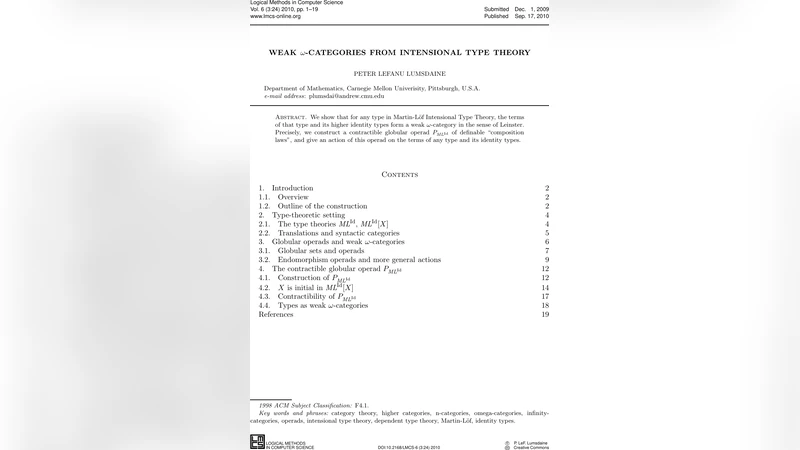
We show that for any type in Martin-L"of Intensional Type Theory, the terms of that type and its higher identity types form a weak omega-category in the sense of Leinster. Precisely, we construct a contractible globular operad of definable composition laws, and give an action of this operad on the terms of any type and its identity types.
💡 Research Summary
The paper establishes that every type in Martin‑Löf Intensional Type Theory (MLTT) naturally carries the structure of a weak ω‑category in the sense defined by Leinster. The authors begin by recalling the hierarchical nature of identity types in MLTT: for a type A one has the ordinary identity type Id_A(x, y) (1‑cells), the identity type of identities Id_{Id_A}(p, q) (2‑cells), and so on, yielding an infinite globular tower of terms. This tower can be viewed as a globular set, the underlying shape of any higher‑dimensional categorical object.
Leinster’s definition of a weak ω‑category is recalled: it is given by an action of a contractible globular operad on a globular set, where the operad encodes all possible ways of composing cells together with the higher coherence data. The central technical contribution of the paper is the construction, inside MLTT itself, of a definable globular operad O_T whose operations are precisely the syntactically definable composition schemes that can be written using the basic rules of MLTT (path induction, the J‑rule, and the usual substitution principles). An operation of O_T at level n takes an n‑tuple of n‑cells (i.e., n‑level identity terms) and returns an (n+1)‑cell, thereby representing a higher‑dimensional composition.
The authors prove that O_T is contractible. Contractibility means that for every arity there is a canonical “standard” composite and that any two composites are related by a higher‑dimensional cell, and that all such higher cells themselves are uniquely related up to still higher cells. The proof proceeds by a double induction: first on the dimension of the cells, and second on the syntactic complexity of the composition scheme. Using the normalization theorem for MLTT and the fact that every identity proof can be reduced to a reflexivity proof via J‑elimination, they show that any composite can be rewritten into a left‑associated normal form. The rewriting steps are witnessed by explicit higher‑identity terms, which themselves can be further rewritten, guaranteeing the existence of the required coherence cells at every level. Consequently, O_T satisfies the contractibility condition required by Leinster.
Having built the operad, the paper defines an action of O_T on any type A. Given a tuple of n‑cells of A (i.e., terms of the n‑th identity type of A), the operad’s n‑ary operation produces an (n+1)‑cell by applying the corresponding definable composition term. This action respects source and target projections because those are built into the typing rules of the identity types, and it respects the operadic composition because the underlying syntactic composition is associative up to the higher cells already supplied by the contractibility proof. In this way, the collection of all terms of A together with all its higher identity terms forms a Leinster weak ω‑category.
The paper illustrates the construction with several examples. For the natural numbers type ℕ, the usual addition and multiplication operations give rise to families of paths whose higher composites are automatically governed by O_T. For dependent function types Π(x:A).B(x), the action reproduces the familiar “function extensionality” coherence at all higher levels, again without leaving the intensional setting.
Finally, the authors discuss the broader significance of their result. Traditionally, the passage from type theory to higher‑category semantics has relied on external models such as simplicial sets, quasi‑categories, or model categories. By exhibiting a purely internal construction of a weak ω‑category, the paper shows that the coherence data required for higher‑dimensional categorical reasoning can be generated directly by the proof‑theoretic machinery of MLTT. This opens the door to integrating higher‑categorical reasoning into proof assistants based on intensional type theory, to automating coherence proofs, and to exploring new type‑theoretic principles (e.g., higher‑dimensional univalence) that are naturally expressed in the language of weak ω‑categories. Future work is suggested on implementing the operad O_T in existing proof assistants, comparing it with other operadic models of higher categories, and exploiting the internal ω‑category structure for applications in homotopy‑type‑theoretic mathematics.
Comments & Academic Discussion
Loading comments...
Leave a Comment