Multi-Objective Model Checking of Markov Decision Processes
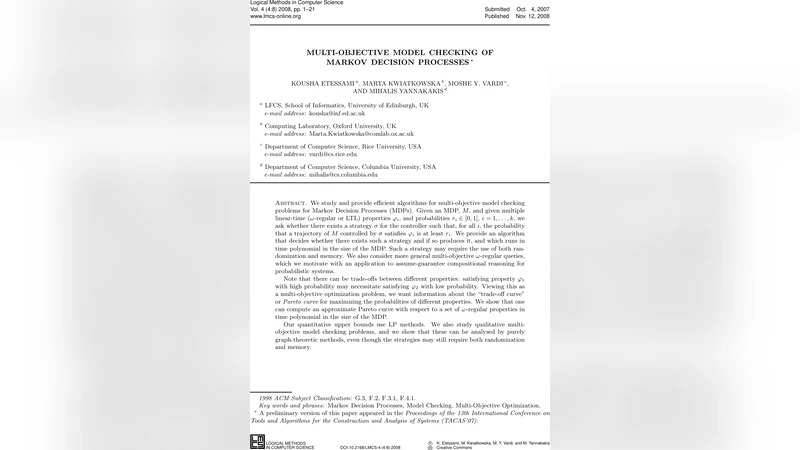
We study and provide efficient algorithms for multi-objective model checking problems for Markov Decision Processes (MDPs). Given an MDP, M, and given multiple linear-time (\omega -regular or LTL) properties \varphi_i, and probabilities r_i \epsilon [0,1], i=1,…,k, we ask whether there exists a strategy \sigma for the controller such that, for all i, the probability that a trajectory of M controlled by \sigma satisfies \varphi_i is at least r_i. We provide an algorithm that decides whether there exists such a strategy and if so produces it, and which runs in time polynomial in the size of the MDP. Such a strategy may require the use of both randomization and memory. We also consider more general multi-objective \omega -regular queries, which we motivate with an application to assume-guarantee compositional reasoning for probabilistic systems. Note that there can be trade-offs between different properties: satisfying property \varphi_1 with high probability may necessitate satisfying \varphi_2 with low probability. Viewing this as a multi-objective optimization problem, we want information about the “trade-off curve” or Pareto curve for maximizing the probabilities of different properties. We show that one can compute an approximate Pareto curve with respect to a set of \omega -regular properties in time polynomial in the size of the MDP. Our quantitative upper bounds use LP methods. We also study qualitative multi-objective model checking problems, and we show that these can be analysed by purely graph-theoretic methods, even though the strategies may still require both randomization and memory.
💡 Research Summary
The paper tackles the problem of verifying Markov Decision Processes (MDPs) against several quantitative objectives simultaneously. Given an MDP M, a collection of ω‑regular (or LTL) properties φ₁,…,φ_k and target probabilities r₁,…,r_k ∈
Comments & Academic Discussion
Loading comments...
Leave a Comment