On the strength of proof-irrelevant type theories
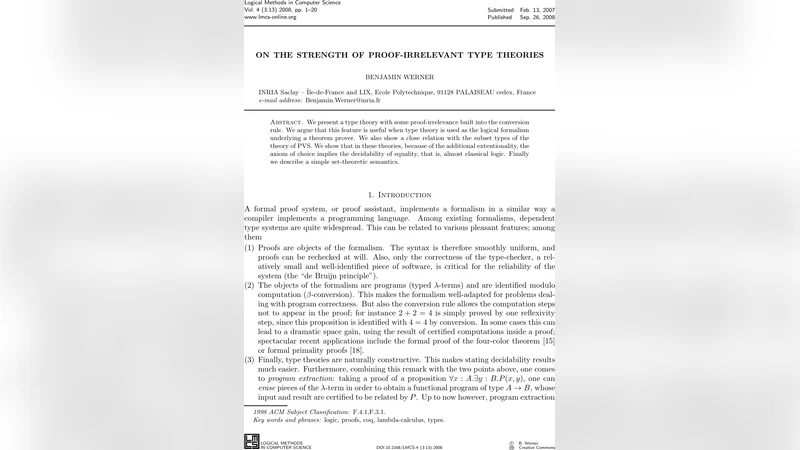
We present a type theory with some proof-irrelevance built into the conversion rule. We argue that this feature is useful when type theory is used as the logical formalism underlying a theorem prover. We also show a close relation with the subset types of the theory of PVS. We show that in these theories, because of the additional extentionality, the axiom of choice implies the decidability of equality, that is, almost classical logic. Finally we describe a simple set-theoretic semantics.
💡 Research Summary
The paper introduces a dependent type theory in which proof‑irrelevance is built directly into the conversion rule. In the proposed system, any two proofs of the same proposition are considered interchangeable during type‑checking: the conversion relation ignores the concrete proof term and only cares about the proposition’s truth value. This design dramatically simplifies the conversion algorithm, reduces the size of proof objects that must be stored, and makes automated proof search more tractable—features that are highly desirable for interactive theorem provers.
A central observation is that this proof‑irrelevant conversion aligns closely with the subset‑type mechanism of the Prototype Verification System (PVS). In PVS a subset type {x : A | P(x)} is formed by restricting a carrier type A with a predicate P, and the proof that an element satisfies P does not affect the type’s computational behavior. The authors show a formal correspondence: the same subset construction can be expressed in their theory, and the conversion rule treats the predicate’s proof exactly as PVS does. Consequently, the two systems are isomorphic with respect to subset types, suggesting that existing PVS developments can be ported to the new framework with minimal friction.
The most striking logical consequence explored in the paper is the interaction between proof‑irrelevance and the Axiom of Choice (AC). By assuming AC, the authors prove that equality on every type becomes decidable. The argument proceeds by using a choice function to select an element from a subset that distinguishes two given terms; if the subset is non‑empty, the terms are different, otherwise they are equal. Because the conversion rule already collapses all proofs of the same proposition, this decision procedure can be carried out inside the type theory itself. Hence, once AC is added, the system acquires “almost classical” strength: it can derive the law of excluded middle for equality, a property that intuitionistic type theories lack.
To substantiate the consistency of this enriched theory, the paper presents a set‑theoretic semantics. Types are interpreted as sets in ZF, and proof‑irrelevant propositions are interpreted as subsets equipped with an equivalence relation that identifies all proofs of the same logical statement. Conversion corresponds to set‑theoretic equality of these interpreted objects, while the choice axiom is modeled by the existence of a choice function in the underlying set universe. Under this semantics, the theory is shown to be sound and to admit models, confirming that the added proof‑irrelevance and the derived decidability of equality do not introduce inconsistency.
The structure of the paper follows a clear progression: (1) definition of the proof‑irrelevant conversion rule and its basic metatheoretic properties; (2) demonstration of the isomorphism with PVS subset types; (3) proof that AC implies decidable equality, together with a discussion of the resulting near‑classical logical strength; (4) construction of a set‑theoretic model establishing consistency; and (5) a discussion of practical implications for theorem‑prover implementation and avenues for future work, such as integrating the approach with homotopy type theory or evaluating its performance in real proof‑assistant environments. In sum, the work offers a compelling blend of theoretical insight and practical benefit, showing that embedding proof‑irrelevance at the core of a type theory can both simplify implementation and yield a surprisingly strong logical system when combined with classical choice principles.
Comments & Academic Discussion
Loading comments...
Leave a Comment