Exhaustible sets in higher-type computation
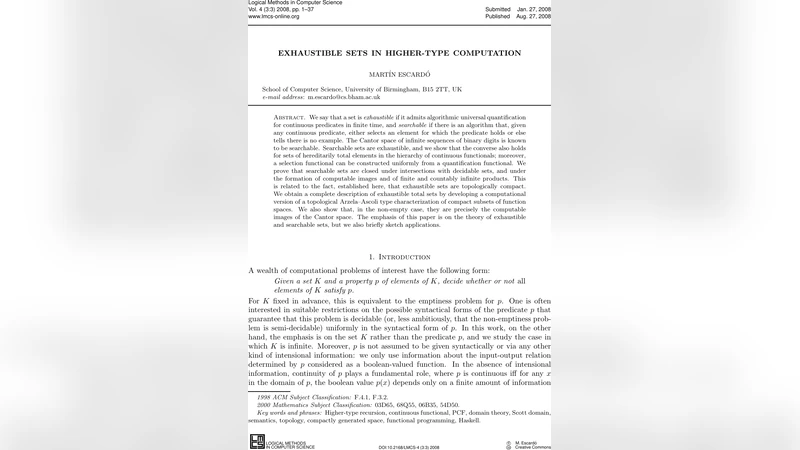
We say that a set is exhaustible if it admits algorithmic universal quantification for continuous predicates in finite time, and searchable if there is an algorithm that, given any continuous predicate, either selects an element for which the predicate holds or else tells there is no example. The Cantor space of infinite sequences of binary digits is known to be searchable. Searchable sets are exhaustible, and we show that the converse also holds for sets of hereditarily total elements in the hierarchy of continuous functionals; moreover, a selection functional can be constructed uniformly from a quantification functional. We prove that searchable sets are closed under intersections with decidable sets, and under the formation of computable images and of finite and countably infinite products. This is related to the fact, established here, that exhaustible sets are topologically compact. We obtain a complete description of exhaustible total sets by developing a computational version of a topological Arzela–Ascoli type characterization of compact subsets of function spaces. We also show that, in the non-empty case, they are precisely the computable images of the Cantor space. The emphasis of this paper is on the theory of exhaustible and searchable sets, but we also briefly sketch applications.
💡 Research Summary
The paper introduces two complementary notions for subsets of higher‑type continuous functionals: exhaustibility and searchability. A set A is called exhaustible if there exists a computable functional Q_A that, given any continuous predicate P : A → Bool, decides the universal quantification “∀x ∈ A. P(x)” in finite time. A set is searchable if there is a computable functional S_A which, for any continuous predicate P, either produces an element a ∈ A with P(a)=true or reports that no such element exists. The classic Cantor space 2^ℕ of infinite binary sequences is known to be searchable; this serves as the canonical example throughout the work.
The central technical contribution is the proof that, for hereditarily total elements in the hierarchy of continuous functionals, exhaustibility and searchability coincide. The authors construct, uniformly and effectively, a selection functional S_A from a given quantification functional Q_A. The construction proceeds by using Q_A to perform a binary search over the representation of elements of A, exploiting continuity to guarantee that the search terminates after finitely many steps. Conversely, a selection functional trivially yields a quantification functional by testing the negation of the predicate.
Having established the equivalence, the paper investigates closure properties of searchable (hence exhaustible) sets. It shows that the intersection of a searchable set with any decidable subset remains searchable, because the decision procedure can be inserted as a pre‑filter. Moreover, the image of a searchable set under any computable map is searchable; the selection functional for the image is obtained by composing the original selector with the computable map. Finite products of searchable sets are searchable in the obvious way, and the authors extend this to countably infinite products. For the latter, they synchronize countably many selectors and rely on the continuity of predicates to ensure that a finite amount of information suffices to determine a witness or to certify emptiness.
From a topological standpoint, the authors prove that every exhaustible set is compact in the natural topology of the function space. This compactness is not merely abstract: it underlies the ability to replace an arbitrary open cover by a finite subcover, which translates algorithmically into the existence of a finite verification procedure for universal quantification. Leveraging this, the paper develops a computational analogue of the Arzelà–Ascoli theorem for higher‑type function spaces. It characterizes exhaustible subsets of C(D,E) (continuous maps from a compact domain D to a metric codomain E) as precisely those families that are equicontinuous and pointwise relatively compact. Consequently, such families are exactly the searchable sets in the higher‑type setting.
A striking corollary is that any non‑empty exhaustible total set is a computable image of the Cantor space. That is, there exists a computable functional g : 2^ℕ → A such that A = g
Comments & Academic Discussion
Loading comments...
Leave a Comment