Canonical calculi with (n,k)-ary quantifiers
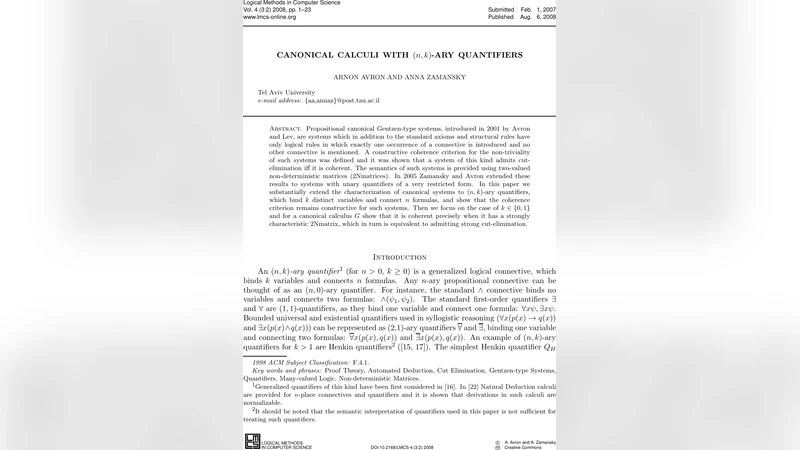
Propositional canonical Gentzen-type systems, introduced in 2001 by Avron and Lev, are systems which in addition to the standard axioms and structural rules have only logical rules in which exactly one occurrence of a connective is introduced and no other connective is mentioned. A constructive coherence criterion for the non-triviality of such systems was defined and it was shown that a system of this kind admits cut-elimination iff it is coherent. The semantics of such systems is provided using two-valued non-deterministic matrices (2Nmatrices). In 2005 Zamansky and Avron extended these results to systems with unary quantifiers of a very restricted form. In this paper we substantially extend the characterization of canonical systems to (n,k)-ary quantifiers, which bind k distinct variables and connect n formulas, and show that the coherence criterion remains constructive for such systems. Then we focus on the case of k∈{0,1} and for a canonical calculus G show that it is coherent precisely when it has a strongly characteristic 2Nmatrix, which in turn is equivalent to admitting strong cut-elimination.
💡 Research Summary
The paper extends the theory of canonical Gentzen‑type calculi, originally developed for propositional logics, to languages that contain (n,k)-ary quantifiers—operators that bind k distinct variables and combine n formulas. An (n,k)-ary quantifier subsumes ordinary propositional connectives ((n,0)-ary), the usual first‑order quantifiers ∀ and ∃ ((1,1)-ary), as well as more complex constructs such as Henkin quantifiers ((2,2)-ary) and other higher‑arity binding operators.
The authors first give a precise syntactic definition of a “canonical introduction rule” for such quantifiers. The key idea is to abstract the internal structure of the quantified formulas by a simplified first‑order language L_{n,k} that contains n predicate symbols of arity k and a set of constants. In a canonical rule the premises are clauses over L_{n,k}, while the conclusion introduces (or eliminates) a single occurrence of the quantifier Q. An instantiation mapping χ replaces the abstract predicates, constants and variables of L_{n,k} with actual formulas, terms and variables of the original language, respecting freshness conditions (constants become terms, variables become eigen‑variables) and ensuring that substituted terms are free for the bound variables.
Two canonical rules are said to be dual when one introduces Q on the right‑hand side of a sequent and the other introduces Q on the left‑hand side. For a pair of dual rules the authors form the union of their premise clause‑sets, rename clashing constants and variables (the operation Rnm), and require that this union be classically inconsistent. This requirement is the coherence condition. It generalises the coherence criterion introduced by Avron & Lev (2001) and later by Zamansky & Avron (2005) for propositional and unary‑quantifier systems, respectively.
The paper proves that coherence is decidable. Because L_{n,k} contains no function symbols, checking classical inconsistency of a finite set of clauses reduces to checking the satisfiability of a finite set of universal formulas, which is decidable by Herbrand’s theorem.
The semantic core of the work is the use of two‑valued non‑deterministic matrices (2Nmatrices). For each (n,k)-ary quantifier Q a distribution function λ_Q : P⁺(V) → V is defined, where V is the set of truth values (typically {t,f}) and P⁺(V) denotes the non‑empty subsets of V. A 2Nmatrix assigns to every atomic formula a set of possible truth values; the value of a quantified formula is then chosen nondeterministically from the image of λ_Q applied to the set of values of its sub‑formulas. A 2Nmatrix is strongly characteristic for a calculus G if, for every canonical rule of G, the truth‑value assignments to the premises guarantee that the conclusion receives a value in the same designated set.
The main technical theorem (restricted to the case k ∈ {0,1}) states the following equivalences for a canonical calculus G:
- Coherence – every pair of dual canonical rules yields an inconsistent clause set after renaming.
- Existence of a strongly characteristic 2Nmatrix – there is a 2Nmatrix that validates exactly the sequents derivable in G and respects all canonical rules.
- Strong cut‑elimination – any proof in G can be transformed into a proof that contains no cuts of the form introduced by the canonical rules (i.e., the calculus admits cut‑admissibility in a strong sense).
Thus, for k = 0 (pure propositional connectives) and k = 1 (ordinary first‑order quantifiers, including bounded quantifiers that combine two formulas), coherence provides a constructive method to build a suitable 2Nmatrix, and the presence of such a matrix guarantees strong cut‑elimination.
The authors also show that coherence is not a necessary condition for ordinary cut‑elimination: there exist non‑coherent canonical systems that still admit cut‑elimination, but these systems are considered “unnatural” because they lack a well‑behaved semantics. Consequently, coherence serves as a syntactic proxy for the existence of a sound and complete semantics.
Finally, the paper outlines future research directions: extending the results to quantifiers with k > 1 (multiple bound variables), incorporating function symbols into the underlying language, and exploring connections with linear logic and other proof‑theoretic frameworks. These extensions would broaden the applicability of canonical calculi to richer logical systems used in computer science, such as higher‑order logics, modal logics with binding operators, and logics for reasoning about programs with complex variable scopes.
Comments & Academic Discussion
Loading comments...
Leave a Comment