Independence and concurrent separation logic
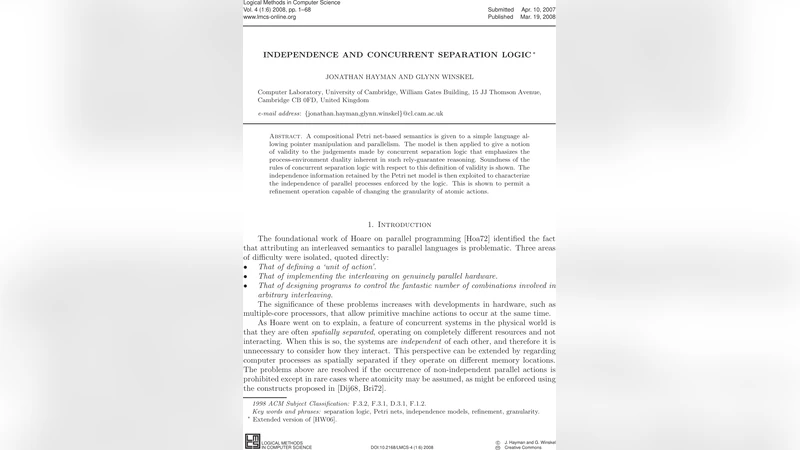
A compositional Petri net-based semantics is given to a simple language allowing pointer manipulation and parallelism. The model is then applied to give a notion of validity to the judgements made by concurrent separation logic that emphasizes the process-environment duality inherent in such rely-guarantee reasoning. Soundness of the rules of concurrent separation logic with respect to this definition of validity is shown. The independence information retained by the Petri net model is then exploited to characterize the independence of parallel processes enforced by the logic. This is shown to permit a refinement operation capable of changing the granularity of atomic actions.
💡 Research Summary
This paper presents a compositional semantics for a small imperative language that supports pointer manipulation and parallel composition, using Petri nets as the underlying model. The language includes variables, heap‑allocated memory, basic arithmetic, and a parallel operator C1 || C2. Each command is translated into a Petri net transition, while heap cells, variables, and synchronization primitives become places. The net captures the flow of tokens that represent the concrete state of the program, and the causal relationships between transitions encode the program’s execution order.
A central contribution is the definition of a validity notion for judgments of Concurrent Separation Logic (CSL) that explicitly incorporates the process‑environment duality typical of rely‑guarantee reasoning. In this setting, a process specifies a guarantee—the set of state changes it promises to respect—while the environment supplies a rely condition—assumptions about the actions of other concurrent components. A CSL judgment {φ} C {ψ} is considered valid if, when the net for C is initialized in a marking satisfying the pre‑condition φ, every reachable marking satisfies the post‑condition ψ and the net’s independence relations are preserved throughout the execution. This bridges the gap between the abstract resource invariants of CSL and a concrete operational model.
The paper proves soundness of the core CSL inference rules (frame, parallel composition, and critical‑section rules) with respect to the Petri‑net based validity. The proof relies on the explicit independence relation: two transitions are independent when their input and output places do not overlap, guaranteeing that their execution order can be swapped without affecting the overall token flow. For parallel composition, soundness follows from the fact that the net of C1 || C2 is the disjoint union of the nets for C1 and C2 plus synchronization places; independence ensures that interleavings respect the CSL parallel rule. The frame rule is justified by showing that adding disjoint resources corresponds to adding independent places, which never interfere with existing transitions.
Beyond soundness, the authors exploit the independence information retained by the net to characterize precisely when two parallel processes are independent in the sense enforced by CSL. This characterization enables a refinement operation that can change the granularity of atomic actions. Two forms of refinement are defined: (1) splitting a coarse transition into a sequence of finer transitions, provided the finer transitions remain mutually independent; and (2) coalescing a set of independent fine transitions into a single atomic transition. The refinement is proved to preserve both the net’s causal structure and the validity of any CSL proof that has already been established, thereby allowing implementation‑level optimizations without re‑proving correctness.
A case study involving a shared linked list and a concurrent stack demonstrates the workflow: the program is translated into a net, CSL proofs are constructed using the defined validity, independence analysis is performed automatically, and then a refinement that merges several pointer updates into a single atomic step is applied. The resulting net exhibits fewer transitions while still satisfying the original CSL specifications.
In the related work discussion, the paper contrasts its approach with earlier CSL semantics based on operational small‑step rules or denotational models that lack an explicit notion of independence. By grounding CSL in Petri nets, the authors obtain a uniform framework that simultaneously supports rely‑guarantee reasoning, independence analysis, and systematic refinement. The conclusion outlines future directions, including extending the language with richer memory models (e.g., weak memory) and developing tool support for automated independence detection and refinement. Overall, the work provides a robust semantic foundation that deepens the connection between concurrent separation logic and concrete models of concurrency, and it offers practical mechanisms for safely adjusting the atomicity of actions in verified concurrent programs.
Comments & Academic Discussion
Loading comments...
Leave a Comment