Interactive Small-Step Algorithms I: Axiomatization
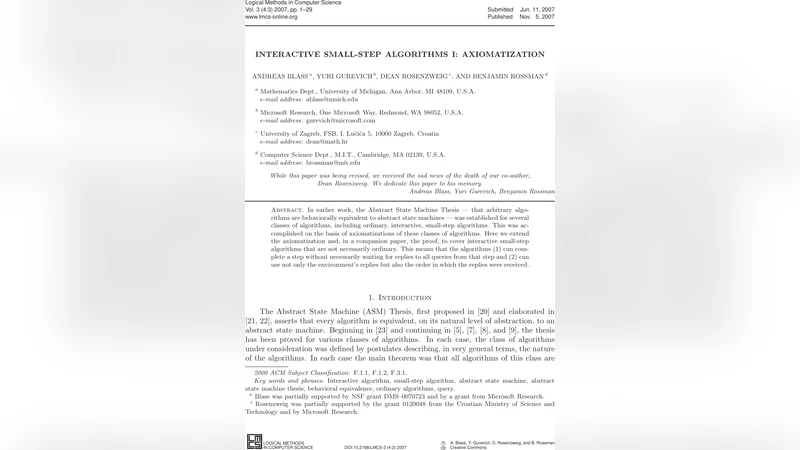
In earlier work, the Abstract State Machine Thesis – that arbitrary algorithms are behaviorally equivalent to abstract state machines – was established for several classes of algorithms, including ordinary, interactive, small-step algorithms. This was accomplished on the basis of axiomatizations of these classes of algorithms. Here we extend the axiomatization and, in a companion paper, the proof, to cover interactive small-step algorithms that are not necessarily ordinary. This means that the algorithms (1) can complete a step without necessarily waiting for replies to all queries from that step and (2) can use not only the environment’s replies but also the order in which the replies were received.
💡 Research Summary
The paper extends the axiomatization of interactive small‑step algorithms, originally formulated for “ordinary” algorithms that must wait for replies to all queries before completing a step. The authors identify two limitations of the earlier framework: (1) the requirement that every query issued in a step be answered before the step can terminate, and (2) the neglect of the order in which replies arrive, even though many real‑world systems are sensitive to timing and sequencing of messages. To address these issues, the paper introduces a richer class of algorithms that may finish a step after receiving only a subset of the expected replies and that may use the arrival order of replies as part of their computational state.
The core contribution is a set of two additional axioms that augment the five foundational axioms of the original ASM thesis (normality, determinism, finiteness, continuity, and equivalence). The “Partial Completion Axiom” guarantees the existence of a finite, sufficient set of replies that allows a step to end; it formalizes the notion of a “minimal decisive reply set.” The “Reply Order Axiom” captures the idea that two executions with the same set of queries but different reply orders can lead to different subsequent states. Together, these axioms preserve the original framework’s logical structure while expanding its expressive power.
To integrate the new concepts into the ASM model, the authors introduce a “history variable” that records each query‑reply pair together with a timestamp and a linear order. This variable is immutable across steps but can be inspected by transition functions, thereby enabling the algorithm to make decisions based on the chronological pattern of incoming messages. In addition, a “fallback rule” is defined to ensure deterministic behavior when essential replies are missing; the rule specifies a default continuation that maintains consistency with the partial‑completion condition.
The paper then proves two central theorems. The Simulation Lemma shows that any algorithm satisfying the extended axioms can be simulated by an abstract state machine that respects the same partial‑completion and order‑sensitive constraints. The Correspondence Theorem establishes behavioral equivalence between the extended algorithm class and a suitably constructed ASM, thereby extending the Abstract State Machine Thesis to this broader setting. The proofs adapt the original ASM arguments, adding case analyses for partial reply sets and for permutations of reply order, and they introduce an “order‑sensitive transition mapping” to handle the additional complexity.
Beyond the theoretical development, the authors discuss practical implications. Many asynchronous protocols, distributed databases, and real‑time control systems operate under conditions where not all messages are guaranteed to arrive before a decision must be made, and where the timing of messages influences the outcome. The extended axiomatization provides a rigorous foundation for modeling, verifying, and reasoning about such systems within the ASM framework. The paper also outlines future research directions, including extending the approach to large‑step algorithms, incorporating probabilistic reply models, and integrating the axioms into automated verification tools. In summary, the work broadens the applicability of the ASM thesis, offering a robust formalism for interactive small‑step algorithms that reflect the realities of modern, asynchronous computing environments.
Comments & Academic Discussion
Loading comments...
Leave a Comment