A Carrington-like geomagnetic storm observed in the 21st century
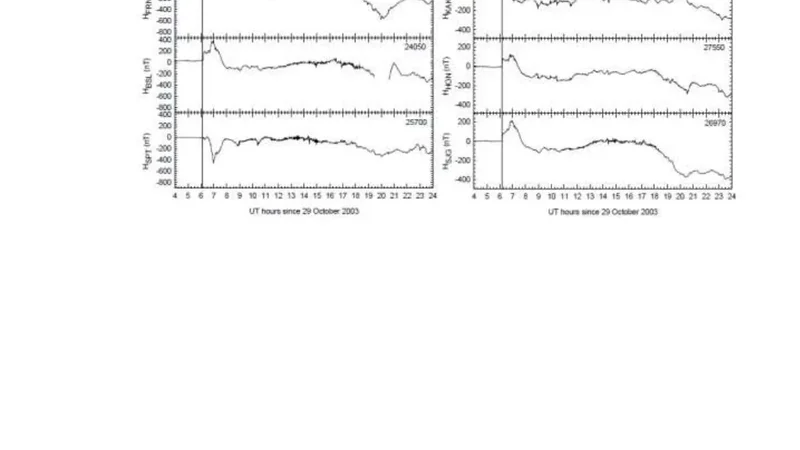
In September 1859 the Colaba observatory measured the most extreme geomagnetic disturbance ever recorded at low latitudes related to solar activity: the Carrington storm. This paper describes a geomagnetic disturbance case with a profile extraordinarily similar to the disturbance of the Carrington event at Colaba: the event on 29 October 2003 at Tihany magnetic observatory in Hungary. The analysis of the H-field at different locations during the “Carrington-like” event leads to a re-interpretation of the 1859 event. The major conclusions of the paper are the following: (a) the global Dst or SYM-H, as indices based on averaging, missed the largest geomagnetic disturbance in the 29 October 2003 event and might have missed the 1859 disturbance, since the large spike in the horizontal component (H) of terrestrial magnetic field depends strongly on magnetic local time (MLT); (b) the main cause of the large drop in H recorded at Colaba during the Carrington storm was not the ring current but field-aligned currents (FACs), and (c) the very local signatures of the H-spike imply that a Carrington-like event can occur more often than expected.
💡 Research Summary
The paper revisits the legendary Carrington storm of September 1859 by presenting a modern analogue that occurred on 29 October 2003 at the Tihany magnetic observatory in Hungary. The authors demonstrate that the temporal profile of the horizontal magnetic component (H) recorded at Tihany is strikingly similar to the “H‑spike” observed at the Colaba (now Mumbai) observatory during the Carrington event: a sudden, large‑amplitude drop followed by a rapid recovery within a few minutes. By analysing H‑field data from more than thirty ground stations worldwide, the study shows that the magnitude of the spike depends strongly on magnetic local time (MLT). At the time of the 2003 event Tihany was situated in the dawn sector (MLT ≈ 06–08 h), where the spike reached about –820 nT, whereas stations located in other MLT sectors recorded only modest variations. Consequently, global indices that are based on averaging, such as Dst or SYM‑H, missed the most extreme part of the disturbance; the indices only reflected a moderate depression of roughly –400 nT.
To identify the physical driver of the spike, the authors combine satellite observations (ACE, Cluster) with ionospheric current models. Their reconstruction points to an intense, short‑lived enhancement of field‑aligned currents (FACs) that simultaneously affected high‑ and mid‑latitude regions. The FAC system, by coupling the magnetosphere to the ionosphere, generated a strong, localized perturbation of the horizontal magnetic field at low latitudes. In contrast, the contribution from the symmetric ring current, which dominates the Dst index, was comparatively weak and could not account for the rapid, large‑amplitude H‑spike. The authors therefore argue that the primary cause of the Carrington‑type H‑spike was the FAC system, not the ring current.
Applying this interpretation to the 1859 event, the paper suggests that the dramatic H‑drop recorded at Colaba was also driven mainly by a dawn‑sector FAC surge, with the ring current playing only a secondary role. This re‑evaluation implies that Carrington‑like disturbances may be more frequent than previously thought, because they can be hidden in global averages that smooth out local spikes. The study concludes that space‑weather forecasting and risk assessment for power grids, satellite operations, and other technological systems must incorporate high‑resolution, MLT‑dependent models of ionospheric currents, especially FACs, rather than relying solely on traditional Dst‑type indices. By providing a detailed modern case study, the paper offers a new framework for understanding extreme geomagnetic storms and for improving preparedness against future Carrington‑scale events.
Comments & Academic Discussion
Loading comments...
Leave a Comment