Undecidability of performance equivalence of Petri nets
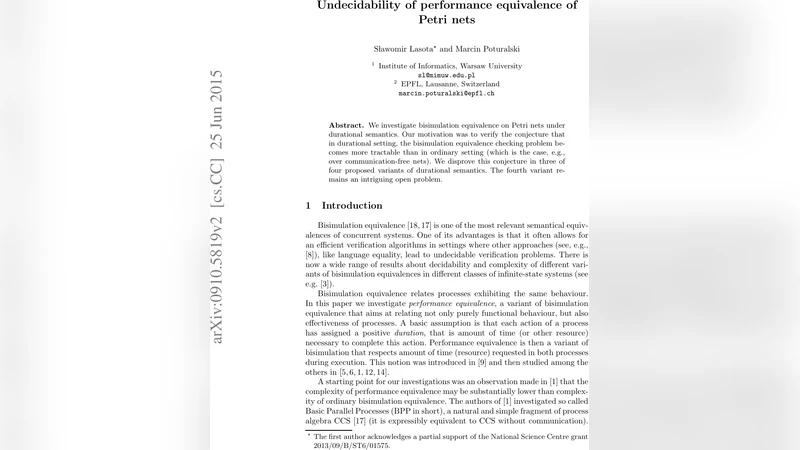
We investigate bisimulation equivalence on Petri nets under durational semantics. Our motivation was to verify the conjecture that in durational setting, the bisimulation equivalence checking problem becomes more tractable than in ordinary setting (which is the case, e.g., over communication-free nets). We disprove this conjecture in three of four proposed variants of durational semantics. The fourth variant remains an intriguing open problem.
💡 Research Summary
The paper investigates bisimulation equivalence for Petri nets when a durational semantics is imposed, i.e., each transition is associated with a positive execution time and the global behavior is observed along a time axis. The authors were motivated by the conjecture that adding explicit durations might simplify equivalence checking, as has been observed for certain restricted classes such as communication‑free nets. To test this hypothesis, they define four distinct variants of durational semantics. Variant 1 assumes a uniform, fixed duration for every transition. Variant 2 allows each transition to have its own fixed duration, but the duration does not change during execution. Variant 3 introduces a cumulative, possibly non‑linear accumulation of durations as transitions fire. Variant 4 is the most general: after a transition fires, its duration may be dynamically reset, leading to a fully flexible timing model.
For each variant the authors formalize the bisimulation equivalence problem and examine its decidability. The core of their undecidability proofs is a reduction from the halting problem for two‑counter Minsky machines, a classic undecidable problem. They construct a Petri net that simulates the Minsky machine’s control flow and counter operations, encoding the machine’s state into the timing of token movements. By carefully designing auxiliary places and timed transitions, they ensure that two nets are bisimilar if and only if the simulated Minsky machine halts.
In Variant 1, despite the simplicity of a uniform duration, the reduction works because the number of elapsed time units directly reflects the number of transition firings, which can be used to count the simulated machine’s steps. Variant 2’s heterogeneous but fixed durations still permit a faithful encoding: each counter increment or decrement is mapped to a transition with a distinct duration, and the overall timing pattern uniquely identifies the machine’s configuration. Variant 3’s cumulative timing introduces non‑linear growth, yet the authors add compensating transitions that reset the accumulated offset, preserving the one‑to‑one correspondence between machine configurations and timed markings. Consequently, for the first three variants the bisimulation equivalence problem is shown to be undecidable, inheriting the hardness of the Minsky halting problem.
Variant 4, however, remains unresolved. The ability to dynamically change a transition’s duration after it fires breaks the static timing correspondence exploited in the reductions for the other variants. The authors were unable to adapt the Minsky‑machine encoding or to devise an alternative proof technique, and they explicitly pose the decidability of bisimulation equivalence under this most expressive durational semantics as an open problem.
The paper concludes that the introduction of explicit durations does not automatically render bisimulation checking more tractable for general Petri nets. While certain subclasses (e.g., communication‑free nets) become easier to analyze under durational semantics, the unrestricted case retains its inherent computational complexity. The results thus refute the initial conjecture for three of the four proposed semantics and highlight Variant 4 as a promising direction for future research.
Comments & Academic Discussion
Loading comments...
Leave a Comment