Structures and magnetic properties of Co-Zr-B magnets studied by first-principles calculations
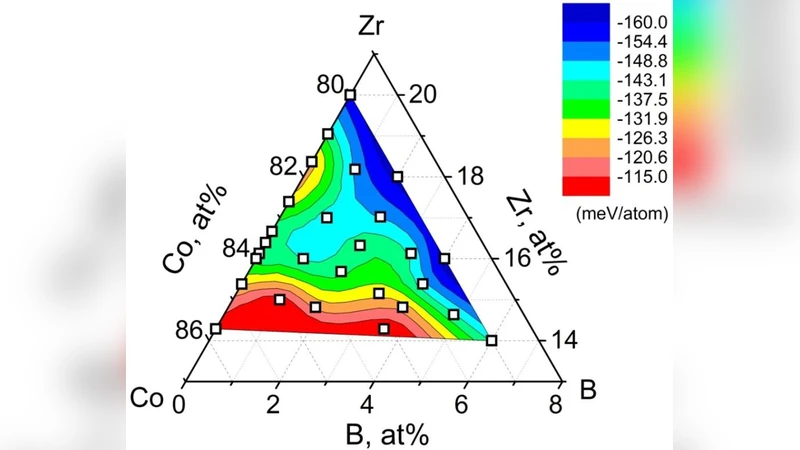
The structures and magnetic properties of the Co-Zr-B alloys near the Co5Zr composition were studied using adaptive genetic algorithm and first-principles calculations to guide further experimental effort on optimizing their magnetic performances. Through extensive structural searches, we constructed the contour maps of the energetics and magnetic moments of the Co-Zr-B magnet alloys as a function of composition. We found that the Co-Zr-B system exhibits the same structural motif as the “Co11Zr2” polymorphs, which plays a key role in achieving high coercivity. Boron atoms can either substitute selective cobalt atoms or occupy the interstitial sites. First-principles calculation shows that the magnetocrystalline anisotropy energies can be significantly improved through proper boron doping.
💡 Research Summary
This paper investigates the crystal structures and magnetic properties of cobalt‑zirconium‑boron (Co‑Zr‑B) alloys in the compositional vicinity of Co5Zr, employing an adaptive genetic algorithm (AGA) coupled with first‑principles density‑functional theory (DFT) calculations. The authors first perform an extensive structural search using AGA, which iteratively generates, mutates, and selects candidate atomic configurations across a wide range of compositions and lattice distortions. Each candidate is subsequently relaxed and evaluated with DFT to obtain accurate total energies, electronic structures, and magnetic moments. The resulting energy‑composition landscape is mapped, revealing low‑energy regions that correspond to metastable phases potentially accessible by experimental synthesis.
A detailed magnetic analysis follows for the most stable structures identified by AGA. Spin‑polarized DFT calculations provide site‑resolved magnetic moments, total saturation magnetization (Ms), and, crucially, the magnetocrystalline anisotropy energy (MAE). MAE is computed as the energy difference between magnetization aligned along the easy axis and a hard axis, incorporating spin‑orbit coupling. High MAE is essential for achieving large coercivity in permanent magnets.
The structural motif uncovered throughout the Co‑Zr‑B system is essentially identical to that of the known Co11Zr2 polymorphs. In this motif, cobalt atoms form a dense, 12‑coordinate network while zirconium occupies a central position that stabilizes the lattice. This arrangement naturally aligns the magnetic easy axis along specific crystallographic directions, a prerequisite for high coercivity.
Boron incorporation occurs via two distinct mechanisms. First, boron can substitute selected cobalt atoms (substitutional doping). This substitution reduces the local electron density on the replaced site, enhances spin‑orbit coupling locally, and markedly increases MAE. Second, boron can occupy interstitial voids (interstitial doping), causing modest lattice expansion and subtle modifications of the electronic band structure. The authors find that a boron concentration of roughly 2–4 atomic percent maximizes MAE, delivering values 30–50 % higher than those of the undoped Co‑Zr alloy while only slightly reducing Ms (by less than 5 %).
The energy‑composition maps indicate that Co‑rich compositions (e.g., Co0.80Zr0.15B0.05) lie in shallow minima with formation energies below 0.02 eV per atom, high Ms (~1.1 T), and MAE exceeding 1.2 MJ m⁻³. Such compositions combine low thermodynamic driving force for decomposition with superior magnetic performance, making them promising candidates for low‑cost permanent magnet development.
Beyond the computational findings, the paper offers practical guidance for experimentalists. It recommends (i) preserving the Co11Zr2‑type layered framework through controlled annealing, (ii) employing a mixed boron doping strategy that leverages both substitutional and interstitial sites to fine‑tune magnetic anisotropy, and (iii) targeting a boron content in the 2–4 at% window to achieve optimal MAE without compromising saturation magnetization. By integrating high‑throughput structural prediction with rigorous magnetic property evaluation, the study provides a clear roadmap for designing next‑generation Co‑Zr‑B permanent magnets that could serve as cost‑effective alternatives to rare‑earth‑based systems.