Individual Biases, Cultural Evolution, and the Statistical Nature of Language Universals: The Case of Colour Naming Systems
Language universals have long been attributed to an innate Universal Grammar. An alternative explanation states that linguistic universals emerged independently in every language in response to shared cognitive or perceptual biases. A computational model has recently shown how this could be the case, focusing on the paradigmatic example of the universal properties of colour naming patterns, and producing results in quantitative agreement with the experimental data. Here we investigate the role of an individual perceptual bias in the framework of the model. We study how, and to what extent, the structure of the bias influences the corresponding linguistic universal patterns. We show that the cultural history of a group of speakers introduces population-specific constraints that act against the pressure for uniformity arising from the individual bias, and we clarify the interplay between these two forces.
💡 Research Summary
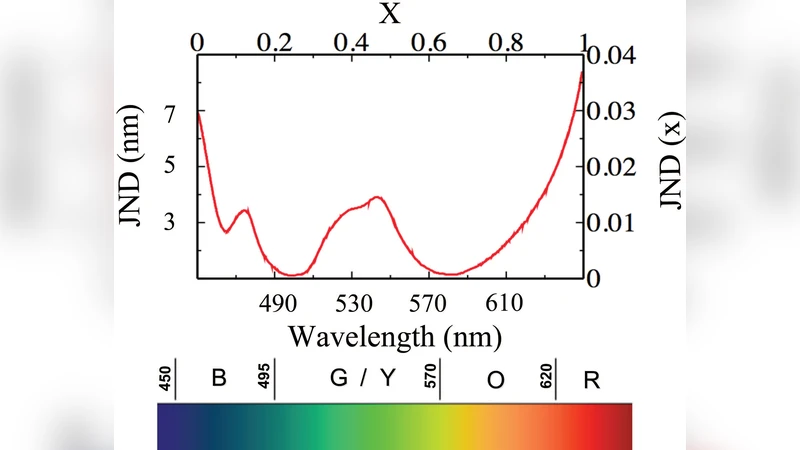
The paper investigates how individual perceptual biases and cultural history jointly shape the emergence of linguistic universals, using colour naming systems as a paradigmatic case. Building on the Category Game—a language‑game model where agents negotiate shared colour categories over a continuous hue channel—the authors embed the human Just Noticeable Difference (JND) function as an individual bias. The JND specifies the minimal discriminable distance between two wavelengths and varies non‑linearly across the spectrum, reflecting known properties of the primate visual system (e.g., the warm‑cold boundary).
In each simulation step, two agents (speaker and hearer) are randomly paired and presented with a set of stimuli that respect the JND constraint. The speaker names a chosen stimulus using its current form‑meaning inventory; the hearer attempts to infer the referent. Success or failure triggers updates to both agents’ inventories, and new colour terms are invented whenever a novel perceptual category is created for discrimination. Initially, the pressure for discrimination causes a rapid proliferation of perceptual categories and a proliferation of synonymous labels. As the game proceeds, labels spread, adjacent categories merge, and a coarser “linguistic category” structure emerges. This coarsening process mirrors physical coarsening dynamics and eventually stabilises with 90‑100 % overlap among agents after roughly 10⁴–10⁶ games per agent.
The authors conduct two main experimental manipulations. First, they compare the standard human JND with a suite of artificial JND functions. Only JNDs belonging to a specific functional class reproduce the statistical regularities observed in the World Colour Survey (WCS): the hierarchical entry order of basic colour terms, the distribution of category boundaries, and the typical number of categories. Arbitrary JND shapes fail to generate these universal patterns, indicating that the human perceptual bias is a necessary condition for the observed universals.
Second, they explore the effect of cultural history by initializing multiple populations with identical JNDs but different random seeds, initial label inventories, and interaction networks. Despite sharing the same bias, each population follows a distinct historical trajectory, leading to variations in the final colour‑naming systems. Some trajectories drift far from the WCS‑derived universal patterns, producing “fat‑tailed” fluctuations in category structure; others converge more tightly to the universal prototype. This demonstrates that historical contingency—early lexical choices, network topology, and stochastic ordering of interactions—acts as a cultural pressure that can either amplify or counteract the bias‑driven pull toward universality.
The paper situates its findings within the broader literature on iterated learning and weak biases. Prior work has shown that weak cognitive biases can be magnified through cultural transmission, while transmission bottlenecks can suppress strong biases. The Category Game complements these studies by providing a concrete, continuous‑space implementation where the interplay of bias and cultural dynamics can be quantitatively measured.
In conclusion, the study argues that linguistic universals are statistical tendencies rather than absolute rules. A weak, shared perceptual bias (the human JND) generates a baseline of universal structure, but the specific cultural history of each speech community introduces population‑specific constraints that can push languages away from or pull them toward that baseline. Thus, the emergence of colour‑naming universals results from a dynamic balance between individual cognition and the historical pathways of cultural evolution.
Comments & Academic Discussion
Loading comments...
Leave a Comment