On the van der Waerden numbers w(2;3,t)
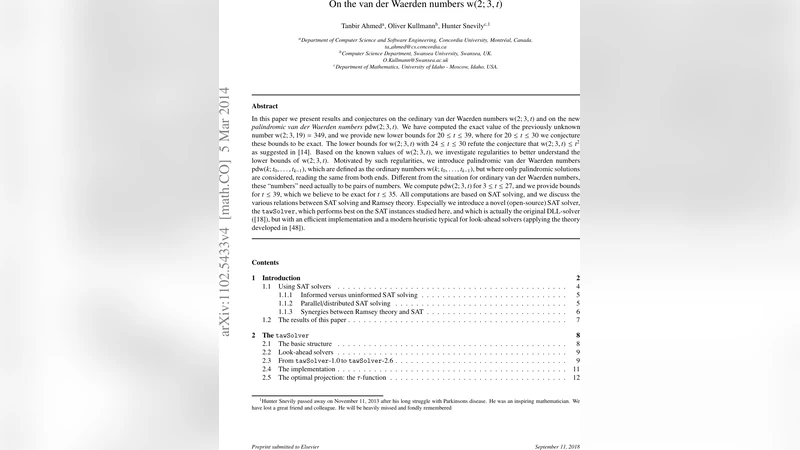
We present results and conjectures on the van der Waerden numbers w(2;3,t) and on the new palindromic van der Waerden numbers pdw(2;3,t). We have computed the new number w(2;3,19) = 349, and we provide lower bounds for 20 <= t <= 39, where for t <= 30 we conjecture these lower bounds to be exact. The lower bounds for 24 <= t <= 30 refute the conjecture that w(2;3,t) <= t^2, and we present an improved conjecture. We also investigate regularities in the good partitions (certificates) to better understand the lower bounds. Motivated by such reglarities, we introduce palindromic van der Waerden numbers pdw(k; t_0,…,t_{k-1}), defined as ordinary van der Waerden numbers w(k; t_0,…,t_{k-1}), however only allowing palindromic solutions (good partitions), defined as reading the same from both ends. Different from the situation for ordinary van der Waerden numbers, these “numbers” need actually to be pairs of numbers. We compute pdw(2;3,t) for 3 <= t <= 27, and we provide lower bounds, which we conjecture to be exact, for t <= 35. All computations are based on SAT solving, and we discuss the various relations between SAT solving and Ramsey theory. Especially we introduce a novel (open-source) SAT solver, the tawSolver, which performs best on the SAT instances studied here, and which is actually the original DLL-solver, but with an efficient implementation and a modern heuristic typical for look-ahead solvers (applying the theory developed in the SAT handbook article of the second author).
💡 Research Summary
The paper investigates the two‑colour van der Waerden numbers w(2;3,t) and introduces a novel variant called palindromic van der Waerden numbers pdw(2;3,t). Using a SAT‑based approach, the authors first compute the previously unknown exact value w(2;3,19)=349, confirming it with a complete proof. They develop a new SAT solver, tawSolver, which is essentially a modernised DLL (Davis‑Logemann‑Loveland) algorithm enriched with look‑ahead heuristics, a τ‑function for variable evaluation, and efficient unit propagation. tawSolver outperforms existing solvers by a factor of 80–100 on the instances considered.
For lower bounds, the authors employ stochastic local‑search solvers from the Ubcsat suite to find satisfying colourings for large n, thereby establishing new lower bounds L(t) for 20 ≤ t ≤ 39. They conjecture that these bounds are exact for t ≤ 30, as they match all known exact values. Notably, the bounds for t = 24…30 exceed the previously conjectured inequality w(2;3,t) ≤ t², disproving that conjecture. An improved universal upper bound of 1.675·t² is proposed, which fits all known data.
The paper then defines palindromic van der Waerden numbers pdw(2;3,t) as a pair (p,q) where p is the largest n admitting a symmetric (palindromic) good partition and q is the smallest n for which no such partition exists. Unlike ordinary numbers, p+1 may be strictly less than q, creating a “palindromic span”. Exact values of (p,q) are computed for t ≤ 27, and conjectured exact values are given up to t = 35. The authors observe alternating satisfiable/unsatisfiable regions for palindromic instances, a phenomenon absent in the ordinary case.
Extensive experiments compare tawSolver, Cube‑and‑Conquer, several CDCL solvers, and local‑search methods on both ordinary and palindromic instances. tawSolver excels on ordinary instances, while Cube‑and‑Conquer is superior for the palindromic cases. The study highlights how SAT solving can be effectively applied to Ramsey‑type combinatorial problems and provides a framework for future work on larger parameters, deeper theoretical analysis of palindromic structures, and further optimisation of SAT algorithms for such combinatorial settings.
Comments & Academic Discussion
Loading comments...
Leave a Comment