A case study in almost-perfect security for unconditionally secure communication
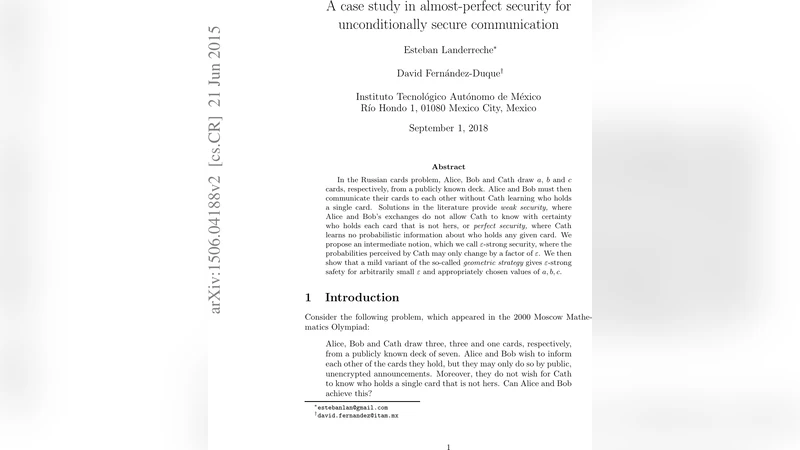
In the Russian cards problem, Alice, Bob and Cath draw $a$, $b$ and $c$ cards, respectively, from a publicly known deck. Alice and Bob must then communicate their cards to each other without Cath learning who holds a single card. Solutions in the literature provide weak security, where Cath does not know with certainty who holds each card that is not hers, or perfect security, where Cath learns no probabilistic information about who holds any given card from Alice and Bob’s exchange. We propose an intermediate notion, which we call $\varepsilon$-strong security, where the probabilities perceived by Cath may only change by a factor of $\varepsilon$. We then show that a mild variant of the so-called geometric strategy gives $\varepsilon$-strong safety for arbitrarily small $\varepsilon$ and appropriately chosen values of $a,b,c$.
💡 Research Summary
The paper addresses the classic Russian cards problem, where three participants—Alice, Bob, and an eavesdropper Cath—draw a, b, and c cards respectively from a publicly known deck. Alice and Bob must publicly announce information that allows them to learn each other’s hands while preventing Cath from learning the ownership of any card she does not hold. Prior work distinguishes two security levels: weak security (Cath cannot be certain about any card’s owner) and perfect security (Cath gains no probabilistic information at all). The authors introduce an intermediate notion called ε‑strong security. Under this definition, after Alice’s announcement the posterior probability that a given card x belongs to Alice, conditioned on Cath’s hand C and the announcement, may differ from the prior probability by at most a multiplicative factor of (1 ± ε). When ε is small, Cath’s knowledge is only minimally altered.
To achieve ε‑strong security, the authors adapt the geometric strategy. They map the deck Ω to the vector space 𝔽_q^d over a finite field 𝔽_q. Alice’s a cards are arranged to form a d‑dimensional affine subspace (typically a line or plane). Alice’s public announcement consists of the set of all possible a‑card hands that lie on some affine subspace of the chosen dimension; each such subspace is equally likely, making the strategy “equitable”. Bob, knowing his own hand B, can eliminate all subspaces intersecting B and uniquely identify Alice’s hand. Cath, holding c cards, discards any subspace intersecting C and is left with a collection of candidate subspaces.
The paper formalizes equitable strategies and shows that for such strategies the posterior probability that Alice’s hand equals a particular a‑set A, given C and the announcement, is 1 divided by the number of candidate a‑sets that avoid C. Moreover, the probability that a specific card x (not in C) belongs to Alice’s hand equals the fraction of candidate a‑sets containing x. Using standard counting results from finite geometry (Gaussian binomial coefficients, numbers of k‑dimensional subspaces, and numbers of subspaces through a point), the authors derive explicit formulas for these fractions.
The central technical result is that by choosing the field size q and the dimensions appropriately, the ratio |A_x \ C| / |A \ C| can be made arbitrarily close to the prior probability a / (a + b). Concretely, for parameters such as a = q, b = q·(q − 1), c = q − 1, the deviation from the prior is on the order of 1/q. Hence ε can be made as small as desired by increasing q. The authors provide a general guideline: for any desired ε > 0, select a finite field with q > 1/ε and appropriate dimensions so that the geometric construction yields ε‑strong security. This works for any admissible values of a, b, c, even when Cath holds many cards, a scenario where perfect security constructions become infeasible.
Compared with earlier perfect‑security constructions that rely on combinatorial designs (e.g., Fano planes, Latin squares, Steiner systems), the geometric approach is considerably simpler: the announcements are just descriptions of affine subspaces, and the required computations are elementary linear algebra over finite fields. The protocol requires only two public announcements (Alice’s subspace description and Bob’s trivial confirmation), making it practical for implementation.
In summary, the paper introduces ε‑strong security as a flexible, quantifiable security notion between weak and perfect security, and demonstrates that a mild variant of the geometric strategy achieves this notion with arbitrarily small ε. The result expands the toolbox for designing unconditionally secure communication protocols, offering both theoretical insight and a practically implementable method for scenarios where perfect security is too restrictive.
Comments & Academic Discussion
Loading comments...
Leave a Comment