Nature of the Effective Interaction Between Dendrimers
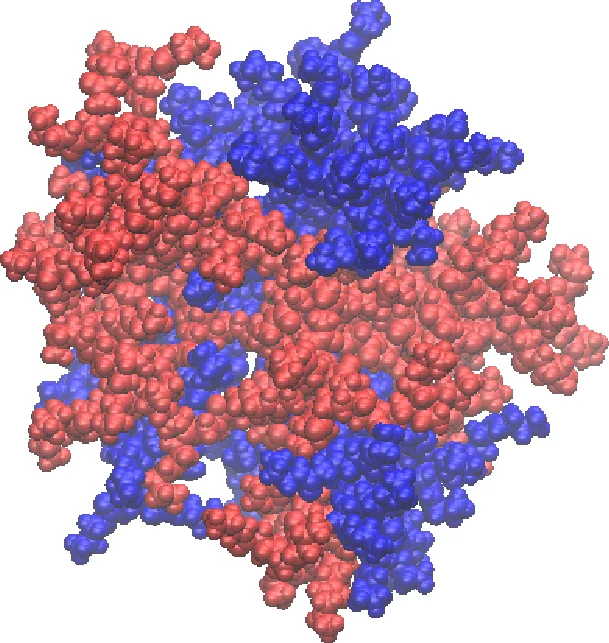
We have performed fully atomistic classical molecular dynamics (MD) simulations to calculate the effective interaction between two polyamidoamine (PAMAM) dendrimers. Using the umbrella sampling (US) technique, we have obtained the potential of mean force (PMF) between the dendrimers and investigated the effects of protonation level and dendrimer size on the PMF. Our results show that the interaction between the dendrimers can be tuned from purely repulsive to partly attractive by changing the protonation level. The PMF profiles are well-fitted by the sum of an exponential and a Gaussian function with the weight of the exponential function dominating over that of the Gaussian function. This observation is in disagreement with the results obtained in previous analytic [Macromolecules 34, 2914 (2001)] and coarse-grained simulation [J. Chem. Phys. 120, 7761 (2004)] studies which predicted the effective interaction to be Gaussian.
💡 Research Summary
The authors performed fully atomistic classical molecular dynamics (MD) simulations combined with umbrella sampling (US) to obtain the potential of mean force (PMF) between two polyamidoamine (PAMAM) dendrimers. Structures of generations 2–4 were built with an in‑house Dendrimer Builder, equilibrated for 20 ns, and then placed in a TIP3P water box with GAFF force‑field parameters. Systems containing 5 × 10⁴ to 1.5 × 10⁵ atoms were simulated using AMBER; after energy minimization and heating to 300 K, US windows (50–70 equally spaced distances) were run for 1–2 ns each, with a harmonic bias on the center‑of‑mass separation. Weighted histogram analysis (WHAM) yielded the PMF as a function of the inter‑dendrimer distance R.
Two protonation states were examined: (i) non‑protonated (high pH, neutral terminal amines) and (ii) fully protonated (low pH, positively charged terminal amines). In the neutral case the PMF displays a shallow attractive well at distances larger than a characteristic value (≈2 nm for G4) and a steep repulsive wall at shorter separations, reflecting van der Waals attraction and steric exclusion. The depth of the attractive well grows with dendrimer generation because larger dendrimers possess more terminal groups that can interact. Energy decomposition shows that the attractive region is dominated by van der Waals contributions, with a smaller hydrogen‑bond component.
In the fully protonated case the PMF is purely repulsive across all distances. The repulsion originates from strong electrostatic interactions between the positively charged dendrimers, partially screened by counter‑ions that accumulate in the inter‑dendrimer region. The dendrimer‑ion interaction energy becomes more favorable as the dendrimers approach, but the overall PMF rises because the electrostatic repulsion outweighs this effect.
To characterize the functional form of the effective interaction, the authors fitted the PMF data with three models: (1) a single Gaussian (the form predicted by early mean‑field theories), (2) a sum of two Gaussians (as used in previous coarse‑grained studies), and (3) a combination of an exponential term and a Gaussian term. The single‑Gaussian fit fails dramatically at short separations, especially for higher generations. The two‑Gaussian model improves the fit at larger separations but still deviates in the strong‑overlap regime. The exponential + Gaussian model reproduces the entire PMF curve with high accuracy for both protonation states. For protonated dendrimers the fit is
V_eff(R) = ε₁ exp(−α₁ R/R_g) + ε₂ exp(−α₂ R²/R_g²)
and for neutral dendrimers
V_eff(R) = ε₁ exp(−α₁ R/R_g) − ε₂ exp
Comments & Academic Discussion
Loading comments...
Leave a Comment