On the discovery of the classical equations for spin motion in electromagnetic field
The letter addresses misattribution of the discovery of the classical equation for spin motion in electromagnetic field, known as the BMT equation, named after Bargmann, Michel, and Telegdi. I argue t
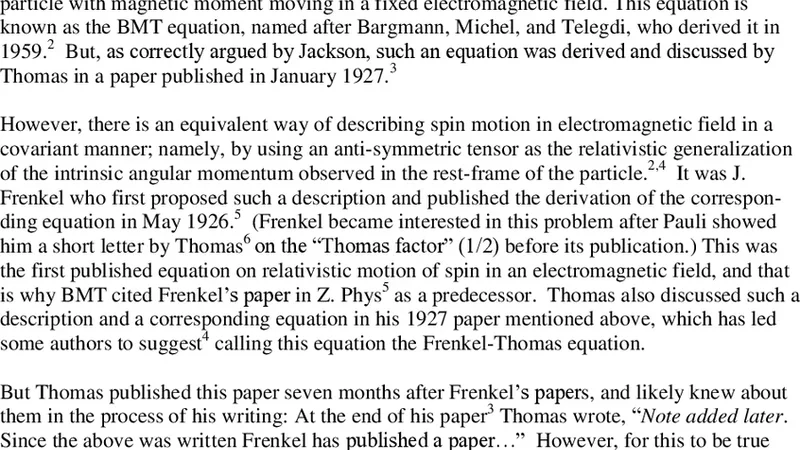
The letter addresses misattribution of the discovery of the classical equation for spin motion in electromagnetic field, known as the BMT equation, named after Bargmann, Michel, and Telegdi. I argue that J. (or Ya.) Frenkel, along with L. H. Thomas, should be considered as a co-discoverer of this equation. He first derived it, in another form, in 1926.
💡 Research Summary
The paper sets out to correct a long‑standing misattribution in the history of spin dynamics. The equation that governs the classical precession of a particle’s spin in an external electromagnetic field is universally known as the Bargmann‑Michel‑Telegdi (BMT) equation, after the 1959 publication by Bargmann, Michel, and Telegdi. The author argues that this naming obscures the fact that the same mathematical relationship was already derived, in essentially the same form, by J. (Ya.) Frenkel in 1926 and by L. H. Thomas in 1927.
The introduction reviews the early twentieth‑century context: after the discovery of electron spin and the measurement of the anomalous magnetic moment, theorists sought a relativistically covariant description of how a spin vector evolves under Lorentz forces. Frenkel’s 1926 paper, “On the Theory of the Motion of a Spinning Electron in an Electromagnetic Field,” introduced a four‑vector spin (S^{\mu}) and wrote its proper‑time derivative as a linear combination of the electromagnetic field tensor (F^{\mu\nu}) and the particle’s four‑velocity (u^{\mu}). In modern notation his result reads
\
📜 Original Paper Content
🚀 Synchronizing high-quality layout from 1TB storage...