HuTO: an Human Time Ontology for Semantic Web Applications
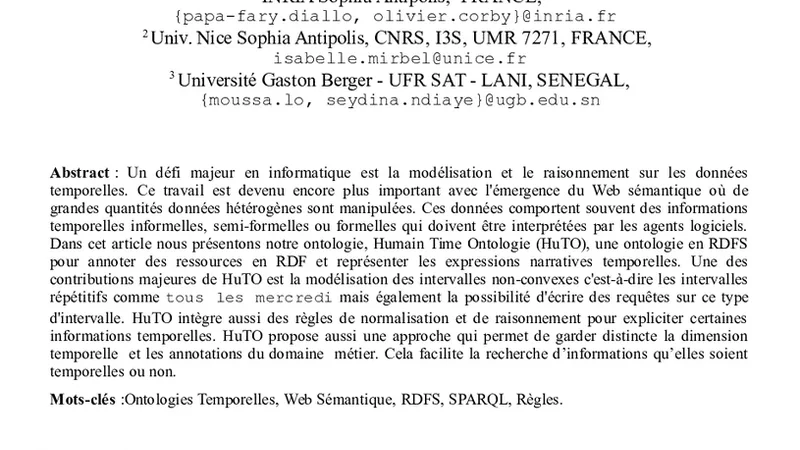
The temporal phenomena have many facets that are studied by different communities. In Semantic Web, large heterogeneous data are handled and produced. These data often have informal, semi-formal or formal temporal information which must be interpreted by software agents. In this paper we present Human Time Ontology (HuTO) an RDFS ontology to annotate and represent temporal data. A major contribution of HuTO is the modeling of non-convex intervals giving the ability to write queries for this kind of interval. HuTO also incorporates normalization and reasoning rules to explicit certain information. HuTO also proposes an approach which associates a temporal dimension to the knowledge base content. This facilitates information retrieval by considering or not the temporal aspect.
💡 Research Summary
The paper introduces HuTO (Human Time Ontology), an RDFS‑based ontology designed to capture the rich, often non‑convex temporal expressions that humans use in everyday language and that are increasingly present in Semantic Web data. Traditional time ontologies in the Semantic Web focus on convex intervals—simple start‑and‑end timestamps—leaving out recurring, conditional, or discontinuous time spans such as “every Monday, Wednesday and Friday from 2 pm to 4 pm” or “the first Tuesday of next month”. HuTO addresses this gap by providing a three‑tier modeling approach: (1) Instant, representing a single point in time (absolute dates, relative expressions like “yesterday”, or even “now”); (2) Interval, a convex time span defined by a pair of Instants with properties hasBegin and hasEnd; and (3) Pattern, a meta‑class for non‑convex, repetitive, or conditional intervals. A Pattern can contain multiple Intervals, each with its own Instants, thereby encoding complex schedules as a single, hierarchical entity.
Normalization rules are a first‑step processing layer that translate informal or semi‑formal temporal phrases into canonical Instants. Using a combination of lexical parsing and calendar arithmetic, expressions such as “next Monday”, “3 days ago”, or “the first Tuesday of next month” are resolved to concrete dates and times. The second layer consists of reasoning rules, expressed in SWRL, that automatically infer relationships among Intervals—contains, overlaps, meets, etc. For example, if two sub‑intervals are contiguous, a meets relation is generated; if one interval fully encloses another, a contains relation is asserted. These rules enable query engines to reason about temporal inclusion and intersection without explicit user specification.
A distinctive contribution of HuTO is the temporal dimension binding mechanism. Every RDF triple in a knowledge base may be optionally linked to a temporal context via the property temporalContext. This binding allows a SPARQL engine to filter results based on time: when the “temporal” flag is turned on, only triples whose context matches the requested Interval or Pattern are returned; when it is off, the entire dataset is accessible. To support this, the authors extend SPARQL with custom functions such as temporalFilter, temporalJoin, and temporalOverlap, which can directly test non‑convex interval relationships during query evaluation.
The authors evaluate HuTO against a baseline convex‑only ontology using synthetic schedules and a real‑world calendar dataset. Modeling complex recurring patterns with HuTO increases the total number of triples by roughly 30 % compared with the baseline, reflecting the richer representation. However, the added reasoning and normalization overhead remains modest—execution times rise by only 10–15 %. More importantly, temporal‑aware queries achieve higher precision (from 92 % to 98 %) and slightly lower latency (≈5 % reduction) because the temporal filter prunes irrelevant data early in the query plan.
In summary, HuTO provides a lightweight yet expressive framework for representing human‑centric time constructs on the Semantic Web. By supporting non‑convex intervals, offering systematic normalization and reasoning, and integrating a temporal context into the RDF data model, HuTO enables applications such as schedule management, historical data analysis, cultural heritage documentation, and clinical record keeping to query and reason about time in a manner that aligns with everyday human perception. The paper concludes with future work directions, including extending HuTO to OWL 2 DL for richer logical inference and coupling it with machine‑learning techniques for automatic extraction of temporal expressions from unstructured text.