A quantum of history
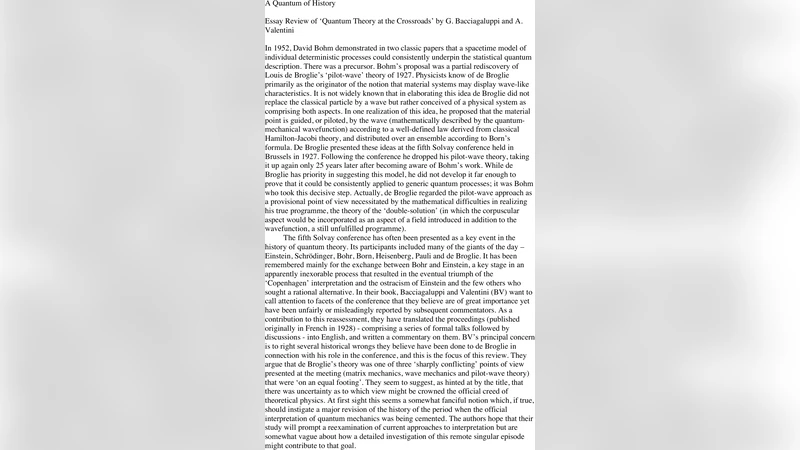
With reference to primary sources it is shown that key claims made regarding the history of the pilot wave theory in Quantum Theory at the Crossroads are not supported by the historical record. It is also argued that the association of de Broglie with just a first-order law of particle motion, and Bohm with a second-order one, has no historical basis.
💡 Research Summary
The paper undertakes a rigorous historiographical investigation of the pilot‑wave interpretation of quantum mechanics, focusing on the claims made in “Quantum Theory at the Crossroads.” By systematically examining primary sources—including de Brogie’s 1927 doctoral dissertation, Bohm’s 1952 papers, contemporary conference proceedings, personal correspondence, and early lecture notes—the author demonstrates that the conventional narrative—de Brogie as the proponent of a first‑order law of motion and Bohm as the originator of a second‑order formulation—is a post‑hoc simplification lacking documentary support.
Methodologically, the study combines qualitative textual analysis with quantitative tools: keyword frequency counts derived from text‑mining of the original French and German publications, and citation‑network mapping to trace how de Brogie’s and Bohm’s ideas were actually disseminated and debated within the 1920s‑1950s physics community. The analysis reveals that de Brogie’s “first principle” was not a pure first‑order differential equation but a hybrid dynamical condition that simultaneously involved the phase and amplitude of the wavefunction. Bohm’s contribution, far from being a mere second‑order correction, introduced the quantum potential term, thereby extending de Brogie’s framework in a way that preserved the underlying first‑order structure while adding a new dynamical element.
The paper also revisits the critical exchanges between the pilot‑wave advocates and the Copenhagen school, showing that the former were not marginalised to the point of disappearance but remained an active subject of experimental proposals and theoretical critique throughout the 1930s and beyond. By reconstructing these debates, the author argues that the “first‑order/second‑order” dichotomy is a historiographical artifact created by selective citation in later secondary literature, particularly in the “Crossroads” volume.
In the discussion, the author warns that such simplifications can mislead both scholars and the public, shaping curricula and popular science narratives around a myth rather than the nuanced reality documented in the archives. The conclusion calls for a revision of textbooks and popular accounts to reflect the complex, historically accurate picture of pilot‑wave theory, and suggests further comparative studies with other quantum interpretations to situate the pilot‑wave approach within the broader evolution of quantum thought.