Mantid - Data Analysis and Visualization Package for Neutron Scattering and $mu SR$ Experiments
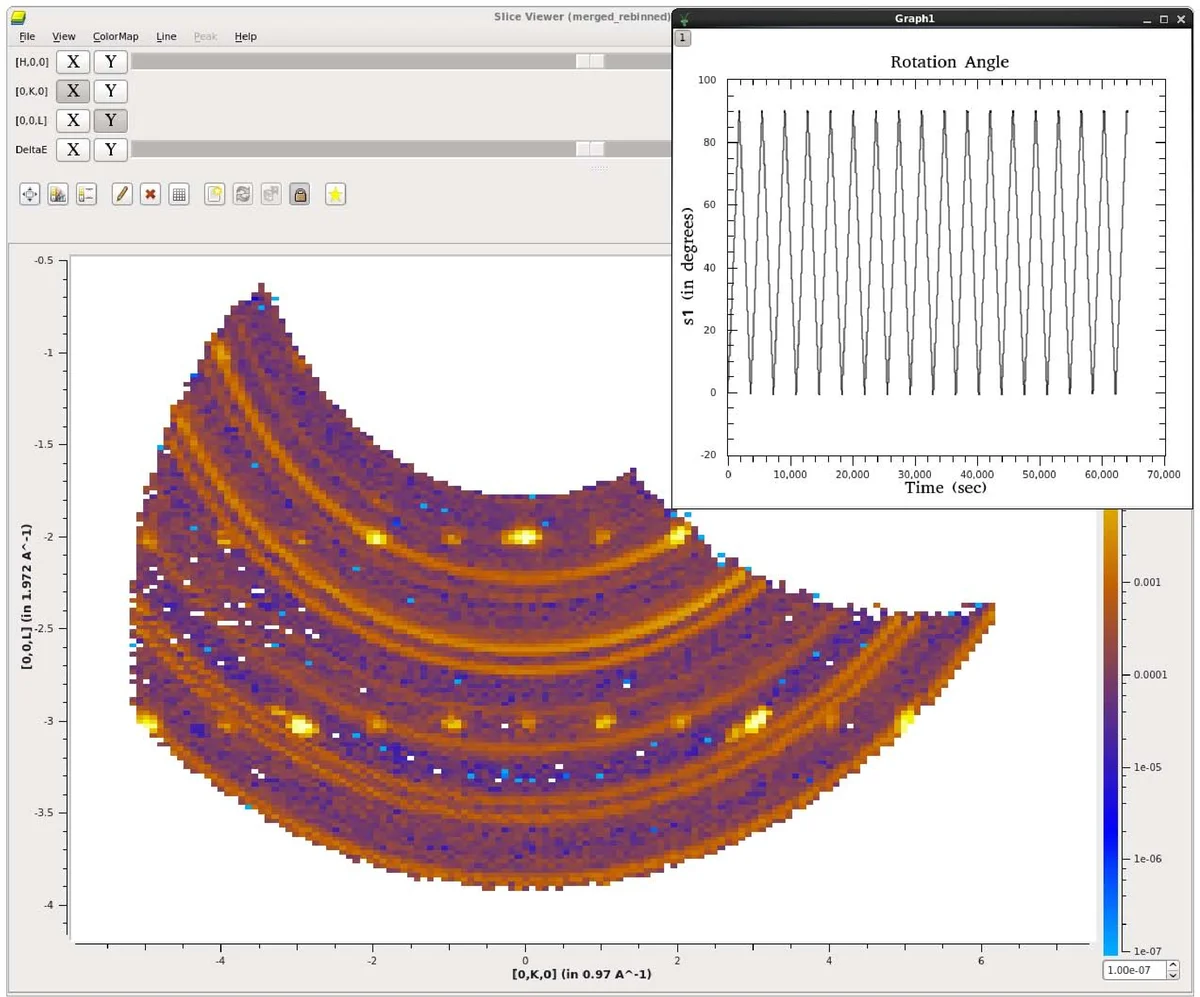
The Mantid framework is a software solution developed for the analysis and visualization of neutron scattering and muon spin measurements. The framework is jointly developed by software engineers and scientists at the ISIS Neutron and Muon Facility and the Oak Ridge National Laboratory. The objectives, functionality and novel design aspects of Mantid are described.
💡 Research Summary
The paper presents Mantid, an open‑source data‑analysis and visualization framework jointly developed by the ISIS Neutron and Muon Facility and Oak Ridge National Laboratory, aimed at streamlining the reduction, analysis, and visualisation of neutron scattering and muon spin rotation/relaxation/resonance (µSR) experiments. Mantid’s primary objectives are to provide a technique‑independent, cross‑platform (Linux, macOS, Windows) environment that integrates data handling from raw instrument output to final scientific interpretation, to ensure software quality through professional development practices, and to make the code freely distributable and extensible by both instrument scientists and end‑users.
The architecture is built around a clear separation of data and algorithms. Data are encapsulated in “workspaces”, which come in several specialised forms: Matrix workspaces store traditional histogram data; Event workspaces retain each detected neutron or muon event together with time‑of‑flight and metadata, enabling efficient sparse‑data handling, real‑time filtering, and asynchronous parameter scans; Multi‑Dimensional (MD) workspaces support up to nine dimensions for complex parameter dependencies; Table workspaces hold generic columnar data. Each workspace records its algorithmic history, allowing full provenance tracking and reproducibility.
Algorithms constitute the second major layer. Over 500 pre‑implemented algorithms cover generic operations (loading, saving, arithmetic, unit conversion) and technique‑specific processing (powder diffraction, single‑crystal diffraction, SANS, reflectometry, inelastic spectroscopy, µSR analysis). Users can write additional algorithms in C++ or Python, which are automatically exposed through the Python scripting interface, the command‑line, or the graphical user interface. This plug‑in model encourages community contributions while preserving a unified API.
Instrument geometry is described by XML‑based Instrument Definition Files (IDF), providing a complete constructive‑solid‑geometry model of detectors, moving components, and coordinate systems. The IDF schema is validated automatically, and the geometry can be visualised or used in Monte‑Carlo simulations.
Mantid reads a wide variety of data sources, primarily NeXus files but also legacy ISIS RAW files and generic ASCII formats. It can also connect directly to instrument data streams for live monitoring and on‑the‑fly processing.
From a software‑engineering perspective, Mantid follows modern collaborative practices: Git for distributed version control, issue tracking for feature requests and bug reports, a branch‑based workflow (feature → develop → master), and continuous integration (CI) that builds on all supported platforms and runs more than 6 000 unit tests plus 150 system tests daily. Successful builds are automatically published, and formal releases occur roughly every three months with extensive release notes and training material.
Performance is achieved through a C++ core with Python bindings, and parallelism is provided via OpenMP, POSIX threads, and MPI, allowing efficient processing of data sets ranging from gigabytes to terabytes, including event‑mode and high‑dimensional MD data. Visualization integrates with ParaView, enabling 3D instrument rendering, adaptive mesh plotting, and interactive exploration of large data volumes.
In summary, Mantid delivers a comprehensive, high‑performance, and extensible platform that abstracts the complexities of modern neutron and µSR experiments. By unifying data reduction, analysis, and visualization under a single, well‑maintained framework, it reduces the time researchers spend on routine data handling, improves reproducibility, and facilitates scientific discovery across a broad user community.
Comments & Academic Discussion
Loading comments...
Leave a Comment