Ponderomotive forces on waves in modulated media
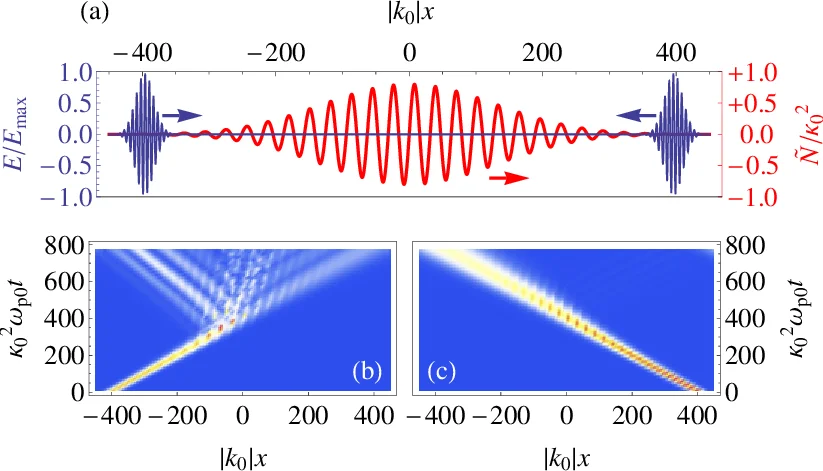
Nonlinear interactions of waves via instantaneous cross-phase modulation can be cast in the same way as ponderomotive wave-particle interactions in high-frequency electromagnetic field. The ponderomotive effect arises when rays of a probe wave scatter off perturbations of the underlying medium produced by a second, modulation wave, much like charged particles scatter off a quasiperiodic field. Parallels with the point-particle dynamics, which itself is generalized by this theory, lead to new methods of wave manipulation, including asymmetric barriers for light.
💡 Research Summary
The paper develops a unified theory describing how waves experience a ponderomotive‑type force when the parameters of the underlying medium are modulated in space and/or time. Starting from a scalar wave field characterized by a phase θ(t, x) and an action density I(t, x), the authors write a Lagrangian density L = −I ∂ₜθ + ω(t, x, ∇θ) I. Variation yields the Whitham equations (∂ₜθ + ω = 0, ∂ₜI + ∇·(I v_g) = 0) together with the consistency relations ∂ₜk + ∇ω = 0, ∇×k = 0, where k = ∇θ and v_g = ∂_k ω.
The dispersion relation ω is split into a slowly varying part \bar{ω} and a small, rapidly oscillating perturbation \tilde{ω}. The perturbation is associated with a modulation wave (MW) of frequency Ω = −∂ₜΘ and wavevector K = ∇Θ, where Θ(t, x) is the fast phase of the MW. Assuming Θ varies much faster than the slow background but still slowly enough for the geometric‑optics (GO) approximation to hold, the authors average over the fast oscillations. This yields an effective Lagrangian L̄ = −\bar{I} ∂ₜ\bar{θ} + w(t, x, \bar{k}) \bar{I}, where the “ponderomotive Hamiltonian” w is
w = \bar{ω} + \frac{K·∂_{\bar{k}}| \tilde{ω}_c |^2}{Ω − K·\bar{v}_g}.
Crucially, w depends only on the unperturbed linear dispersion ω and on the MW parameters; the detailed nonlinear dynamics of the medium do not enter. The resulting ray equations (the “oscillation‑center” equations) are
\dot{\bar{x}} = ∂{\bar{k}} w, \dot{\bar{k}} = −∂{\bar{x}} w,
which describe the averaged motion of wave packets under the ponderomotive force.
The theory predicts a strong enhancement of the effect when the modulation frequency satisfies the group‑velocity resonance (GVR) condition Ω ≈ K·\bar{v}_g. Near GVR the denominator in w becomes small, leading to large shifts in the effective frequency and group velocity. This mechanism works for any wave type—acoustic, electromagnetic, plasma, etc.—and is independent of the specific nonlinear response of the medium.
Two concrete examples illustrate the formalism. For an acoustic wave with sound speed C(t, x) = C₀ + Re
Comments & Academic Discussion
Loading comments...
Leave a Comment