Site-Percolation Threshold of Carbon Nanotube Fibers: Fast Inspection of Percolation with Markov Stochastic Theory
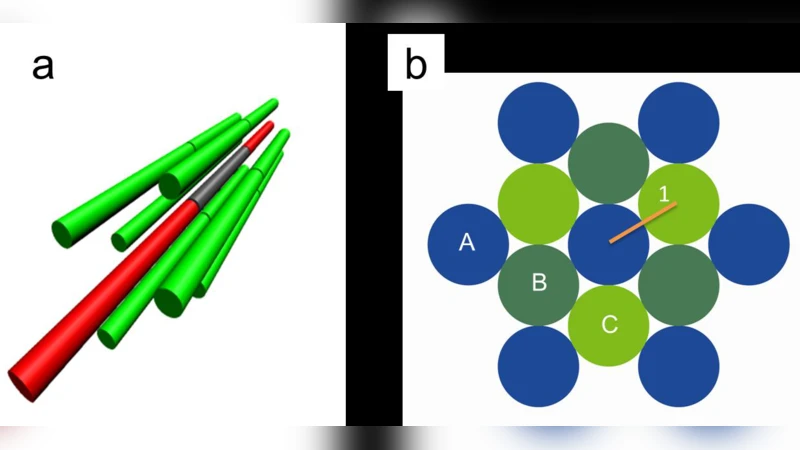
We present a site-percolation model based on a modified FCC lattice, as well as an efficient algorithm of inspecting percolation which takes advantage of the Markov stochastic theory, in order to study the percolation threshold of carbon nanotube (CNT) fibers. Our Markov-chain based algorithm carries out the inspection of percolation by performing repeated sparse matrix-vector multiplications, which allows parallelized computation to accelerate the inspection for a given configuration. With this approach, we determine that the site-percolation transition of CNT fibers occurs at p_c =0.1533+-0.0013, and analyze the dependence of the effective percolation threshold (corresponding to 0.5 percolation probability) on the length and the aspect ratio of a CNT fiber on a finite-size-scaling basis. We also discuss the aspect ratio dependence of percolation probability with various values of p (not restricted to p_c).
💡 Research Summary
The paper introduces a novel site‑percolation framework tailored to carbon‑nanotube (CNT) fibers and couples it with an efficient percolation‑inspection algorithm grounded in Markov stochastic theory. Recognizing that conventional lattice models (e.g., simple cubic) inadequately capture the irregular, highly connected geometry of real CNT bundles, the authors adopt a modified face‑centered cubic (FCC) lattice. In this lattice each node can have up to twelve nearest neighbours, allowing a more realistic representation of the multi‑tube contacts observed in actual fibers. Sites are independently occupied with probability p, which corresponds to the fraction of nanotubes that contribute to an electrically or thermally conductive path.
To determine whether a given random configuration percolates, the authors abandon depth‑first or breadth‑first search, which become computationally prohibitive for large systems. Instead they construct the sparse transition matrix T of the underlying Markov chain, where each non‑zero entry encodes the probability of moving from one occupied site to a neighbouring occupied site. Starting from a source vector v₀ that represents the entry face of the fiber, they iteratively compute v_{k+1}=T v_k. After each multiplication the probability that the walk has reached any site on the opposite face is examined; once this probability exceeds a preset threshold (0.5 in the study) the configuration is declared percolating. Because the operation is a sparse matrix‑vector product, it can be accelerated with standard high‑performance linear‑algebra libraries and parallelised across GPUs or multi‑core CPUs. Benchmarks reported in the manuscript show speed‑ups of an order of magnitude or more compared with traditional graph‑search methods, enabling the authors to evaluate tens of thousands of configurations for each set of parameters.
Using this machinery the authors perform extensive finite‑size scaling simulations. They generate fibers of varying length L (from 10 to 200 lattice units) and aspect ratio AR (ratio of length to cross‑sectional width, ranging from 1 to 10). For each (L, AR) pair, the percolation probability P(p; L, AR) is measured over 10⁴ independent realizations for p values spanning 0.05–0.30 in increments of 0.001. By collapsing the data onto a universal scaling function f
Comments & Academic Discussion
Loading comments...
Leave a Comment