Endemic infections are always possible on regular networks
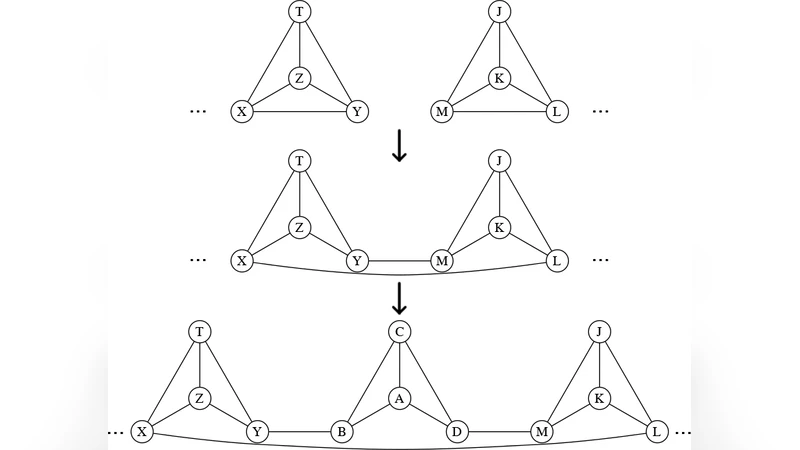
We study the dependence of the largest component in regular networks on the clustering coefficient, showing that its size changes smoothly without undergoing a phase transition. We explain this behaviour via an analytical approach based on the network structure, and provide an exact equation describing the numerical results. Our work indicates that intrinsic structural properties always allow the spread of epidemics on regular networks.
💡 Research Summary
The paper investigates how the size of the largest connected component (often called the giant component) in regular networks depends on the clustering coefficient, and it challenges the prevailing belief that a phase transition occurs at a critical clustering value. Regular networks are graphs in which every node has the same degree k. The authors begin by noting that many epidemiological models use such networks to represent populations with uniform contact patterns, and that clustering—measured as the fraction of closed triplets among all possible triplets—has been identified as a key structural factor influencing disease spread. Earlier work based on moment‑closure approximations predicted a critical clustering c* = (k − 2)/(k − 1): for c < c* the giant component would scale linearly with the total number of nodes N, while for c ≥ c* it would grow sub‑linearly, implying that highly clustered regular graphs could fragment and thus prevent endemic infections.
To test this hypothesis, the authors generate ensembles of regular graphs for several degrees (k = 3, 4, 5, 8) using the exact construction algorithm described in Del Genio et al. (2010), which samples uniformly from all k‑regular graphs with a prescribed clustering coefficient. For each generated graph they compute the relative size s = S/N, where S is the number of nodes in the largest component. The numerical results, displayed in Figure 1, show a smooth, monotonic decline of s as c increases from 0 to 1, with no sign of a discontinuous jump or critical scaling. The standard deviations are small, confirming that the observed behaviour is not a finite‑size artifact.
To explain why a giant component persists for any non‑zero clustering, the authors construct an analytical argument. They start from the extreme case c = 1, which corresponds to a disjoint union of (k + 1)‑cliques. For c = 1 − ε with ε ≪ 1 they consider a rewiring process: pick two cliques, delete one internal edge in each, and reconnect the four involved vertices across the cliques, thereby creating two “external” links. This operation reduces the clustering by an amount proportional to ε while adding external links that can bridge different cliques. Using the Molloy‑Reed criterion Σ = ∑σ² − 2σ > 0, where σ is the number of external links of a local neighbourhood, they show that Σ = O(ε²) > 0 for any ε > 0, guaranteeing the existence of a giant component regardless of how small ε is. Hence, the network never truly fragments.
The authors then derive explicit formulas for s(c) in the two asymptotic regimes. At low clustering (c small) most nodes belong to isolated cliques, and the fraction of nodes outside the giant component is proportional to the number of cliques, giving
s ≈ 1 − c · k(k − 1)/2 (Equation 1).
At high clustering (c close to 1) cliques are progressively merged by the rewiring process; each added clique contributes (k + 1) nodes to the giant component, leading to
s ≈ 1 − c · k(k + 1)/6 (Equation 7).
To interpolate between these limits they model each node’s neighbourhood as a k‑star (a hub with k leaves). A neighbourhood is considered “highly clustered” if every leaf participates in at least one triangle formed solely among leaves. The minimal number of internal leaf‑leaf links required for this is M = (k − 1)(k − 2)/2 + 1. Assuming each possible leaf‑leaf link exists independently with probability c, the probability that a neighbourhood fails to be highly clustered is
W(k,c) = ∑_{x=0}^{M} Binom( k(k − 1)/2, x ) c^{x}(1 − c)^{k(k − 1)/2 − x} = 1 − I_c( (k − 1)(k − 2)/2 + 2, k − 2 ),
where I_c is the regularized incomplete beta function. The final expression for the giant‑component size, weighted by the probabilities of being in the low‑c or high‑c regime, is
s(c) = 1 − c · k(k + 1)/6 + W(k,c)
Comments & Academic Discussion
Loading comments...
Leave a Comment