FEAST Eigenvalue Solver v3.0 User Guide
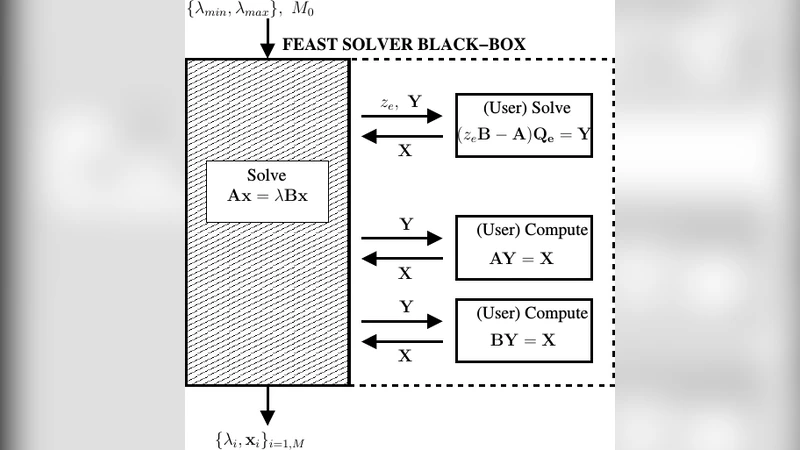
The FEAST eigensolver package is a free high-performance numerical library for solving the Hermitian and non-Hermitian eigenvalue problems, and obtaining all the eigenvalues and (right/left) eigenvectors within a given search interval or arbitrary contour in the complex plane. Its originality lies with a new transformative numerical approach to the traditional eigenvalue algorithm design - the FEAST algorithm. The FEAST eigensolver combines simplicity and efficiency and it offers many important capabilities for achieving high performance, robustness, accuracy, and scalability on parallel architectures. FEAST is both a comprehensive library package, and an easy to use software. It includes flexible reverse communication interfaces and ready to use predefined interfaces for dense, banded and sparse systems. The current version v3.0 of the FEAST package can address both Hermitian and non-Hermitian eigenvalue problems (real symmetric, real non-symmetric, complex Hermitian, complex symmetric, or complex general systems) on both shared-memory and distributed memory architectures (i.e contains both FEAST-SMP and FEAST-MPI packages). This User’s guide provides instructions for installation setup, a detailed description of the FEAST interfaces and a large number of examples.
💡 Research Summary
The FEAST Eigenvalue Solver version 3.0 is a high‑performance numerical library designed to compute all eigenvalues and the corresponding right and left eigenvectors that lie inside a user‑specified spectral interval (for Hermitian problems) or an arbitrary contour in the complex plane (for non‑Hermitian problems). Its core innovation is the contour‑integral based subspace projection technique, which replaces traditional iterative schemes such as Lanczos or Arnoldi. The user defines a contour (real‑axis interval or a closed curve) and selects a set of Gaussian‑Legendre nodes and weights. For each node the algorithm solves a shifted linear system of the form (A‑z B) x = b. The collection of solutions builds a subspace that directly approximates the invariant subspace associated with the eigenvalues inside the contour. A small dense generalized eigenproblem is then solved, yielding the desired eigenpairs with high accuracy.
FEAST supports both Hermitian (real symmetric, complex Hermitian) and non‑Hermitian (real non‑symmetric, complex general) problems, covering real and complex data types. It provides three families of interfaces: dense, banded, and sparse. The library is available in two parallel execution models. FEAST‑SMP uses OpenMP to parallelise over contour nodes on shared‑memory machines, while FEAST‑MPI distributes the contour points across MPI ranks, enabling near‑linear scaling on clusters and supercomputers. A hybrid OpenMP+MPI mode is also supported for modern heterogeneous architectures.
A distinctive feature is the Reverse Communication Interface (RCI). Rather than embedding a specific linear solver, FEAST asks the user to solve each shifted system with any preferred method—direct factorisation, preconditioned Krylov subspace solvers, or external packages such as PETSc or Trilinos. This design gives maximum flexibility, allows reuse of existing high‑performance solvers, and simplifies integration with application codes.
Accuracy is controlled by the number of integration nodes (typically 8–16) and the tolerance on the subspace residual. With modest node counts FEAST routinely achieves relative errors below 10⁻¹². Convergence is monitored through both residual norms and eigenvalue changes, preventing unnecessary iterations.
The user guide details installation via CMake, automatic detection of MPI, BLAS/LAPACK (Intel MKL, OpenBLAS, etc.), and optional Python bindings via pybind11. Language bindings for C, Fortran, MATLAB, and Python are provided, each accompanied by extensive example programs that illustrate dense, banded, and sparse use cases.
Benchmark results included in the guide show that FEAST outperforms traditional solvers (LAPACK’s dsyevd, ARPACK’s eigs) by factors of 2–10 on problems of moderate size, and delivers near‑linear speed‑up on thousands of cores for large sparse matrices (dimension ≥ 10⁶). The guide also discusses practical parameter selection, troubleshooting tips, and a FAQ section.
In summary, FEAST v3.0 offers a robust, scalable, and easy‑to‑use solution for eigenvalue problems across a wide range of scientific and engineering applications. Its contour‑integral algorithm, flexible RCI design, and comprehensive parallel implementations make it suitable for both research prototyping and production‑level large‑scale simulations.