An agent based multi-optional model for the diffusion of innovations
We propose a model for the diffusion of several products competing in a common market based on the generalization of the Ising model of statiscal mechanics (Potts model). Using an agent based implementation, we analyze two problems: (i) a three optio…
Authors: Carlos E. Laciana, Nicolas Oteiza Aguirre
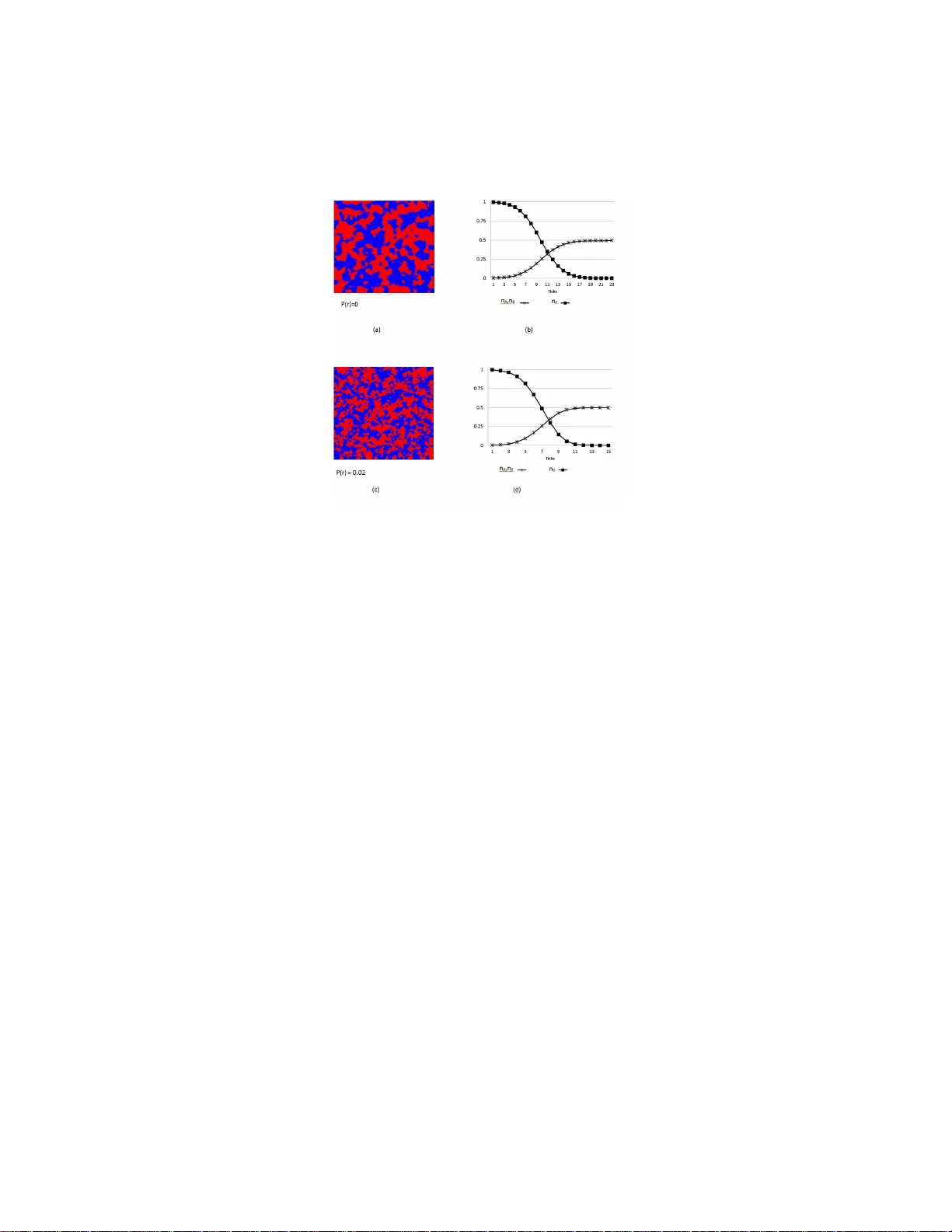
An agen t based m ulti-optiona l m o del for the diffusion of inno v ations Carlos E. Laciana and Nicol´ as Oteiza-Aguirre Grup o de Aplicaciones de Modelos de Agen tes (GAMA), F acultad de Ingenier ´ ıa, Univ ersidad de Buenos Aires, Av enida Las Heras 2214 Ciudad Aut´ onoma de Buenos Aires, C1127AAR, Argen tina. clacian@fi.uba.ar Keywor ds: Pro duct competitio n; Decision under uncertain ty ; P otts mo del; Heterogeneous p opulation; Inno v ation diffusion Abstract W e prop ose a mod el for the diffu sion of several pro ducts competing in a common market based on the generalization of th e Ising mo del of statistical mec han ics (Po tts mo del). Using an agen t based implemen tation w e analyze t wo problems: (i) a t h ree options case, i.e. to adop t a p roduct A, a prod uct B, or non-adoption and (ii) a four option case, i.e. the adoption of p ro duct A, pro duct B, b oth, or n one. In the first case we analyze a launching strategy for one of the tw o p roducts, whic h delays its launching with the ob jective of competing with imp roveme nts. Marke t shares reac hed by eac h pro duct are then estimated at market saturation. Finally , simulatio ns are carried out with va rying d egrees of so cial netw ork top olo gy , uncertaint y , and p opulation homogeneity . 1 In tro duction The pro cess of diffusion of inno v ations ha s motiv ated ample academic interest in the decade of the sixties, extending until to da y . A pio neer work has bee n the o ne developed by Bass [1 ]. Originally , this mo del was fitted, with enough precision, to the observ ationa l data of adoption rates corres p onding to many consumer dura ble goo ds, obtaining the cum ulative S-curves for the num b er of adopters, in w hich fast growth is generated by word of mouth b et ween ea rly and late adopter s [2]. La ter, the Bass mo del was extended in its use to other pro ducts, for example those r elated to the telecommunications se c tor [3]. Many of the innov ation diffusion mo de ls were inspired by models initially develope d 1 for application in different disciplines. The Bas s mo del w as not the exception; in that case the a nalogy was made with epidemic models [4 ]. The Bass mo del per forms a n ag g regate description of the b ehavior of p oten- tial decision makers in relation with the adoption or not o f an innov ation (or techn o logy). In this formulation the set of decider s is assumed to b e ho moge- neous and tota lly connected, or equiv alently , we suppo se that each individual is influenced by all re ma ining decis ion makers. The ba s ic a s sumption of the mo del is that at ea c h p oin t in time, p otential buyers ar e exp osed to tw o kinds o f influ- ences: an external influence, in the shap e of advertising campaig ns car r ied o ut by the compa nie s via the mass media; and an internal influence coming from ”word-of-mouth” interactions with adopters [5]. The Ba ss mo del ha s the general adv antage of its s imple application, consti- tuting a descr iption on a macro level that shows the obser ved global behavior [6]. How ever, the lack of detail at a microsco pic level turns it int o a w ea k pre- diction instrumen t, restricting its application to analo gies with similar known pro ducts [3]. On the o ther hand, the study of diffusion mo dels at micro level has rec e n tly int ensified, with s pecial fo cusing o n agent bas ed models (ABMs), a s is shown, for ex ample, in the r eview pap er by [7]. In general, ABMs inv olve tw o co m- plement ar y causes for innov ation a doption: a ) the individual ev aluatio n of the adv an tag es rela ted to the adoption of the new pro duct (or technology) and b) the imitation of behavior of close co ntacts which are co nsidered as e x amples to follow b y the decision maker. ABMs hav e the adv an tag e , compar ed to macro mo dels, that the intro duction of the so cial net works is p ossible. Those so cial net works are the routes for in teractio n b etw een the elemen ts of the system [8]. In the c a se of the diffusion of only one new pro duct in a po ten tial market, individuals in ABMs must choose b etw een tw o alternatives: to adopt or not to adopt. It was found that the soc ia l system describ ed befor e, can be obtaine d by using the analogy with the well-kno wn Ising statistic mo del [9], which w a s originally developed in the field of physics to describ e the phase transition in ferromag netic materials [10]. In the physical mo del the agents represe nt spins in a regular lattice. Those spins can b e in tw o p ositions: one in the direction of an external field and the other in the opp osite direction. In that mo del, each agent (ion in the metallic lattice) can b e influenced by its neighbors, which g enerate a lo cal field that induce the orientation of the spin. There a re examples in scientific literature in which the Ising mo del is adapted to mo deling the so cial pro cess of opinion forma tion [11] [12] a nd o ther s in whic h the diffusio n of tec hnology is studied [1 3]. In the Ising mo del, the interaction is limited to the nearest neighbo rs in a regular array . Ho wever, a so cial pr o cess of communication not necessa rily cor- resp onds to an in ter action with the geogr aphic proximity , so it is necess a ry to mo dify the for malism in or der to include ir r egular netw orks where the notion o f nearness is diffuse. Suc h is the ca se of the family of netw or k s k nown as ” small world net works” (SWN) descr ibed by W a tts and Stro gatz [14]. The different net works in the family o f SWN are o btained by the v ariation o f only one pa r am- eter called r ewiring probability . The idea is to reco nnect the agents, starting 2 from a r egular netw ork with a probability which is the para meter men tioned befo re. A rewiring pr obabilit y of ze r o corr esponds to a regula r netw ork, and a probability of one to a to ta lly random netw or k. F or v alues of pro babilit y in the interv a l [0.003, 0.0 2], the SWN for a tw o dimensio nal netw or k, ar e o bta ined [15]. SWN hav e b een strongly studied in the scientific litera ture, observ ing that they have s uitable prop erties for applica tions in the so cial co mm unications and other natur a l pheno mena [1 6]. A t this point w e hav e an Ising-like mo del equipped with a SWN which lets us study the technology diffusion pro cess cor r esponding to only one pr oduct, as was applied in the previous work [13]. How ever the g e neralization o f this mo del to more products, whose physical ana logy is the Potts mo del, ha s b een used in few cases o f the so cial field [17]. The idea of the pr esen t work is the ex plo ration of the p ossibilities of the P otts-like formulation for the ana lysis of the diffusion pro cess asso ciated to the launching o f ”M” pro ducts in a common ma rk et. The case in which t wo brands compete for a unique market, is analyzed in ref. [18] , by using an agent-based casca de mo del. F o llo wing refs. [1 9] [20], w e can iden tify t wo may or categories o f agent-based diffusion mo dels: a)thres hold mo dels, in which a gen ts adopt when a sp ecified minim um num b er o f neighbo r s hav e ado pted, and b) ca scade mo dels, where the proba bilit y of a doption in- creases with the num ber o f adopters in the neig h b orho od, with an exp onential mathematical dep endency . One contribution of our prop osal, considering the tw o categor ies giv en b efore, is tha t this formalis m could b e thought of a s a threshold mo del, but applicable to “M” o ptions, and particular ly applied in this pa per to systems of three and four options. In the alg o rithm we prop ose, adapted from statistical mechanics applications, a gen ts hav e an implicit threshold that r elates to the p erceived ef- fective utility o f each of the p otential choices. This thresho ld is a function of the differences of utility o f the av ailable options, a s is shown in ref. [13] . Moreov er , this mo del can also gener ate a more sto chastic decision pro cess, slightly moving aw ay from the “ threshold” categ ory , when uncerta in ty is considered by v arying the temp erature pa rameter. Y et another contribution of this pa per lies in the way agents decide b e- t ween the av ailable choices, which is em b edded in the mode l. That means that the probability of adoption is dynamica lly mo dified in time for each ag en t, de- pending of the co ns umption choices of their particula r set of neighbor s. This metho dology is different from, for exa mple, the ones used by [2 1] [22] , whe r e diffusion is describ ed as a tw o sta ge pr o cess; first, the units a dopt, and then, at each p oint in time, ado pters can decide whether to disadopt, or switch, ac c o rd- ing to a separa te “coin-flip” . The work is organized as follows: section 2 gives the forma lism for ” M” options, showing also how the Ising-like (M=2) and the studied cases (M=3 and M=4) can b e deduced fro m it. Section 3 describ es the v ariables o f the mo del, such a s: rewiring probability , the utility o f each pro duct, the spa tial and tempo ral distr ibution o f ea rly adopter s, and the temper ature as a measure of uncertaint y in the decision. Sec tion 4 g iv es the details ab out the implementation of the agent bas ed mo del. Sectio n 5 shows and p erforms the ana lysis of the 3 results o bta ined. Sec tio n 6 summar izes the main conclusions. 2 F ormalism for ”M” options (P ot ts-lik e) Let us cons ide r a p opulation of N agents, which ar e identified by Greek indexes, and M possible states, which ar e identified by Latin indexes, for all the agents. The se t of states E is written as: E = n − → X 1 , ..., − → X M o with − → X i ∈ R M . F or sim- plicit y we c ho ose a canonical bas is, then E = { (1 , 0 , ..., 0) ; (0 , 1 , 0 , .., 0) ; ... ; (0 , 0 , ..., 1) } . Int r o ducing the scalar pro duct betw een a pair of states, we have − → X i · − → X j = δ ij , (1) where the term on the r.h.s. is the Kr¨ oeneker delta. Because the agent will b e in s ome of the states of the set E , it is conv enient to define a time-dep endent vectorial function, − → S α ( t ), where the discrete v ariable α ident ifies each agent, then, α = 1 , 2 , ..., N , and N is the total num be r of a gen ts. F or example, if ag en t α is in the k state, a t time t, w e have − → S α ( t ) = − → X k . (2) The interpretation of the s tate k could b e the ado ptio n of a given pr oduct (w e can directly call it pro duct k ), then the dimension of the spa ce generated by E coincides with the num b er of options. Now we intro duce the proba bility to find the a gen t α , at the instant t in the state k , indicated as P ( − → S α ( t ) = − → X k ). W e will assume, in order to re- obtain the Ising mo del when N = 2, that the probability to finding a gen t α in the k state in a given insta n t, is given by the Boltzmann-Gibbs distr ibution, i.e. P − → S α ( t ) = − → X k = e β − → m α · − → X k M P j =1 e β − → m α · − → X j , (3) where, as in the Is ing mo del, β = 1 /κT , κ is the Boltzmann constant and T is the temperaur e . In our calculation we will consider κ = 1 . W e define vector − → m α by − → m α ( t ) = 1 V α ( t ) N X γ =1 J αγ ( t ) − → S γ ( t ) + − → u , (4) V α ( t ) is the num b er of contacts o f a gen t α at time t . The co efficien ts J αγ ( t ) allow the connectio n betw een agent α a nd agent γ . Those co efficients, in the simpler for m, are zeros or ones, where 1 indicates the connection betw een the resp ectiv e agents exis ts. In this case, all the connections a re equally w eighted. The distribution of the zer os a nd ones in the matr ix J ≡ [ J αγ ] descr ibes the so cial netw ork top ology . 4 V ector − → u is defined as the utility v ector . It has a dimension equal to the nu mber of states i.e. M, b eing each one of its elemen ts the utilit y that corr e- sp onds to the election of each one o f the M pro ducts (or states), so − → u = u − → X 1 , ..., u − → X k , ..., u − → X M . (5) The sca lar pro duct b et ween − → u and the state vector − → X k shows the utility corres p onding to that s tate. Mathematically , this can be expressed as − → u · − → X k = u − → X k , (6) bec ause is − → X k = (0 , ..., 0 , 1 , 0 , ..., 0) with the k th comp onen t equa l to one. Dividing in the n umerator a nd denominator o f Eq. (3) by exp β − → m α · − → X k the expr ession ca n b e r e-written in the following wa y to simplify its analysis: P − → S α ( t ) = − → X k = 1 1 + P j 6 = k e − β ∆ kj , (7) where the expo ne nt has the form ∆ kj ≡ − → m α · − → X k − − → X j = 1 V α ( t ) N X γ =1 J αγ ( t ) − → S γ ( t ) · − → X k − − → X j + u − → X k − u − → X j , (8) The first term on the r.h.s. of Eq. (8) represents the so cial contribution due to the imitation effect. If o ur interest is in the a do ption dynamics of pro duct k , we can see that when − → S γ ( t ) · − → X j 6 = 0 we obtain a negative contribution in regar ds to a doption, whic h is pro duced by the existence of s ome non-adopters within the group of contacts of the c o nsidered ag en t. The other term in Eq . (8) is the difference b et ween the utilities of pro ducts k and j . In a more intuitiv e way ∆ kj can b e written as ∆ kj = ν k − ν j + u − → X k − u − → X j ≡ ∆ ν kj + ∆ u kj , (9) where ν k , ν j represent the pr opor tions of adopters of k and j resp ectively within the set of co n tacts of the agent conside r ed (nearest ne ig h b ors in the particular case o f the regula r lattice). The fir st subtractio n on the r.h.s . is related with the so cial imitation pro cess a nd the second one with the p ersonal differences in the ev aluation ab out the rela tiv e adv antages of the a doption. As we s ho w in the reference [1 3], when the commer cial target ha s decision makers with different psychological characteris tics, a weigh t factor m ultiplying each difference individually of Eq. (9) ca n b e added. As a n example we consider the particular case of T = 0 ( β = ∞ ). 5 F rom E q. (7) the following decis io n a lgorithm results P − → S α = − → X k = 1 if ∆ kj > 0 ∀ j 6 = k 1 1+ l if ∃ l v alues of j with ∆ kj = 0 and ∆ kj > 0 for all o thers 0 if ∆ kj < 0 for any j 6 = k (10) 2.1 Ising-lik e mo del as a particular case (M=2) In this case there are only tw o states, i. e. E = { (1 , 0) , (0 , 1) } ≡ n − → X 1 , − → X 2 o . Then E q. (9) b ecomes: ∆ 12 = ν 1 − ν 2 + u − → X 1 − u − → X 2 . In the simplest cas e o f T=0 , using Eq. (10) w e obtain P − → S α = − → X 1 = 1 if ∆ 12 > 0 1 / 2 if ∆ 12 = 0 0 if ∆ 12 < 0 (11) The algor ithm given by Eq. (1 1) has be e n used in r ef.,[13] for the calculation of the penetra tion of a given new pro duct in a p otential market. The options in that case were o nly a doption or no n-adoption. 2.2 Decision algorithm for the studied cases (M=3 and M=4) In wha t follows, we will adapt Eq. (7) to sp ecific exa mples,determining the state of each agent acc ording to the probability resulting from it. 2.2.1 Case of three options W e will apply the formalis m developed before to the c ase of three options; the adoption of the pr oduct 1, the adoption of the product 2 or the non-adoption. W e assume that b oth pro ducts are in comp etition for the same po ten tial mar k et. Then the set of states will b e g iv en by E { (1 , 0 , 0) ; (0 , 1 , 0 ) ; (0 , 0 , 1) } ≡ n − → X 1 ; − → X 2 ; − → X 3 o . (12) The adoption pro babilit y o f ag en t α , for example, in relation with a g eneric pro duct 1 in the t instant, with a noise level in the decision given by β , is obtained by the simple a pplication of Eq. (7), o btaining the following expre s sion P − → S α ( t ) = − → X 1 = 1 1 + e − β ∆ 12 + e − β ∆ 13 . (13) 6 2.2.2 Case of four options W e will als o consider an a pplication example with four options, in order to illustrate the adaptability of this forma lism to more c o mplex problems. The ap- plication is co mpletely analogous to the pre vious c a se, ex cept fo r the a dditional state in the set: E { (1 , 0 , 0 , 0) ; (0 , 1 , 0 , 0 ) ; (0 , 0 , 1 , 0) ; (0 , 0 , 0 , 1) } ≡ n − → X 1 ; − → X 2 ; − → X 3 ; − → X 4 o . (14) Where one o f the states co rresp onds to non-adoption. The pro ba bilit y of ag e n t α taking, for example, state − → X 1 , a s deduced from Eq. (7), will b e: P − → S α ( t ) = − → X 1 = 1 1 + e − β ∆ 12 + e − β ∆ 13 + e − β ∆ 14 . (15) 3 V ariables o f the mo del The micro scopic v ariables introduced in the diffusion mo del ar e related ess en- tially with: the wa y in which the agents are in communication (ma inly b y means of the k ind of so cial netw ork ), the individual ev aluation ab out the ado ption of a new pr oduct (per sonal p erception), the initial ra te of innov ators (mainly influ- enced by campaig ns of a dv ertising) a nd finally the int r oduction of a n a dditional parameter (temp erature) for the qua n tification o f the uncertaint y in the decision pro cess. 3.1 Rewiring probability of the SWN W e will use W atts and Strogatz’s [1 4] metho d to generate a family of netw or k s, from the regular netw ork to the one to ta lly rando m, passing by the set of net- works k nown as sma ll world netw orks (SWN). The SWN ha s similar prop erties to the socia l r e a l netw o r ks, such as is stressed in ref. [16]. W e b e g in with a re g ular lattice in tw o dimensions , with in ter action b etw een the eight nearest ne ig h b ors for ea c h agent (neighborho o d of Mo ore), then we consider the p ossibility o f re-connec tio n b et ween an agent and another one o ut- side the neighborho o d, intro ducing a re-wiring pro babilit y . This metho dology lets us study how the top ological changes in the so cial netw or k influence the adoption pr o cess. 3.2 Utilit y of pro ducts in comp etition W e use the concept of utilit y in a broad sense as the v alue that the decision- maker gives to the new pro duct. The functional fo rm o f this v ariable will dep end on the type of co ns idered ar ticle, i.e. by the differ en t attributes that characterize the pro duct in question. F or exa mple in the case of a car the attributes could be: price, efficiency , comfor t, safety , s peed, etc. Ea c h one of tho se attributes 7 could b e p ondered in a different way depending on the individual. Utilit y is a conv enient co ncept to describ e the sub jectiv e pers onal de c is ion. Another example, totally different to the one g iv en b efore, are financial ass ets. It is evident in this case that decisio n is strongly induced b y the ris k av ersio n of ea c h individual [23] [24] [25]. The definition of a utility function is in general a complex task in the field of the econo m y , for that reason this sub ject is not ana lyzed in the present work. In our case we introduce a para meter which takes v alues b et ween 0 a nd 1 which plays the ro le of utility . In our approa ch the utilities o f the t wo pro ducts considered will be resp ect to the utility of non-adoption. 3.3 Spatial and temp oral distribution of early adopters The tec hnolo gy diffusion mo del prop osed ha s, for a g iv en agent an implicit adoption threshold, which will be related to the n umber of adopters within its group of contacts (neigh b ors for a regular net) and to the p ersonal ev aluation ab out the adv antages of the adoption. F or ex a mple, such it is shown in ref. [13], for the case of the intro duction of only one new pro duct (M = 2), when the difference of utilit y is 0.6, in a regula r netw ork with an interaction un til 8 neighbors, the adoption threshold is of tw o ado pters in the neighborho o d, while for a difference o f utility of 0.8 it is 1. Then we can say that the c hange in the distribution of the initial adopters in space mo difies the poss ibilities to reach, for a given agent, the adoption threshold, just as it is shown in ref. [26], [13] and with it the time in that the pro duct re ac hes the sa turation of the po ten tial market. The r ate at which innov ators ar e g enerated is also impo rtan t, a s it strongly affects the takeoff time. The innov ators will b e introduced, in the prese nt work, in a linear wa y until we r each the 2.5 %, in agreement with ref. [2]. Tha t pro ceeding was intro duced in ref. [2 7]. 3.4 T emperature as a measure of uncert ain t y in the deci- sion “T emp erature” in the so cial system consider e d represents the global uncertaint y regar ding the decision. With temper ature different to 0, via Eq. (7), the decision pro cess ab out the adoptio n or not of the new pro ducts (o r technologies) b ecomes more sto chastic. In fact that effect can b e in terpr eted as noise, due to erra tic circumstances which hav e an influence in the opinion o f all agents, in the moment of p erforming the decision [11], [28]. F or exa mple, if the ag en ts a r e agr icultural pro ducers deciding whether to adopt of a new seed, the temper ature could represent fluctuations due to epidemics, weather v ariations, p olitical even ts, etc. [26]. As consequence of those even ts the decision is no t taken with normality . 8 4 Agen t model imple men tation Initially we will co nsider a reg ular s q uare g rid o f 200 X 200, i.e. 40,000 age nts. W e are not assuming p erio dic conditions in the b oundaries. Agents will b e initially connec ted in a regula r lattice, and thro ugh W atts and Str ogatz’s [14] metho d of re- wiring we will replicate small world netw o r ks. F or the implementation o f the mo del we will use the softw are k no wn as Anylogic [29]. In all the cases the decision a lgorithm is coming fro m E q. (7). 5 Results By means of n umeric al exp eriments we will study how the p enetration, in a common market, of pr oducts in comp etition is influenced b y the v aria tion of the following micro scopic v ariables: the pr obabilit y of rewir ing P r , the difference of utilities b etw een a dopting and not ado pting ∆ u , the initial rate o f innov ators γ and the temp e rature T as a measure of the uncer tain ty in the decis ion pro cess. Also w e will ana lyze the effects, in terms o f market p enetration, of improv- ing a pro duct, but dela ying the launch in relation to another pr oduct with no improv ement, but that it is launched without dela y . Finally , in o r der to explicitly s how the versatility of the prop osed for malism, we will make an exp eriment with four options. In this case, we will consider t wo not mutually ex c lus iv e pro ducts (ado pting b oth of them is a p ossibilit y) in a common market, and analyze the influence of v ariables T and P r in the diffusion cur v es. 5.1 Exp erimen ts with three options W e will consider the introductio n of tw o pro ducts in a co mmon p oten tial mar k et. Therefore in our dyna mical system we hav e three kinds of agents; those tha t adopt pro duct A, tho s e that adopt pr oduct B , a nd those that do not a dopt any of b oth pro ducts. W e can call the la s t option 0. In our pro posa l the dis-ado ption is not inc luded, the following tr ansitions are no t a llo wed: A → B, B → A, A → 0 and B → 0 . The allowed transitions are: 0 → A and 0 → B. The probability of o ccurr ence of those transitions is given by Eq. (13), with the states given by − → X 1 , − → X 2 , − → X 3 corres p onding to the options A, B a nd 0 resp ectiv ely . 5.1.1 Influence of P r in the adoption pattern In this num er ical experiment w e will consider tw o very differen t v alues for the probability of rewir ing, one c o rresp onding to the regular net work ( P r = 0 .) and another ab o ve the sup erior limit of the SWN ( P r = 0.02). W e will also suppo se that the ev aluation that the ag en ts per form ab out the adv ant a ges o f adopting one or a nother pro duct is the sa me for b oth pr oducts and for all agents 9 Figure 1: Ado ption patter ns and gr aphics for the prop ortion of adoption of pro duct A (n A ), pr opor tion of adoption of pro duct B (n B ) and prop ortion of non-adopters (n 0 ) as a funcion of time (ticks). In (a) la ndscape of adoption a t saturation, with rewiring pro babilit y P r = 0 , in (b) curves n A , n B and n 0 vs t with P r = 0 , in (c) adoption la ndscape for P r = 0 . 02 , a nd in (d) n A , n B and n 0 vs t when P r = 0 . 02 . (homogeneous market) i.e . ∆ u A = ∆ u B = 0.6 for a ll the agents. W e will also suppo se that the innov ators are introduced to complete the 2 .5% of the market with a temp oral r ate ( γ ) of 125 by tick. The results are shown in Fig. 1 a) and b): This simulation serves firstly as a way of testing the mo del, since as the con- sidered pro ducts which hav e the same utility and time of launching, they s ho uld present the same adoption curve. That in fact o ccurs a s ca n be observed in Fig. 1 a,b. Secondly , the adoption distribution pattern in the gr id at the end o f the adoption pr ocess , as can b e seen in the figure, is more homogeneous in the case of biggest rewiring probability . Finally , we can o bserve that the satur a tion time is smaller in the cas e of biggest rewir ing probability . This behavior cor respo nds with the fact that the path length and the clustering co efficient of the net work are smaller for the big gest rewiring pro babilit y [1 4]. 5.1.2 Dep endence of the adopter prop ortion with the inno v ators generation rate F ollowing the methodo logy introduced in ref. [27] the innov a tors are intro duced according to Roger [2] until reaching 2.5% of the market. W e wan t to see how the 10 Figure 2: n A and n B at s aturation, v s the rate of inno v ator s o f pro duct B. wa y of in tro ducing the innov a tors affects the prop ortion o f the market rea c hed at the end of the pro cess. In order to study tha t effect we employ a different incorp oration rate of innov ators for each pro duct. Pr oduct A is introduced at a rate of 125 b y tick (i.e. γ = 125), this wa y 8 tic ks are necessary to complete the tota l num b er of innov ators, while for the pr oduct B we consider ed v alues of γ from 125 until 1000 (where a ll innov ators a r e all in tro duced in the first tick). F rom an op erative p oin t of view, this c ould mean an aggr essiv e advertising campaign of pro duct B before its launc hing. The results are sho wn in the Fig. 2. W e can see from Fig. 2 that the influence of the micros copic v ariable γ is decisive in the p ossibility of o btaining a bigg er p o rtion of the market. Pro duct B almo s t reaches 7 5% of the market although the only difference b et ween the pro ducts A and B would b e, for example, a differen t advertising campaign in the launc hing whic h enables product B to b egin the comp etition with a bigger nu mber of innov ators. In the studied exa mple b oth pro ducts have the s a me difference o f utilit y (0.6) in relation to no adoption. W e have rep eated the nu mer ical exp eriment with the v ariation of other q ua n tities such as the tempe r - ature and the rewiring proba bilit y without observing considera ble differences in the final res ult. W e ther efore conclude that the most imp ortant effect is the o ne asso ciated to the v a riable γ . 11 5.1.3 T radeoff b et w een impro vemen t and time of launc hing W e will consider t wo pro ducts, A and B, c o mpeting for the same potential market. A is launched at time t = 0, while B is la unc hed at a p osterio r time t = t B , but, dur ing that time difference, B is impr o ved. In reference [30] t wo practical p ossibilities for the use o f the extr a time previous to the launching a re presented, one w ould b e to decreas e the unitary cos t and the other is our cas e, where the time is employed to improv e the pro duct. Let us call the differ ence o f utility betw een adopting pro duct A o r not ∆ u A and the analog o us fo r pr o duct B; ∆ u B . During time t B pro duct B is improv ed and we assume that the utilit y ∆ u B is an incr easing function of t B , with ∆ u B ( t B = 0 ) = ∆ u A as an initial condition. Then we prop ose the following expression for the utility: ∆ u B = ∆ u A + (1 − ∆ u A ) tanh t B τ . (16) Parameter τ gauge s the difficult y of improving the pro duct, and has units of time. As w e see from Eq. (16), when t B → ∞ the utility ∆ u B → 1 and when t B → 0 the utility ∆ u B → ∆ u A . W e assume tha t the utility is nor malized such that 0 6 ∆ u 6 1 . Numeric e xperiments will b e p erformed c onsidering ∆ u A = 0 . 6, P r = [0 , 0 . 02] (the seco nd v alue of r e w ir ing pro babilit y corr esponds to the maximum v alue of the SWN) and T = [0 , 0 . 05] for the temp erature. The tr ia ls will b e separ ated in t wo subsectio ns cor respo nding to the following cases: a) when the po pulation is homogeneous , in r e lation to the ev aluation of the utility , and b) when the po pulation is he ter ogeneous. W e assign the co n venien t v alue o f 20/3 to τ . Homogeneo us p opulation of deci s ion mak ers In this case all the deci- sion makers ev aluate both pro ducts in the same w ay . Then, for all the agents, we assume that pro duct A has a utility ∆ u A = 0 . 6 and that the a dv a n tages of pro duct B are increas e d res p ect to A according to Eq. (16), star ting fro m the v alue 0 .6. In this sense, the p oten tial market can b e cons idered as a ho- mogeneous population. Under this supp osition the graphics of the Fig. 3 w ere obtained. In Fig.3 a, that corresp onds to P r = 0 and T = 0, w e obs e rv e a non-realistic pattern. The max im um difference of market pr opor tion b et ween the pro ducts is obtained at t B =1. At t B =2 the difference diminishes, but it increa ses at t B =3 again. That o ccurs bec ause the adoptio n threshold changes in t B =1 in the same wa y for all the agents a nd it is necessa ry to w ait until t B =3 to obs e r v e a new threshold change. Therefore, the delay in launching b et ween t B =1 and t B =2 has no po sitiv e effect on the diffusion of pro duct B at all, allowing pro duct A to gain e x tra market share. That o ccurs b ecause the decis io n makers, under the homogeneity assumption, act all in the same way; this behavior would b e no t realistic. As will b e s een in the next subsection, when a heterog e ne o us p opulation of deciders is co ns idered, the patter n men tioned b efore is not obser v ed. Another 12 Figure 3: n A and n B at saturation for differen t launching times of B, for a homogeneus set of decision makers. In (a) P r = 0 and T = 0 , in (b) P r = 0 . 02 and T = 0 , in (c) P r = 0 and T = 0 . 0 5, and in (d) P r = 0 . 02 and T = 0 . 05 . wa y o f intro ducing heterogeneity and thus avoiding this non- realistic pattern, is to g iv e v alues differ en t than zero to the rewiring probability Pr or to the temper ature, as s hown in figures 3 b), 3 c) and 3 d). When rewiring is p erformed, the av erag e num b er of connections p e r ag en t remains cons ta n t, which in o ur case is of 8 near e st neigh b ors. Ho wev er , at an individual level, this num ber is not main tained. This fact gener ates hetero - geneity in the popula tio n, whic h is manifested thro ugh the individua l net work of co n tacts. Therefore, when pr oduct B is improved, ea c h a g en t’s a nsw er is unique, co n trary to the ‘in blo c k’ r e sponse of a homogeneo us p opulation o f de- cision makers, i.e. so me o f them reach the following threshold later than in the regular lattice comp e ns ated by others that reach it earlier. The result of that comp ensation can be seen on the Fig. 3 b), where the cur ve flattens out after the first tick compa red to Fig. 3 a). Another thing that we ca n observe in Fig. 3 b) compara tiv ely with Fig. 3 a) is that the cr itical launch time, time limit below which product B o btains most of the market, is reached one tic k b efore than in the case o f 3 a). W e emphas ized before that the temper a ture adds uncertaint y to the deci- sion, this means that rea c hing the threshold doe s n’t a s sure that the adoptio n is pro duced and not reaching the threshold do esn’t inv alidate the p ossibility of adopting. As a co nsequence there is a tendency of reducing the differenc e s b e- t ween the ado pter prop ortion of A a nd B . As we c a n see in Fig. 3 c) the gr a ph is more flattened, the maximum difference of prop ortions is now for t B = 2 and 13 Figure 4: n A and n B at saturation for differen t launching times of B, for a heterogeneus set of decision makers. In (a) P r = 0 and T = 0, in (b) P r = 0 . 02 and T = 0 , in (c) P r = 0 and T = 0 . 0 5, and in (d) P r = 0 . 02 and T = 0 . 05 . the critica l p oint, where inv ers ion of the po pulation prop ortions o ccurs, is closer to t B = 3 . Finally , in Fig. 3 d) the combined effect of P r 6 = 0 and T 6 = 0 is observed. The only difference with Fig. 3 c) is that the maximum difference of prop ortions app ears at t B = 1 . Heterogeneus p opulation of decision m ak ers As w e mentioned b efore, when a homog e ne o us populatio n of p otent ia l adopters is co nsidered, the pa tterns obtained are not very realistic. In this subse c tion w e assume that ag en ts hav e individual p e rceptions of the utility o f pro duct A, i.e. ∆ u A , has the av erage v alue o f < ∆ u A > = 0.6 , but at an individua l level there ar e some differences given by the following dis tribution: 40% of the deciders with ∆ u A = 0 .6, another 40% with ∆ u A = 0.7 a nd the other 20 % with ∆ u A = 0.4. F o r pro duct B, the distribution is the same than A, whe n the de lay in the launching is not taken int o account, and when it is, the distribution is mo dified in ag reemen t with Eq. (16). The same numerical exp eriment s that in the homogeneo us case were p er- formed and the results a re shown in the Fig. 4. In Fig. 4 a) we ca n se e tha t the bigge s t difference b et ween b oth po pulations is pro duced when the dela y in the la unching of B is of t wo tic ks, and that the po pulation o f B is bigger than tha t of A until the seven ticks a re r eac hed. After that, the relationship b et ween p opulations is reverted. In the Fig. 4 a ) we can obs erv e the existence, at t B = 2, of an abso lute 14 maximum, cont ra ry to what happ ens with Fig. 3 a), where tw o lo cal maxima exist. This is not mo dified in the other exp eriments: in Fig. 4 b) for example, corres p onding to P r 6 = 0 , the maximu m difference of populations betw een both pro ducts happ ens for a delay of tw o ticks in the launching of B. The o nly change is the decr e ase, in approximately a tick, of the time for the p o pulation o f the adopters of pro duct A to ov er come the p opulation o f ado pters of pro duct B . This would b e a critical p oin t beyond which the la unc hing is no longer con venien t. The v ariable that pro duces a drastic c hange is temp erature, as can be ob- served in figures 4 c) and 4 d). The uncertaint y in the decision, quan tified by the temper a ture, distorts the relativ e adv an tag es of a product compare d to the other. This wa y of introducing uncer tain ty is the s implest. A more realis- tic fo rm would b e to keep in mind each agent ’s differences regarding the risk. How ever, fo r simplicity , in this ana ly sis we will supp o se that all the agen ts are affected in the same way . In such sense, temper ature can b e thoug h t of a s a global par a meter, like inflation or do llar quotation. The pro cess of decisio n will bec ome then more sto chastic than a utomatic a nd ca usal. In gra ph 4 c) w e see tha t the improv ement of pr oduct B do es not assure a g reat adv antage for rea c hing a large r part of the market. The maxim um difference is betw een t B =1 a nd t B =2 , being a ppro xima tely of o nly 10%, while in the e xample of null temp erature it w as aro und 50%, a s we can see in g raphs 4 a) and b). Mor eo ver, when T 6 = 0 a delay of 3 o r more tic ks in the launc hing is an unfa vorable s tr ategy . In Figures 3 and 4 we can see that improving the pr oduct ha s a p ositive effect in its mar k et p enetration until a “critical time”, where the further delay of the impro ved pro duct would make it giv e up the mar k et leadership. By comparing figur es 3 a) and 3 b), we ca n see that increa sing the ra ndo m- ness of the netw o r k ( P r = 0 → 0.02) reduces the critica l time. This b ehavior is obse rv ed with the sa me in tensity even in the heterogeneous case, as we can see in figures 4 a) a nd 4 b), in this case the critical time being one unit larger. Adding uncertaint y to the decisio n through temp erature, strongly affects the v alue of the critical p oint . Compa ring Fig.3 a) with 3 c ) w e can obser ve how this po in t decreases by three units. The sa me effect is seen when consider ing a mor e realistic so cial netw ork ( P r = 0.02) in fig ures 3 b) and 3 c). Thes e behaviors, asso ciated to the change of temper ature, show us how a more uncer tain sc enario adds r isk to the launching strategy , making the c hoice of further developmen t disadv ant a geous. It sho uld b e noted that in a n uncer tain scenario ( T > 0) the type of netw ork bec omes less imp ortant a s ca n b e seen in figures 3 c) a nd 3 d), where the cr itical time is not altered. The observed effects in uncer tain scenar ios b ecomes mo re dra ma tic for a more r ealistic mo del with the possibility of a hetero geneous po pulation, as can be see n by compar ing figures 4 a) with 4 c), and 4 b) with 4 d). W e can also co nclude in this case tha t the effect o f c ha ng es on the net work top ology is negligible when uncertaint y is considered. 15 5.2 Exp erimen ts with four options As an example tha t sho ws the v er satilit y of the fo rmalism w e prop ose, w e will analyze a case in which the decision- ma k ers choose b etw een four options. Thes e options will be of not m utually exclusive durable go o ds, suc h that agents can choose pro duct A, pro duct B , b oth A and B or no n-adoption. W e could imagine, as a p ossible ex ample, that ag en ts are household heads that must decide b et ween buying a mid-range car (A), a high-end car (B) or both. If we are sp eaking of middle class households, the cost of the purchase and o f fixed c osts would b e determining attributes in the decision pro cess. Our focus will b e in analyzing how the ne tw o rk top ology (by v arying pa- rameter P r ) and the uncerta in ty of the so cio-economic scena r io (by v arying parameter T ) affect the final pattern of adoption. As a simplification w e will ass ume that decision-makers ev aluate the o ptions in the sa me way (we could think of av era ge agents). W e will then have all po ten tial co ns umers that consider a difference of utility ∆ u A, 0 betw een ado pting pro duct A and non-adoptio n (0 ), a ∆ u B , 0 for pro duct B, and a ∆ u AB , 0 for the adoption of b oth pr o ducts. F or a more rea listic appro a c h, instead of considering av erag e decision- mak ers , using distr ibutions of utility tha t tak e into account so cial classes s ho uld b e us e d. The v alue of the utilities in our case will be assigned ar bitrarily , as this is simply an academic example, but in a real problem, a fine analys is of the attributes of ea ch pr oduct would b e required. The only ass umption re s pecting the chosen v alues is that, for this sp ecific g roup o f households, the high-end pro duct will b e of a low er utility that the mid-ra nge, a nd that the acquisition of bo th will hav e the low er utility . This o r der should b e mo dified if we co nsidered high class decision-makers. W e will also assume that, considering that A and B ar e dur able go o ds , dis- adoption is not allow ed, but a s A and B are not mutually exclusive, A → AB and B → AB are admitted transitio ns . W e will also co ns ider the 0 → AB transi- tion, that is, the switch fro m a state of no n- adoption to the a cquisition o f both pro ducts simultaneously . Therefore, in the decision algo rithm given by Eq. (15) , in ter v ene, throug h ∆ j k , the differences o f utilit y ∆ u A, 0 , ∆ u B , 0 , and ∆ u AB , 0 , a s socia ted to transi- tions 0 → A , 0 → B , and 0 → AB , a nd ∆ u AB ,A , and ∆ u AB ,B corres p onding to A → AB y B → AB resp ectively . Thes e latter differences are calcula ted using the firs t, since: ∆ u AB ,A = u AB − u A = ∆ u AB , 0 − ∆ u A, 0 . (17) ∆ u AB ,B = u AB − u B = ∆ u AB , 0 − ∆ u B , 0 . (18) In our exa mple, taking into acco un t the considera tions previously mentioned of the order of preference of each of the options, we a ssign ∆ u A, 0 = 0 . 7, ∆ u B , 0 = 0 . 65, and ∆ u AB , 0 = 0 . 6. 16 Figure 5 : Diffusion prop ortion vs time; a) P r =0., T = 0, b) P r =0.02, T =0, c) P r =0, T =0.05 , P r =0.02, T =0,05. W e will p erform four exp erimen ts, with P r v alues of 0 and 0.0 2 (regular lattice and small world netw ork ) and T v alues of 0 and 0.05 (deterministic scenario a nd modera te uncer tain ty sc e nario). The r esults a re shown in Figures 5 a ,b,c and d. By observing figures 5 a and 5b we can see that increa sing P r has a p ositive effect on the diffusion o f pr oduct A. This see ms reasona ble, as it would show that a more efficient netw ork increases the imitation effect, and therefor e fav or s the mor e massive choice, in our c ase, the mid-r ange, mo r e a ccessible c a r. This, in turn, affects the diffusion of the high-end c a r (pro duct B). The num ber of buyers of both pro ducts stays vir tua lly unchanged. When uncertaint y is added to the mo del (Fig. 5 c)), we o bserve tha t some of the consumers of pro duct B decide to a dopt A as well. This could infer that the increased uncerta int y lea ds decision-makers to a less-rationa l b ehavior, ma k ing them choo se an ope r ation with higher risk in volved. Finally , in Fig. 5 d) we see how an increas e in P r and T sim ultaneously , pro duces a co mpensation of effects in the prop ortion o f adopters. An imp ortant result o f these exp eriments is rela ted to the differences in times of ma rk et satura tion for each o f the s c e narios, which can be ev aluated a pproxi- mately b y analyzing the non-adoption curves when v arying P r and T . W e can see that increa sing either of them decreases the time of s a turation str ongly . In the case o f the rewiring probability , the more efficient co mm unication betw een agents favors the imitation effect, and th us the sp eed of diffusion. In the case of temp erature, some transitions that have null proba bilit y of occurr ence when 17 T = 0 beco me slig h tly p ossible with T > 0, and this reduces the diffusion time sharply . 6 Conclusions A formalism has b een developed tha t allows the study of systems for med by in- dividuals tha t must decide among several optio ns. This formalism is sufficie ntly versatile for it to include heteroge ne o us p opulations of decision makers deciding betw een many different options. In our work, that metho dology is applied to a pro blem of three o ptions; the adoption o f a pro duct A, a pro duct B, or the non-adoption. It is also applied to a four options pro blem wher e the p ossibilities are: a doption of pro duct A, of pro duct B, of b oth, or no adoption. F rom the numerical exp eriment s pe rformed, for three optio ns case, w e ca n extract the following conclusions : * As the so cial netw ork b ecomes more rando m, the market b ecomes satur ated with pro duct buy ers more quickly . * A quic ker genera tio n of innov ators, for exa mple through a big ger inv estment in publicit y , m o difies the curve of a doption o f the pro duct dras tically , reaching as a consequence , in the b est of cases more than 70 % of the mar- ket. The final prop ortion rea c hed, is slightly a ffected b y the uncertaint y in the decision (whic h is intro duced through a parameter analog ous to the temp erature of the sta tis tica l system). The final prop ortion pr a cti- cally do es not c hange with the mo dification of the topolo gy of the so cial net work (by means o f the r ewiring probability). Howev er these fa c tors accelerate the arriv al to the equilibrium. W e hav e als o per formed numerical exp erimen ts related with the diffusion of t wo pro ducts in the same p otential market, but where one of the pro ducts is launc hed with a delay , and during this time this pro duct is being improved. W e analy ze then, when the mar k et is saturated, the a dv antage obtained by the improv ed pro duct. In relation to these e x periments we c onclude the following: * When a homogene o us set of ag e n ts is considered, in relation to their ev alua - tion of the compara tiv e adv antages of the pro ducts, unrea listic res ults ar e obtained, due to the emerg ence of a collective threshold o f decision. * T emp erature, or the inv er se of the co nfidence co efficient [9], is the v ar ia ble that pro duces the biggest effect when changed. This v aria ble is a s socia ted with the noise o r uncertaint y in the pro cess of decision, which can be related with cer tain so cio-econo mic scenario s of high v olatility . F ro m the results we c a n see that temp erature caus e s an apprecia ble reduction o f the adv an tag es of pro duct improv ement, fav oring the one that was launc hed first. It also reduces the interv a l of dela y in la unc hing ( t B ) for which an adv an tag e in the won market pro portio n is obtained at mar ket saturatio n. 18 A topic to inv estigate in the future, by means of the applicatio n of the devel- op ed metho dology , would b e for exa mple, the r e sulting effect of the inv estment in a dv ertising (via the innov ators generation) in scenar ios with certain degree of uncertaint y and distr ibutions o f decision makers with different risk aversion. This is o nly one of ma n y p ossible cases of numerical exp eriment s that ar e facil- itated, without big computing efforts, by a gen t ba s ed mo deling. In r e gards to the four options pr oblem, we o bserve that: * With a lar ger rewiring probability , the adoption of the pro duct with grea ter utilit y is favored. In other words, the reduction in the mean characteristic path length o f the net work increa ses the imitation e ffect, and leads to a massification of the most co n venien t pro duct. * An increase in uncertaint y (temper ature greater than 0) increases the prob- ability of adopting the combination of b oth pro ducts. The patterns we obse r v e using this mo del s how no unexp ected b eha vio r s, how ever, future inv estigations should c o mpare these results with rea l pro cesses, for v alidation purposes . 7 Ac kno wledgmen ts This inv estig ation has b e en enriched by comments and suggestio ns of an a non y- mous revisor. This resea rc h was supported partially by tw o U.S. National Sci- ence F ounda tion (NSF) Coupled Na tural and Human Systems grants (041 0348 and 070 9681) and b y the Univ ers ity of Buenos Aires (UBACyT 0008 0). References [1] F. M. Bas s , A new pr oduct growth for mo del consumer durables. Ma na ge- men t Science 1 5 (1969) 215 -227. [2] E. M. Rogers, Diffusion of innov ations, F ree Press, New Y ork, 2003 . [3] F. M. B ass, Comments on ”A new Pro duct Gr owth for Model Consumer Durables”. Ma nagement Science 5 0 (2004) 183 3-1840. [4] P .A. Geroski, Mo dels of technology diffusio n. Resea rc h Policy 29 (2000) 603-6 25. [5] V. Maha jan, E. Muller, and F.M. Bas s, New Pro duct Diffusion Mo dels in Marketing: A Review and Directions for Research. Journal of Ma r k eting, 54 (19 90) 1- 26. [6] R. Peres, E. Muller , V. Maha jan, Innov atio n diffusion and new pro duct growth mo dels: A critical review a nd res earch directions , International Journal of Res e a rc h in Marketing 27 (2010) 9 1-106. 19 [7] E. Kiesling, M. G¨ un ter, C. Stummer, and L.M. W akolbinger, Agent-based simulation of inno v ation diffusion: a review. Central Europe a n Jo urnal of Op eration Resear c h (CEJOR) 20 (2012) 18 3-270. [8] L. Kuandyko v, M. Sokolo v, Impact of so cial neig hbo rhoo d on diffusion of innov ation S-curve, Decision Support Systems 48 (2 010) 5 31-535. [9] P . Bourg ine, J .P . Nadal, Cognitive Economics : An In ter dis ciplinary Ap- proach, Springer 20 04. [10] E. Ising , B eitrag zur Theorie des F er romagnetismus, Zeitschrift f¨ ur P h ysik 31 (19 25) 25 3-258. [11] A. Gr abowski, R.A. Kosinski, Ising-based mo del of opinion for mation in a complex netw or k o f in terp ersonal interactions, Physica A 361 (2006) 651 - 664. [12] S. Ga lam, Rational gro up decisio n making: A ra ndom field Ising mo del a t T = 0, Physica A 238 (1997) 66-8 0. [13] C.E. Laciana, S.L. Rov ere, Ising-like ag en t-based technology diffusion mo del: adoption patterns vs. seeding strategie s , P h ysica A 39 0 (20 1 1) 1139 - 1149. [14] D.J. W atts, S.H. Stroga tz, C o llectiv e dynamics of ‘sma ll-w or ld’ netw ork s , Nature 393 (1 998) 4 40-442. [15] Z. Xu, D.Z. Sui, E ffect o f Sma ll-W orld Netw orks on Epidemic Pr opagation and Interven tion, Geogra phical Analysis 41 (200 9 ) 263 - 282. [16] R. Albert, A.L. Barab´ asi, Statistical mechanics of complex netw ork s, Re- views of Mo dern P h ysics 74 (20 02) 47-9 7 . [17] F. V ega-Redondo, Complex Socia l Netw or k s, Cambridge Universit y Press, 2007. [18] B. Libai, E. Muller, R. Peres, Deco mposing the V alue of W ord-o f-Mouth Seeding Pro grams: Acceleration V ersus Expansion ,Jour nal of Marketing Research, V ol. L (2013) 161 -176. [19] D.Kemp e, J. Kleinberg, E. T ardos , Maximizing the Sprea d of Influence through a So cial Net work, KDD’03 Pro ceedings o f the ninth ACM SIGKDD Int er national Conference on Knowledge Discov er y a nd Data Mining. A CM, New Y o rk, NY, USA (2003), 13 7 -146. [20] J. Leskov ec, L. A. Adamic, B. A. Huberma n, The Dynamics o f Vira l Mar- keting, EC’06: Pr oceeding s of the 7 th ACM Conference on E lectronic Commerce, a rcXiv: preprint physics/05 0 9039 . [21] B. Libai, E. Muller, and R. Peres, “The r ole o f se eding in m ulti-mar k et ent r y ” Inter. J. of Resear c h in Ma rk eting, vol. 22 (20 05) pp. 3 75-393. 20 [22] J. Goldenberg , B. Libai, E. Muller , Using Complex Systems Analys is to Adv ance Marketing Theor y Developmen t: Mo deling Hetero geneit y Effects on New Pro duct Growth through Sto c hastic Cellular Automata, Academ y of Marketing Science Review, V o lume 2001, No. 9 - Academy of Marketing Science. [23] P .J .H. Scho emak er , The Exp ected Utilit y Mo del: Its V ar ia n ts, Purp oses, Evidence and Limitations, Journal of Economic Literature 20 (1982) 529- 563. [24] J. W. Pr a tt, Risk Av ers ion in the Small a nd in the La rge, Eco nometrica 32 (19 64) 12 2-136. [25] M. J . Machina, Choice Under Uncerta in ty: Problems Solved and Unsolved, The J o urnal o f Economic Persp ectiv es 1 (1987) 121-1 54. [26] G. W eisbuch, G. Boudjema, Dynamical a spects in the a doption of agr i- environmen tal mea sures, Adv ances in Complex Systems 2 (199 9) 11 - 36. [27] C. E. L a ciana, S. L. Rovere, G. P . Podest´ a, Exploring ass ociatio ns b e- t ween micro-level mo dels o f innov ation diffusion and emer ging macr o-level adoption patter ns, Physica A 39 2 (201 3) 187 3-1884. [28] F. Sch weitzer, J. A. Holyst, Mo delling collective opinio n forma tion by means of active Brownian particles. Europ ean P h ysical Journal B 15 (2 000) 723-7 32. [29] M. Garifullin, A. Bo rshch ev , T. Popk ov, Using AnyLogic and Ag en t Bas ed Approach to Mo del Consumer Mar k et - Multimetho d Simulation So ft ware T o ol AnyLogic”, EUROSIM 2007 , Septem b er 9 -13, Ljubljana, Slovenia. [30] S. Bha tta charya, V. Krishman, V. Maha jan, Managing new pro duct defi- nition in hig hly dynamic enviroment s, Manage men t Sci. 44 (1998) 5 50-564. 21
Original Paper
Loading high-quality paper...
Comments & Academic Discussion
Loading comments...
Leave a Comment