Visibility graphs and deformations of associahedra
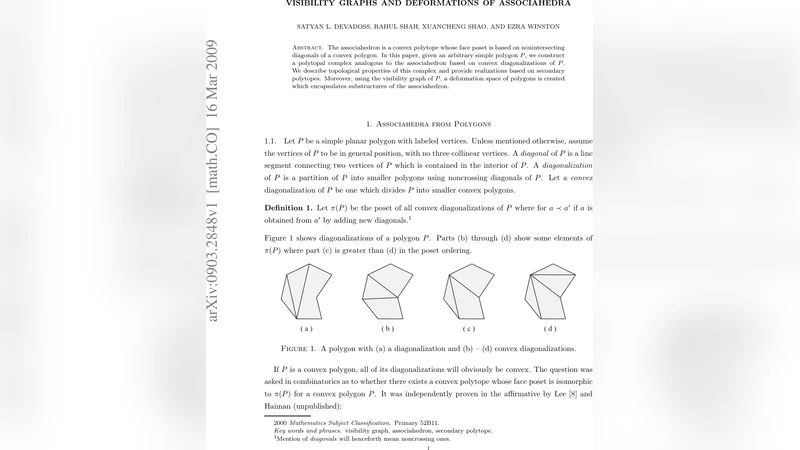
The associahedron is a convex polytope whose face poset is based on nonintersecting diagonals of a convex polygon. In this paper, given an arbitrary simple polygon P, we construct a polytopal complex analogous to the associahedron based on convex diagonalizations of P. We describe topological properties of this complex and provide realizations based on secondary polytopes. Moreover, using the visibility graph of P, a deformation space of polygons is created which encapsulates substructures of the associahedron.
💡 Research Summary
The paper extends the classical notion of the associahedron—originally defined for convex polygons via non‑crossing diagonal triangulations—to arbitrary simple polygons P. The authors introduce a polytopal complex 𝔄(P) whose vertices correspond to all convex diagonalizations of P, i.e., ways of dissecting P into convex sub‑polygons using non‑intersecting diagonals. Two vertices are joined by an edge when the corresponding diagonalizations differ by a single diagonal flip, exactly mirroring the flip graph of triangulations in the convex case. This construction yields a simplicial complex whose dimension equals the number of interior diagonals of P.
Topologically, the authors prove that 𝔄(P) is always a contractible simplicial complex with the same homotopy type as a sphere of appropriate dimension, thereby preserving the familiar topological properties of the classical associahedron. They further show that 𝔄(P) can be realized as a secondary polytope of the vertex set of P: each convex diagonalization defines a weight vector (the sum of the areas of the resulting convex cells), and the convex hull of all such vectors is precisely a polytope whose face lattice coincides with the flip complex. This provides an explicit convex realization and connects the construction to the well‑studied theory of secondary polytopes.
A central innovation is the use of the visibility graph G(P). In G(P) vertices are the polygon’s corners, and an edge exists when the straight segment between two vertices lies entirely inside P. The authors observe that cliques of G(P) correspond to sets of vertices that can be simultaneously connected by non‑crossing diagonals, i.e., to faces of 𝔄(P). By mapping each maximal clique to the convex diagonal set it determines, they define a deformation space 𝔇(P) that parametrizes all possible “visibility‑preserving” deformations of P. Within 𝔇(P) the subcomplexes that are isomorphic to classical associahedra appear as faces associated with particular cliques, thereby embedding the Catalan‑type combinatorial structure inside the more general visibility‑based framework.
The paper also addresses algorithmic aspects. Using the secondary‑polytope realization, the authors give a linear‑programming formulation for constructing the coordinates of 𝔄(P) in Euclidean space. They illustrate how to compute the flip graph efficiently, how to detect maximal cliques in G(P), and how to update the complex when a vertex of P is moved, thereby tracking continuous deformations of the polygon’s visibility structure. Experimental results on several non‑convex polygons demonstrate that the method scales well and that the resulting complexes faithfully capture both the combinatorial and geometric features of the underlying polygon.
In summary, the authors provide a comprehensive theory that (1) generalizes the associahedron to any simple polygon via convex diagonalizations, (2) supplies a concrete convex realization through secondary polytopes, (3) links the combinatorial structure to the visibility graph, and (4) defines a deformation space that unifies these ideas. The work bridges discrete geometry, topological combinatorics, and computational geometry, opening new avenues for applications in mesh generation, shape analysis, and the study of polygonal deformation pathways.
Comments & Academic Discussion
Loading comments...
Leave a Comment