A multi-opinion evolving voter model with infinitely many phase transitions
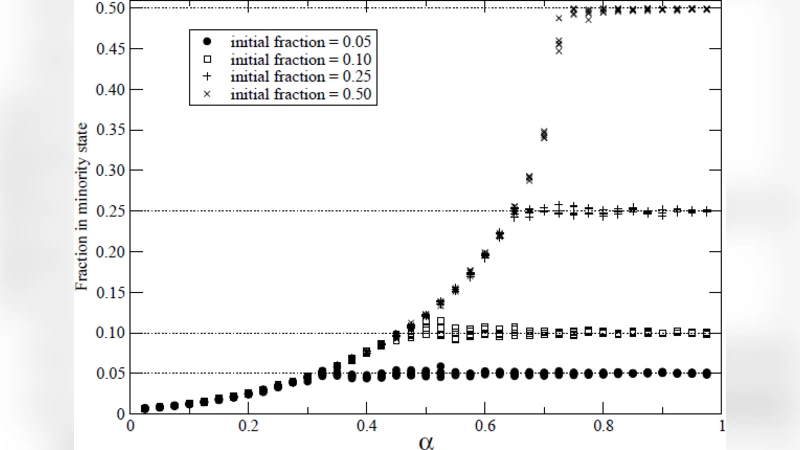
We consider an idealized model in which individuals’ changing opinions and their social network coevolve, with disagreements between neighbors in the network resolved either through one imitating the opinion of the other or by reassignment of the discordant edge. Specifically, an interaction between $x$ and one of its neighbors $y$ leads to $x$ imitating $y$ with probability $(1-\alpha)$ and otherwise (i.e., with probability $\alpha$) $x$ cutting its tie to $y$ in order to instead connect to a randomly chosen individual. Building on previous work about the two-opinion case, we study the multiple-opinion situation, finding that the model has infinitely many phase transitions. Moreover, the formulas describing the end states of these processes are remarkably simple when expressed as a function of $\beta = \alpha/(1-\alpha)$.
💡 Research Summary
The paper studies a co‑evolving opinion‑network model in which individuals can change their opinion and simultaneously rewire their social ties. The basic mechanism is as follows: at each discrete time step a vertex x is chosen uniformly at random. If x has at least one neighbor, a neighbor y is selected uniformly among its incident edges. With probability 1 − α, x copies y’s opinion (the classic voter update). With probability α, x cuts the edge to y and reconnects that edge to a uniformly chosen vertex that currently holds the same opinion as x (the “rewire‑to‑random” rule). The process repeats until there are no discordant edges, i.e., every edge connects two vertices that share the same opinion.
The authors first review the two‑opinion case (opinions 0 and 1) studied in earlier work. When α = 0 the model reduces to the voter model on a static Erdős–Rényi graph, which quickly forms a giant component and reaches consensus in O(N²) updates, with one opinion dominating. When α = 1 only rewiring occurs; after each edge has been rewired the graph fragments into G small components, each containing only one opinion, and the final opinion distribution mirrors the initial one. For intermediate α a phase transition occurs at a critical value α_c (≈ 0.46 for average degree λ = 4 and G ≈ 10). Below α_c the system spends O(N²) steps in a “slow‑consensus” regime, while above α_c it reaches consensus in O(N log N) steps.
A key conceptual tool introduced for the two‑opinion case is the notion of quasi‑stationary distributions. Simulations show that after a brief transient the pair (fraction of discordant edges N₀₁/M, fraction of opinion‑1 vertices N₁/N) rapidly collapses onto a one‑dimensional curve (an “arc”). The dynamics along this curve can be approximated by a Wright–Fisher diffusion dθ_t = p(1 − α)
Comments & Academic Discussion
Loading comments...
Leave a Comment