Entropic Inference: some pitfalls and paradoxes we can avoid
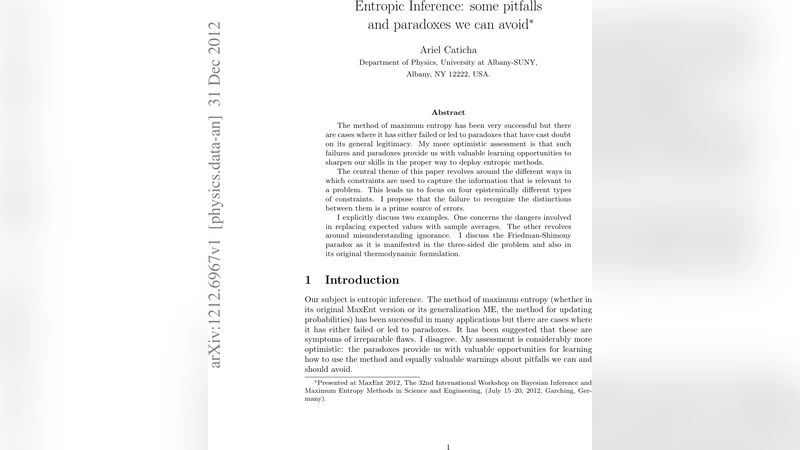
The method of maximum entropy has been very successful but there are cases where it has either failed or led to paradoxes that have cast doubt on its general legitimacy. My more optimistic assessment is that such failures and paradoxes provide us with valuable learning opportunities to sharpen our skills in the proper way to deploy entropic methods. The central theme of this paper revolves around the different ways in which constraints are used to capture the information that is relevant to a problem. This leads us to focus on four epistemically different types of constraints. I propose that the failure to recognize the distinctions between them is a prime source of errors. I explicitly discuss two examples. One concerns the dangers involved in replacing expected values with sample averages. The other revolves around misunderstanding ignorance. I discuss the Friedman-Shimony paradox as it is manifested in the three-sided die problem and also in its original thermodynamic formulation.
💡 Research Summary
The paper “Entropic Inference: some pitfalls and paradoxes we can avoid” offers a thorough examination of why the maximum‑entropy (MaxEnt) method sometimes appears to fail or to generate paradoxes, and it argues that these problems are not flaws in the theory itself but rather stem from a mis‑handling of the constraints that encode the information relevant to a problem. The author identifies four epistemically distinct types of constraints: (1) directly observed expectation values, (2) sample averages that are used as proxies for true expectations, (3) constraints that are meant to express ignorance (often implemented as symmetry or uniformity assumptions), and (4) constraints that arise from physical or structural laws such as conservation principles. By distinguishing these categories, the paper shows that many of the reported failures of MaxEnt arise from conflating them.
The first major pitfall discussed is the “sample‑expectation confusion.” In practice, researchers frequently replace a true expectation value with the empirical mean of a finite data set, assuming that the two are interchangeable. The author demonstrates, both analytically and with simulations, that this substitution injects sampling noise into the constraint and can lead the entropy maximisation to produce a posterior distribution that is overly confident or biased. When this noisy constraint is combined with a Bayesian prior, the resulting posterior may conflict with the prior’s intended influence, effectively double‑counting information and producing paradoxical inferences. The paper stresses that the size of the data set, the measurement error, and the underlying variability must be taken into account before a sample average is admitted as a hard constraint.
The second major source of error concerns the representation of ignorance. The common practice of modelling “complete ignorance” by a uniform distribution is shown to be a hidden symmetry assumption rather than a true lack of information. This mis‑representation is at the heart of the Friedman‑Shimony paradox. The author revisits the classic three‑sided die example: one can either assert that the die is fair (all faces equally likely) or that one knows nothing about the die’s bias. Although both statements sound equivalent, the MaxEnt solution differs because the first imposes a symmetry constraint while the second imposes no constraint at all. In the thermodynamic formulation, the paradox appears when one treats the absence of knowledge about a system’s microstate as a uniform distribution over all microstates, ignoring the fact that the macroscopic constraints (energy, volume, particle number) already break the full symmetry. The paper shows that respecting the distinction eliminates the apparent contradiction: ignorance should be encoded by the maximum‑entropy distribution subject only to the known macroscopic constraints, not by an additional uniformity constraint.
Beyond these two illustrative cases, the paper provides a practical checklist for applying MaxEnt responsibly. First, classify every constraint according to the four types above. Second, quantify the uncertainty associated with sample‑based constraints (e.g., by confidence intervals or Bayesian hierarchical modelling) before feeding them into the entropy maximisation. Third, avoid imposing uniformity as a proxy for ignorance; instead, let the known constraints alone determine the least‑biased distribution. Fourth, explicitly incorporate physical laws (energy conservation, symmetries, etc.) as hard constraints whenever they are relevant, ensuring that the resulting distribution is physically admissible. Fifth, when combining MaxEnt with Bayesian updating, verify that the prior and the entropy‑derived likelihood are based on the same informational foundation to prevent double‑counting.
In the concluding discussion, the author argues that once practitioners adopt a disciplined approach to constraint specification, the MaxEnt method retains its status as a powerful, principled tool for inference under uncertainty. The “failures” and “paradoxes” become valuable learning moments that sharpen our understanding of how information should be encoded, rather than indictments of the entropy formalism itself. By recognizing the epistemic nature of constraints, researchers can avoid the pitfalls highlighted in the paper and apply entropic inference with confidence across physics, statistics, machine learning, and other fields where uncertainty quantification is essential.
Comments & Academic Discussion
Loading comments...
Leave a Comment