Turbulent convection in stellar interiors. III. Mean-field analysis and stratification effects
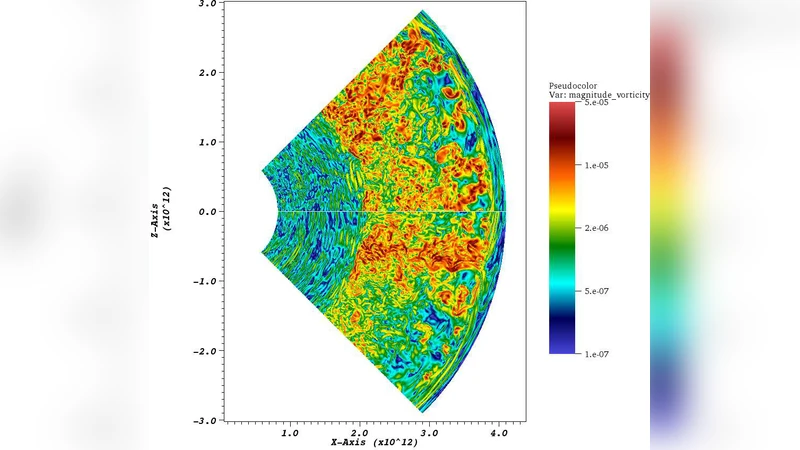
We present 3D implicit large eddy simulations (ILES) of the turbulent convection in the envelope of a 5 Msun red giant star and in the oxygen-burning shell of a 23 Msun supernova progenitor. The numerical models are analyzed in the framework of 1D Reynolds-Averaged Navier-Stokes (RANS) equations. The effects of pressure fluctuations are more important in the red giant model, owing to larger stratification of the convective zone. We show how this impacts different terms in the mean-field equations. We clarify the driving sources of kinetic energy, and show that the rate of turbulent dissipation is comparable to the convective luminosity. Although our flows have low Mach number and are nearly adiabatic, our analysis is general and can be applied to photospheric convection as well. The robustness of our analysis of turbulent convection is supported by the insensitivity of the mean-field balances to linear mesh resolution. We find robust results for the turbulent convection zone and the stable layers in the oxygen-burning shell model, and robust results everywhere in the red giant model, but the mean fields are not well converged in the narrow boundary regions (which contain steep gradients) in the oxygen-burning shell model. This last result illustrates the importance of unresolved physics at the convective boundary, which governs the mixing there.
💡 Research Summary
This paper presents three‑dimensional implicit large‑eddy simulations (ILES) of turbulent convection in two astrophysical contexts: the envelope of a 5 M⊙ red‑giant star and the oxygen‑burning shell of a 23 M⊙ supernova progenitor. The authors analyze the simulation data using the Reynolds‑averaged Navier‑Stokes (RANS) framework, decomposing each flow variable into a mean component and a fluctuation. By constructing the one‑dimensional mean‑field equations for mass, momentum, and energy, they quantify the contribution of each term to the overall dynamics.
In the red‑giant envelope, the convective zone is strongly stratified, leading to relatively large pressure fluctuations. These pressure terms appear prominently in the momentum and energy balances, particularly through the pressure‑velocity correlation ⟨p′ u′⟩ and the pressure work term ⟨p′ ∇·u′⟩. The strong stratification amplifies acoustic‑like motions that modulate the convective transport. By contrast, in the oxygen‑burning shell the stratification is milder; buoyancy work ⟨ρ′ g·u′⟩ dominates the kinetic‑energy production, while pressure fluctuations play a secondary role.
The kinetic‑energy budget in both models is governed by a clear source–sink balance. Buoyancy work supplies roughly 70–80 % of the kinetic‑energy input, with pressure work providing the remainder. The turbulent dissipation term, represented by the Reynolds stress work ⟨τ′ : ∇u′⟩, is found to be of the same order as the convective luminosity. This indicates that the turbulent cascade efficiently converts the convective heat flux into internal heating, even though the flows are low‑Mach (Ma ≪ 1) and nearly adiabatic. Consequently, the rate of turbulent dissipation can be used as a direct proxy for the convective energy transport in one‑dimensional stellar evolution codes.
A resolution study was performed by comparing simulations at two grid resolutions (256³ and 512³). The mean‑field balances (convective flux, pressure flux, turbulent stresses) show little sensitivity to grid refinement, demonstrating that the RANS analysis is robust for the bulk of the convective zones. However, in the oxygen‑burning shell the narrow convective‑stable interface exhibits steep gradients that are not fully resolved at the available resolutions. The mean fields in this boundary layer do not converge, highlighting the importance of unresolved physics—such as wave generation, entrainment, and sub‑grid mixing—at convective boundaries.
The authors draw several implications for stellar modelling. First, pressure‑fluctuation terms should be retained in one‑dimensional convection prescriptions when the stratification is strong, as neglecting them can misrepresent the energy balance. Second, because turbulent dissipation matches the convective luminosity, a simple closure that equates the dissipation rate to the local convective flux may be sufficient, eliminating the need for an independent turbulent viscosity parameter. Third, the lack of convergence in thin boundary layers suggests that current mixing‑length or overshoot prescriptions may underestimate mixing and entrainment; more sophisticated sub‑grid models or higher‑resolution simulations are required to capture these processes accurately.
In summary, this work validates a hybrid ILES‑RANS methodology for dissecting stellar convection, clarifies the relative importance of pressure versus buoyancy driving, confirms that turbulent dissipation is a dominant sink comparable to the convective luminosity, and underscores the challenges posed by convective boundaries. The findings provide a solid foundation for developing improved one‑dimensional convection and mixing models that can be applied across a wide range of stellar masses and evolutionary stages. Future work will extend the approach to higher resolutions, incorporate detailed nuclear reaction networks, and explore its applicability to surface convection zones and photospheric granulation.