Core organization of directed complex networks
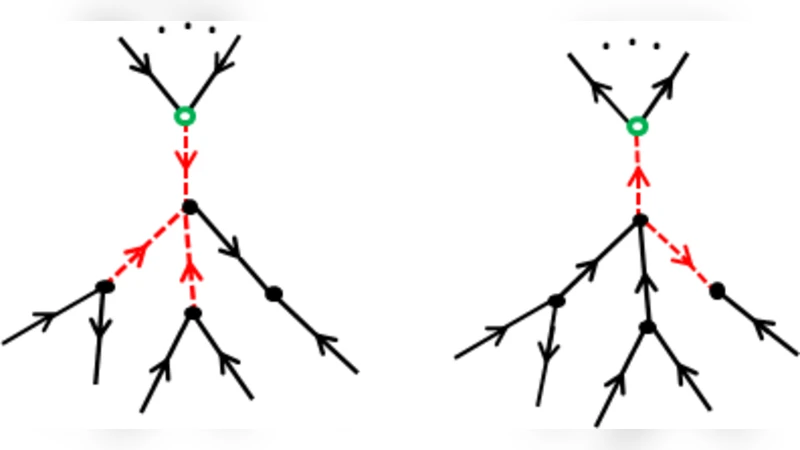
The recursive removal of leaves (dead end vertices) and their neighbors from an undirected network results, when this pruning algorithm stops, in a so-called core of the network. This specific subgraph should be distinguished from $k$-cores, which are principally different subgraphs in networks. If the vertex mean degree of a network is sufficiently large, the core is a giant cluster containing a finite fraction of vertices. We find that generalization of this pruning algorithm to directed networks provides a significantly more complex picture of cores. By implementing a rate equation approach to this pruning procedure for directed uncorrelated networks, we identify a set of cores progressively embedded into each other in a network and describe their birth points and structure.
💡 Research Summary
The paper “Core organization of directed complex networks” extends the well‑known leaf‑pruning core concept from undirected graphs to directed networks, revealing a far richer hierarchical structure. In undirected graphs, repeatedly removing leaves (vertices of degree one) together with their neighbors eventually leaves a subgraph called the core; when the average degree exceeds a critical value, this core becomes a giant component. The authors point out that many real systems—web hyperlinks, neuronal connections, traffic flows—are inherently directed, so the undirected definition is insufficient.
To address this, they introduce two directed leaf types: in‑leaves (vertices with in‑degree = 1 and out‑degree = 0) and out‑leaves (out‑degree = 1, in‑degree = 0). The pruning algorithm removes all in‑leaves and out‑leaves simultaneously, together with any vertices directly connected to them. This process is treated as a continuous‑time dynamical system, and a set of nonlinear rate equations is derived for uncorrelated directed networks characterized by a joint degree distribution (P(k_{in},k_{out})). The equations track the fraction of surviving vertices as a function of pruning time and encode how the degree distribution evolves under removal.
Solving the rate equations analytically uncovers two distinct critical points. The first marks the emergence of an “outer core,” a large subgraph that, once the average in‑/out‑degree (\langle k\rangle) surpasses a threshold (c_c), contains a finite fraction (≈30‑40 %) of all vertices. The second critical point signals the formation of an “inner core” embedded within the outer core. The inner core is much smaller but densely interconnected, often comprising feedback loops and strongly reciprocal connections. Importantly, the two cores are non‑overlapping; the inner core is fully contained within the outer core, establishing a nested hierarchy that does not appear in the undirected case.
The authors validate their theory with extensive simulations on two canonical models: Erdős‑Rényi random digraphs and scale‑free digraphs with power‑law degree distributions. In both cases, the numerical results match the analytical predictions for the size and birth points of the cores, confirming that the rate‑equation framework captures the essential physics of directed pruning.
Beyond the structural findings, the paper discusses functional implications. The outer core provides the bulk of the network’s connectivity; its removal leads to rapid fragmentation, indicating a vulnerability similar to percolation thresholds in undirected graphs. The inner core, however, remains resilient and continues to support cyclic pathways, suggesting a role in maintaining essential dynamical processes such as sustained oscillations, information circulation, or metabolic cycles. Consequently, the presence of multiple embedded cores may explain why directed systems often display both robustness (through the inner core) and fragility (through the outer core) under targeted attacks or random failures.
In the concluding section, the authors propose several avenues for future work: extending the analysis to correlated directed networks, incorporating weighted edges, and studying time‑varying (temporal) directed graphs. They also suggest that the nested core architecture could serve as a new basis for community detection, functional module identification, and the design of control strategies that specifically target either the outer or inner core depending on the desired outcome. Overall, the study provides a comprehensive theoretical framework for understanding how directedness reshapes the core‑percolation landscape, offering fresh insights into the resilience, dynamics, and modular organization of complex directed networks.
Comments & Academic Discussion
Loading comments...
Leave a Comment