Coarse-grained cellular automaton for traffic systems
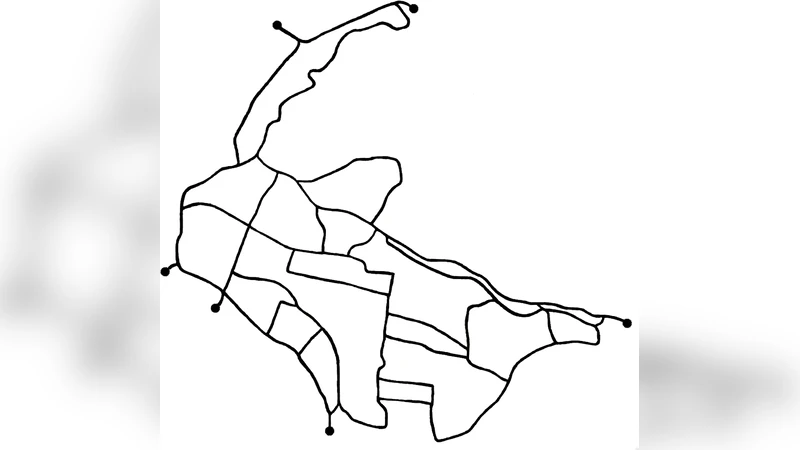
A coarse-grained cellular automaton is proposed to simulate traffic systems. There, cells represent road sections. A cell can be in two states: jammed or passable. Numerical calculations are performed for a piece of square lattice with open boundary conditions, for the same piece with some cells removed and for a map of a small city. The results indicate the presence of a phase transition in the parameter space, between two macroscopic phases: passable and jammed. The results are supplemented by exact calculations of the stationary probabilities of states for the related Kripke structure constructed for the traffic system. There, the symmetry-based reduction of the state space allows to partially reduce the computational limitations of the numerical method.
💡 Research Summary
The paper introduces a coarse‑grained cellular automaton (CA) designed to model traffic flow at the level of road sections rather than individual vehicles. Each cell represents a discrete segment of roadway and can occupy only two binary states: “passable” (free flow) or “jammed” (congested). The evolution of a cell’s state depends on three probabilistic parameters: (i) p, the probability that new vehicles enter the network from the external environment; (ii) w, the probability that a jam propagates from a neighboring jammed cell to a currently passable one; and (iii) v, the probability that a jammed cell clears and becomes passable. Transition rules are defined so that a passable cell surrounded by k jammed neighbours becomes jammed with probability 1‑(1‑w)^k, while a jammed cell becomes passable with probability v. Open boundary conditions allow vehicles to leave the system freely.
Three experimental configurations are examined: (1) a square lattice of size L × L with all cells present, (2) the same lattice with a random subset of cells removed to mimic road closures, and (3) a realistic map of a small city where each road segment is mapped to a cell. For each configuration the authors sweep the ratio w/v while keeping p modest, run the automaton for 10^5 time steps, and record the stationary jam density ρ (fraction of jammed cells). The results reveal a sharp transition: when w/v ≫ 1 the system settles into a globally jammed phase (ρ≈1); when w/v ≪ 1 it remains largely free‑flowing (ρ≈0). Near w/v≈1 a critical region appears where small changes in the parameters produce large jumps in ρ, indicating a macroscopic phase transition analogous to those found in statistical‑physics models.
To complement the stochastic simulations, the authors construct the exact Kripke structure of the system, treating each possible global configuration (2^N states for N cells) as a node in a Markov chain. By diagonalising the transition matrix they obtain the stationary distribution over all configurations. Because the state space grows exponentially, they employ a symmetry‑based reduction: cells that are related by lattice rotations, reflections, or have identical neighbourhood structures are grouped into equivalence classes. Transition probabilities are then aggregated at the class level, dramatically shrinking the effective state space (by factors of 10^2–10^3 for the sizes considered). This reduction enables exact calculation of stationary probabilities for small networks and validates the Monte‑Carlo results.
The significance of the work lies in demonstrating that a highly simplified, binary CA can capture essential collective phenomena of traffic, notably the emergence of a jammed phase and a free‑flow phase, and the existence of a critical point separating them. The parameters w and v have clear operational interpretations (e.g., signal timing, lane addition, or incident clearance), suggesting that the model could be used as a rapid assessment tool for traffic‑management policies: adjusting w/v mimics the effect of interventions on the likelihood of congestion spreading versus dissipating. Moreover, the symmetry‑based state‑space reduction provides a practical pathway toward exact analysis of larger urban networks, which could be integrated with real‑time sensor data for predictive traffic control.
Future directions proposed include extending the model to multiple congestion levels, incorporating time‑varying parameters to reflect rush‑hour dynamics, and calibrating the CA against empirical traffic flow measurements. Overall, the paper contributes a novel, computationally tractable framework that bridges microscopic traffic dynamics and macroscopic statistical‑physics concepts, offering both theoretical insight and potential practical applications in urban traffic management.