The standard flare model in three dimensions. II. Upper limit on solar flare energy
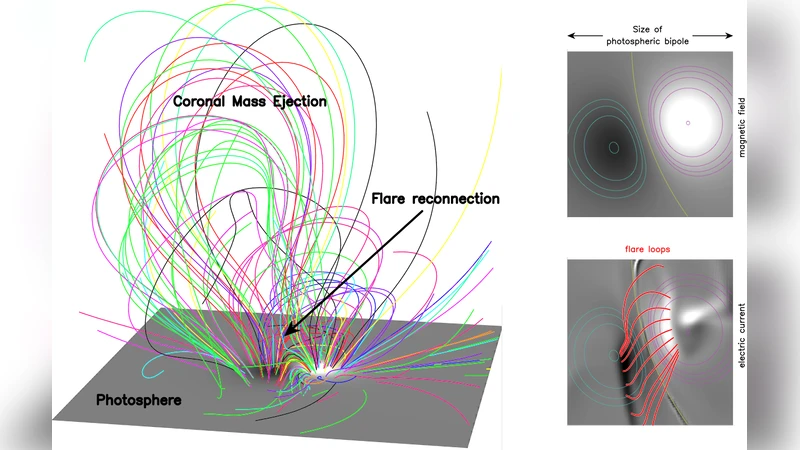
Solar flares strongly affect the Sun’s atmosphere as well as the Earth’s environment. Quantifying the maximum possible energy of solar flares of the present-day Sun, if any, is thus a key question in heliophysics. The largest solar flares observed over the past few decades have reached energies of a few times 10^{32} ergs, possibly up to 10^{33} ergs. Flares in active Sun-like stars reach up to about 10^{36} ergs. In the absence of direct observations of solar flares within this range, complementary methods of investigation are needed. Using historical reports for solar active region, we scaled to observed solar values a realistic dimensionless 3D MHD simulation for eruptive flares, which originate from a highly sheared bipole. This enabled us to calculate the magnetic fluxes and flare energies in the model in a wide paramater space. Firstly, commonly observed solar conditions lead to modeled magnetic fluxes and flare energies that are comparable to those estimated from observations. Secondly, we evaluate from observations that 30% of the area of sunspot groups are typically involved in flares. This is related to the strong fragmentation of these groups, which naturally results from sub-photospheric convection. When the model is scaled to 30% of the area of the largest sunspot group ever reported, with its peak magnetic field being set to the strongest value ever measured in a sunspot, it produces a flare with a maximum energy of ~ 6x10^{33} ergs. The results of the model suggest that the Sun is able to produce flares up to about six times as energetic in total solar irradiance fluence as the strongest directly-observed flare from Nov 4, 2003. Sunspot groups larger than historically reported would yield superflares for spot pairs that would exceed tens of degrees in extent. We thus conjecture that superflare-productive Sun-like stars should have a much stronger dynamo than in the Sun.
💡 Research Summary
The paper addresses a fundamental question in heliophysics: what is the absolute upper limit of energy that a solar flare on the present‑day Sun can release? While the most energetic flares recorded in recent decades have reached a few × 10³² erg, and occasionally up to 10³³ erg, flares on Sun‑like stars have been observed with energies as high as 10³⁶ erg. Because such extreme solar events have never been directly observed, the authors adopt a complementary approach that combines historical sunspot data with a realistic three‑dimensional magnetohydrodynamic (MHD) simulation of eruptive flares.
The simulation starts from a highly sheared bipole configuration, a geometry that reproduces the strong magnetic shear and current sheets commonly seen in active regions. It solves the ideal, incompressible MHD equations in a fully three‑dimensional domain, allowing the magnetic field to reconnect, the flux rope to erupt, and the Poynting flux to be measured throughout the event. The model is dimensionless; therefore, to translate its results into physical units the authors introduce two observationally motivated scaling factors. First, they note that, on average, only about 30 % of a sunspot group’s area participates in a flare, a fraction derived from historical flare‑area statistics. Second, they adopt the strongest magnetic field ever measured in a sunspot (≈ 3500 G) as the peak field strength for the scaling. By applying these factors to the simulation, the authors can compute the magnetic fluxes and total magnetic energy released for any chosen sunspot size.
When the model is scaled to the most extreme sunspot group ever recorded (the 1947 “Great” group) but limited to the 30 % active fraction, the resulting flare releases roughly 6 × 10³³ erg. This value is about six times larger than the energy of the largest directly observed solar flare (the 2003‑11‑04 X28 event). In terms of total solar irradiance (TSI) fluence, such a flare would deliver a comparable factor of six increase over the strongest observed event. The authors also explore the parameter space beyond realistic solar values: if a bipole were to span tens of degrees on the solar surface, the model predicts energies exceeding 10³⁵ erg, i.e., the regime of so‑called “superflares.” Since the Sun never exhibits such enormous spot separations, the conclusion is that the Sun’s dynamo cannot generate the magnetic configurations required for superflares, whereas superflare‑productive Sun‑like stars must possess a substantially stronger dynamo and larger, more coherent magnetic structures.
The paper discusses several caveats. The simulation assumes ideal MHD with negligible resistivity and viscosity, and it uses a simplified boundary condition that may underestimate energy losses. Small‑scale magnetic fragmentation, which is ubiquitous in real active regions, is not fully resolved, potentially leading to an overestimate of the available magnetic energy. Moreover, the 30 % active‑area fraction is a statistical average; individual events could involve a larger or smaller portion of the spot group. Despite these limitations, the authors argue that their approach provides a robust upper bound for solar flare energies under present‑day solar conditions.
In summary, the study demonstrates that the Sun is theoretically capable of producing flares up to about 6 × 10³³ erg, roughly six times the energy of the most powerful flare ever recorded. Achieving the much larger energies observed on other Sun‑like stars would require magnetic field strengths and spot configurations far beyond anything the contemporary solar dynamo can generate. The work thus bridges the gap between solar observations and stellar superflares, offering a quantitative framework for assessing the flare‑energy limits of our own star and highlighting the need for higher‑resolution observations and more sophisticated 3‑D modeling to refine these limits further.
Comments & Academic Discussion
Loading comments...
Leave a Comment