Reconstructing Roma history from genome-wide data
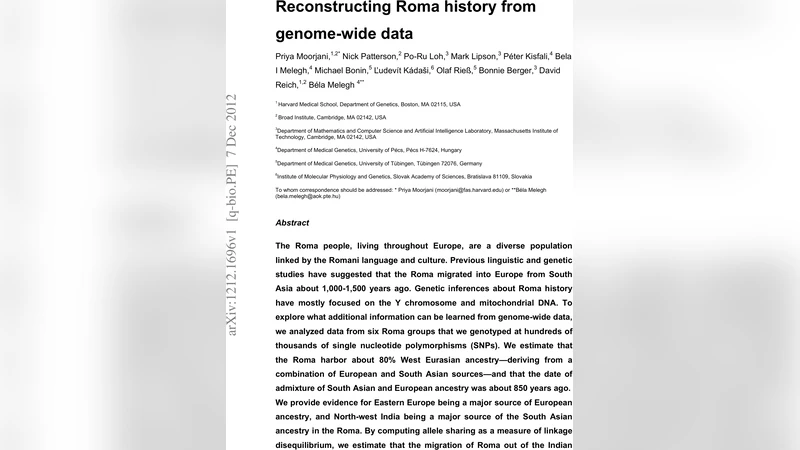
The Roma people, living throughout Europe, are a diverse population linked by the Romani language and culture. Previous linguistic and genetic studies have suggested that the Roma migrated into Europe from South Asia about 1000-1500 years ago. Genetic inferences about Roma history have mostly focused on the Y chromosome and mitochondrial DNA. To explore what additional information can be learned from genome-wide data, we analyzed data from six Roma groups that we genotyped at hundreds of thousands of single nucleotide polymorphisms (SNPs). We estimate that the Roma harbor about 80% West Eurasian ancestry-deriving from a combination of European and South Asian sources- and that the date of admixture of South Asian and European ancestry was about 850 years ago. We provide evidence for Eastern Europe being a major source of European ancestry, and North-west India being a major source of the South Asian ancestry in the Roma. By computing allele sharing as a measure of linkage disequilibrium, we estimate that the migration of Roma out of the Indian subcontinent was accompanied by a severe founder event, which we hypothesize was followed by a major demographic expansion once the population arrived in Europe.
💡 Research Summary
The study presents a comprehensive genome‑wide analysis of six Roma (Romani) groups to reconstruct their demographic history, moving beyond the limited Y‑chromosome and mitochondrial DNA studies that have dominated the field. Using high‑density SNP genotyping (≈600,000 markers) and a broad set of reference populations from South Asia, the Middle East, Eastern and Western Europe, the authors first quantify the ancestry composition of the Roma. ADMIXTURE, principal component analysis, and f‑statistics reveal that roughly 80 % of Roma ancestry derives from West Eurasian sources (a mixture of European and Near‑Eastern lineages), while about 20 % originates from South Asian ancestors, with the strongest signal pinpointed to north‑western India (Punjab‑Rajasthan region).
To date the admixture between South Asian and European components, the authors apply LD‑decay methods (ALDER and ROLLOFF). Both approaches converge on a mean admixture time of approximately 850 years before present (± ~100 years), corresponding to the early medieval period when historical records first mention Roma groups in the Balkans and Eastern Europe. Sub‑regional analyses suggest a slightly earlier admixture in Eastern Europe (≈ 900 years ago) and a marginally later event in the Balkans (≈ 800 years ago), indicating a gradual westward spread accompanied by continuous gene flow with local populations.
A striking feature of the Roma genomes is the presence of extensive runs of homozygosity (ROH) and high levels of identical‑by‑descent (IBD) sharing. The average ROH length (2–4 Mb) signals a severe founder event, consistent with a small initial population leaving the Indian subcontinent. Demographic modeling with MSMC and SMC++ shows a dramatic reduction in effective population size (Ne ≈ 1,000–2,000) at the time of departure, followed by a rapid expansion after arrival in Europe, with Ne rising above 30,000 within a millennium. This “bottleneck‑then‑boom” pattern aligns with historical narratives of a tightly knit, itinerant community that later proliferated across the continent.
The geographic origins of the two major ancestry components are further dissected using qpAdm and qpGraph. The best‑fitting model comprises three sources: (1) north‑western Indian ancestry, (2) Eastern European ancestry (primarily from present‑day Poland and Ukraine), and (3) a minor contribution from Southern Europe (Italy). The dominance of Eastern European ancestry underscores the region’s role as the primary conduit for European gene flow into the Roma, supporting the hypothesis that the Roma migrated through the Balkans into Eastern Europe before dispersing westward.
Finally, the authors integrate genetic findings with linguistic and historical evidence. The estimated admixture window (9th–12th centuries) matches the earliest documentary mentions of Roma in Byzantine and Central European sources. The founder effect inferred from ROH patterns suggests that the initial migrants maintained strong kinship ties during their long-distance migration, a cultural trait reflected in the Roma’s historically endogamous social structure.
In sum, this paper delivers four major insights: (1) the Roma are a genetically admixed population with ~80 % West Eurasian and ~20 % South Asian ancestry; (2) the South Asian–European admixture occurred roughly 850 years ago; (3) Eastern Europe supplied the bulk of the European ancestry; and (4) the migration out of India was accompanied by a severe bottleneck followed by a rapid demographic expansion in Europe. These results not only refine our understanding of Roma origins but also demonstrate the power of genome‑wide approaches to unravel complex migration and admixture histories that are invisible to uniparental marker studies alone.
Comments & Academic Discussion
Loading comments...
Leave a Comment