Far- and mid-infrared spectroscopy of complex organic matter of astrochemical interest: coal, heavy petroleum fractions, and asphaltenes
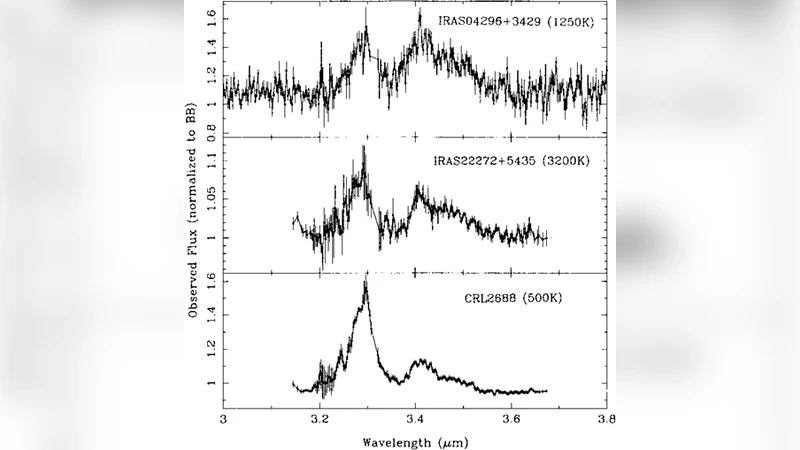
The coexistence of a large variety of molecular species (i.e., aromatic, cycloaliphatic and aliphatic) in several astrophysical environments suggests that unidentified IR emission (UIE) occurs from small solid particles containing a mix of aromatic and aliphatic structures (e.g., coal, petroleum, etc.), renewing the astronomical interest on this type of materials. A series of heavy petroleum fractions namely DAE, RAE, BQ-1, and asphaltenes derived from BQ-1 were used together with anthracite coal and bitumen as model compounds in matching the band pattern of the emission features of proto-planetary nebulae (PPNe). All the model materials were examined in the mid-infrared (2.5-16.7 um) and for the first time in the far-infrared (16.7-200 um), and the IR bands were compared with the UIE from PPNe. The best match of the PPNe band pattern is offered by the BQ-1 heavy aromatic oil fraction and by its asphaltenes fraction. Particularly interesting is the ability of BQ-1 to match the band pattern of the aromatic-aliphatic C-H stretching bands of certain PPNe, a result which is not achieved neither by the coal model nor by the other petroleum fractions considered here. This study shows that a new interesting molecular model of the emission features of PPNe are asphaltene molecules which are composed by an aromatic core containing 3-4 condensed aromatic rings surrounded by cycloaliphatic (naphtenic) and aliphatic alkyl chains. It is instead shown the weakness of the model involving a mixture of PAHs for modeling the aromatic IR emission bands. The laboratory spectra of these complex organic compounds represent a unique data set of high value for the astronomical community; e.g., they may be compared with the Herschel Space Observatory spectra (~51-220 um) of several astrophysical environments such as (proto-) PNe, H II regions, reflection nebulae, star forming galaxies, and young stellar objects.
💡 Research Summary
The paper addresses the long‑standing problem of unidentified infrared emission (UIE) in various astrophysical environments by investigating terrestrial complex carbon materials as analogues of the carriers. The authors selected a set of heavy petroleum fractions—DAE, RAE, BQ‑1—and the asphaltene fraction derived from BQ‑1, together with anthracite coal and bitumen, to serve as laboratory models. Using Fourier‑transform infrared (FTIR) spectroscopy they recorded high‑resolution spectra in the mid‑infrared (2.5–16.7 µm) and, for the first time, in the far‑infrared (16.7–200 µm). The far‑infrared data extend the spectral coverage to the range observed by the Herschel Space Observatory (≈51–220 µm), providing a unique benchmark for comparison with astronomical observations of proto‑planetary nebulae (PPNe), H II regions, reflection nebulae, star‑forming galaxies and young stellar objects.
Spectral analysis shows that the BQ‑1 heavy aromatic oil fraction and its asphaltene sub‑fraction reproduce the PPNe UIE pattern far better than the other samples. In the 3.3 µm aromatic C‑H stretch and the 3.4 µm aliphatic C‑H stretch, BQ‑1 displays two distinct, strong peaks that match the simultaneous presence of both features in many PPNe spectra. Coal, DAE and RAE either lack the aliphatic component or present it too weakly, leading to a poor overall match. In the far‑infrared, BQ‑1 and its asphaltenes exhibit a series of broad bands between 30 and 50 µm and additional structures up to 120 µm, which resemble the broad FIR features reported in Herschel observations of PPNe and other dusty environments.
Structural interpretation, supported by complementary Raman and NMR data, indicates that BQ‑1 and the asphaltene molecules consist of a compact aromatic core containing three to four condensed benzene rings, surrounded by cyclo‑aliphatic (naphthenic) rings and aliphatic alkyl chains. This “core‑shell” architecture provides both aromatic and aliphatic vibrational modes, unlike a simple mixture of polycyclic aromatic hydrocarbons (PAHs). The asphaltene fraction, although a high‑molecular‑weight aggregate (several thousand daltons), retains distinct molecular vibrational signatures, suggesting that similar large, partially ordered carbonaceous particles could exist as solid dust grains in space.
The study makes three principal contributions. First, it delivers a comprehensive laboratory spectral library that spans both mid‑ and far‑infrared wavelengths, enabling direct quantitative comparison with current and future space‑based infrared data sets. Second, it demonstrates empirically that BQ‑1 and its asphaltenes are the most successful terrestrial analogues for reproducing PPNe UIE, thereby challenging the prevailing PAH‑only paradigm. Third, it highlights asphaltene‑type molecules as promising candidates for the carriers of UIE across a wide range of astrophysical environments, opening new avenues for modeling dust composition, formation pathways, and evolution.
Future work should focus on determining the optical constants, temperature‑dependent emissivities, and size distributions of these complex organics, and incorporating them into radiative transfer models of dusty nebulae. By doing so, the astronomical community can assess the relative abundance of asphaltene‑like particles in space and evaluate their role in the carbon cycle of the interstellar medium. The data presented here thus constitute a valuable resource for interpreting Herschel, JWST, and upcoming far‑infrared missions, and for refining our understanding of the organic chemistry that pervades the cosmos.
Comments & Academic Discussion
Loading comments...
Leave a Comment