The three different phases in the dynamics of chemical reaction networks and their relationship to cancer
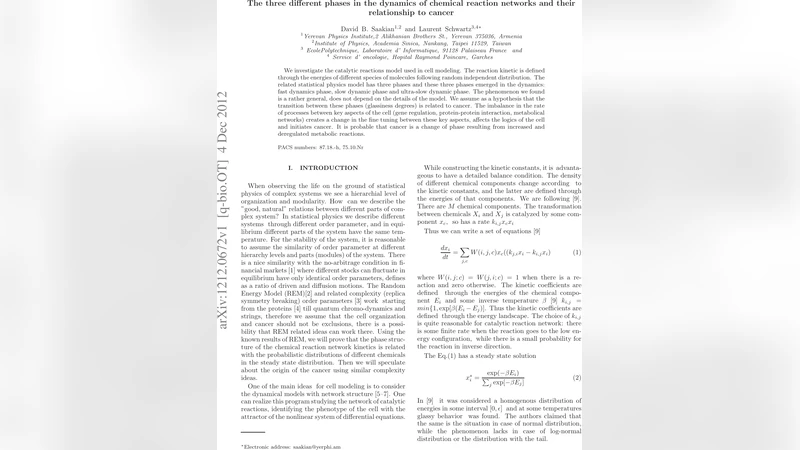
We investigate the catalytic reactions model used in cell modeling. The reaction kinetic is defined through the energies of different species of molecules following random independent distribution. The related statistical physics model has three phases and these three phases emerged in the dynamics: fast dynamics phase, slow dynamic phase and ultra-slow dynamic phase. The phenomenon we found is a rather general, does not depend on the details of the model. We assume as a hypothesis that the transition between these phases (glassiness degrees) is related to cancer. The imbalance in the rate of processes between key aspects of the cell (gene regulation, protein-protein interaction, metabolical networks) creates a change in the fine tuning between these key aspects, affects the logics of the cell and initiates cancer. It is probable that cancer is a change of phase resulting from increased and deregulated metabolic reactions.
💡 Research Summary
The paper presents a statistical‑physics framework for modeling catalytic reaction networks inside cells and argues that the resulting dynamics naturally fall into three distinct phases—fast, slow, and ultra‑slow (glassy). The authors begin by treating the free energies of individual molecular species as independent random variables drawn from a prescribed distribution. Reaction rate constants are then defined through an Arrhenius‑type relationship, where each elementary step’s activation energy is the difference between the energies of reactants and products. Under these assumptions the entire reaction network maps onto a Random Energy Model (REM), a well‑studied construct in spin‑glass theory.
In the REM, the system’s behavior is governed by an effective temperature that controls the probability of crossing energy barriers. At low temperature the system becomes trapped in deep minima, exhibiting glassy dynamics; at intermediate temperature it explores the landscape more freely, displaying liquid‑like dynamics; at high temperature barrier crossing is essentially unrestricted, leading to gas‑like dynamics. By analogy, the authors identify three dynamical regimes for the biochemical network: (1) a fast dynamics phase where most reactions proceed unhindered and the system quickly reaches a quasi‑steady state; (2) a slow dynamics phase where a subset of reactions is hindered by relatively high barriers, creating metastable plateaus and prolonged transients; and (3) an ultra‑slow or glassy phase in which many reactions are confined to deep energetic traps, resulting in extremely long relaxation times.
Crucially, the paper posits that these phases are not merely mathematical curiosities but correspond to functional “time‑scale modules” in the cell: gene‑regulatory circuits, protein‑protein interaction (PPI) networks, and metabolic pathways. In a healthy cell, each module operates at a characteristic time scale, and the coexistence of the three phases provides a balanced, hierarchical timing that underlies robust decision‑making, differentiation, and apoptosis.
The central hypothesis is that cancer arises when the cell undergoes a phase transition from a mixed‑phase regime to a more homogeneous, high‑activity regime. External stresses (nutrient excess, oxidative stress) or internal alterations (oncogene activation, tumor‑suppressor loss) effectively raise the system’s “temperature,” increasing the probability of crossing previously prohibitive barriers. Consequently, the network shifts from the ultra‑slow (glassy) or slow phase toward the fast phase. This shift deregulates the delicate timing between gene expression, PPIs, and metabolism: metabolic fluxes become hyperactive, feedback inhibition is weakened, and signaling pathways that normally enforce cell‑cycle checkpoints become desynchronized. The authors argue that such a loss of temporal hierarchy can rewire the logical architecture of the cell, allowing uncontrolled proliferation and the metabolic reprogramming characteristic of cancer (the Warburg effect, glutamine addiction, etc.).
Importantly, the authors emphasize that the emergence of the three phases does not depend on the detailed stoichiometry or topology of the network; it follows from the statistical properties of the energy distribution alone. This universality suggests that the phase‑transition mechanism could be operative across diverse cell types, organisms, and tumor lineages.
To support their claim, the paper proposes experimental strategies: simultaneous high‑throughput measurement of reaction rates in the three modules (e.g., fluorescence‑based metabolic flux analysis, real‑time single‑molecule PPI kinetics, and live‑cell transcriptional reporters) combined with temperature‑like perturbations (chemical stressors, controlled ATP depletion). By mapping the distribution of relaxation times before and after oncogenic transformation, one could directly observe a shift in the proportion of fast versus slow processes, thereby validating the phase‑transition hypothesis.
If confirmed, this framework would complement the prevailing genetic view of oncogenesis by providing a physical, systems‑level description of how deregulated metabolism can drive a cell into a new dynamical phase. Therapeutically, it opens the possibility of “phase‑targeted” interventions—drugs that restore the glassy component of the network (e.g., metabolic inhibitors that re‑introduce high‑energy barriers) or agents that re‑establish the hierarchical timing between modules. In summary, the paper offers a novel, physics‑inspired perspective on cancer as a dynamical phase transition in the underlying biochemical reaction network, linking statistical‑mechanical concepts to cellular biology and suggesting concrete avenues for experimental validation and therapeutic exploitation.