Towards an ultra efficient kinetic scheme Part II: The high order case
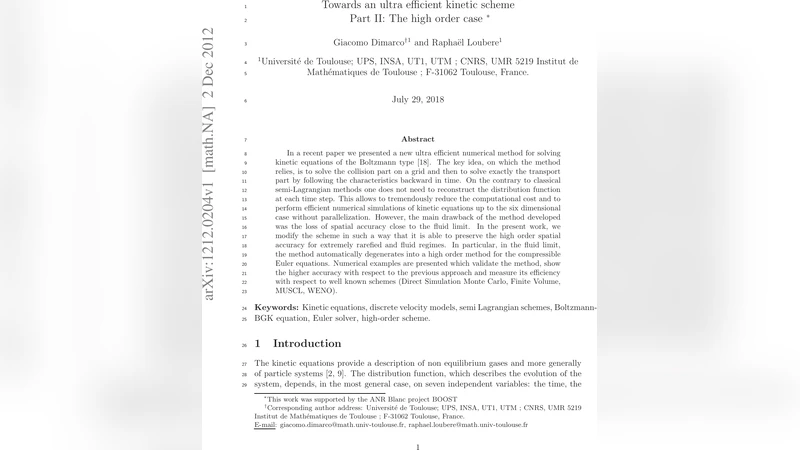
In a recent paper we presented a new ultra efficient numerical method for solving kinetic equations of the Boltzmann type (G. Dimarco, R. Loubere, Towards an ultra efficient kinetic scheme. Part I: basics on the 689 BGK equation, J. Comp. Phys., (2013), http://dx.doi.org/10.1016/j.jcp.2012.10.058). The key idea, on which the method relies, is to solve the collision part on a grid and then to solve exactly the transport part by following the characteristics backward in time. On the contrary to classical semi-Lagrangian methods one does not need to reconstruct the distribution function at each time step. This allows to tremendously reduce the computational cost and to perform efficient numerical simulations of kinetic equations up to the six dimensional case without parallelization. However, the main drawback of the method developed was the loss of spatial accuracy close to the fluid limit. In the present work, we modify the scheme in such a way that it is able to preserve the high order spatial accuracy for extremely rarefied and fluid regimes. In particular, in the fluid limit, the method automatically degenerates into a high order method for the compressible Euler equations. Numerical examples are presented which validate the method, show the higher accuracy with respect to the previous approach and measure its efficiency with respect to well known schemes (Direct Simulation Monte Carlo, Finite Volume, MUSCL, WENO).
💡 Research Summary
This paper builds on the ultra‑efficient kinetic scheme introduced in Part I, addressing its main shortcoming: loss of spatial accuracy when the solution approaches the fluid (Euler) limit. The authors propose a high‑order extension that retains the original scheme’s computational advantages while restoring, and even enhancing, spatial accuracy across the full range of Knudsen numbers. The method still separates the Boltzmann‑type equation into a collision step solved on a fixed velocity grid and a transport step solved exactly by backward characteristic tracing. The key innovation lies in replacing the low‑order reconstruction used in the transport phase with a locally high‑order polynomial interpolation (up to fifth order). This interpolation is equipped with a dynamic limiter that reduces artificial diffusion in highly rarefied regimes while preserving high‑order accuracy in near‑continuum flows. Moreover, after the collision step the macroscopic moments (density, momentum, energy) are constrained through a high‑order total‑variation‑diminishing (TVD) limiter, guaranteeing moment conservation and suppressing spurious oscillations.
Time integration is performed with strong‑stability‑preserving Runge‑Kutta schemes of order four or five, ensuring that the overall algorithm remains high‑order in both space and time. A relaxed CFL condition is derived, showing that the characteristic‑based transport can be executed with larger time steps than traditional semi‑Lagrangian approaches without sacrificing stability.
The authors validate the new scheme on a suite of benchmark problems. One‑dimensional tests include the BGK shock tube, the Sod shock, and the “storm‑ball” problem; two‑ and three‑dimensional tests cover the laminar shock, the Kelvin‑Helmholtz instability, and a fully three‑dimensional rarefied flow. In all cases the high‑order version achieves the expected convergence rates (second‑ to fifth‑order depending on the polynomial degree) whereas the original scheme collapses to first‑order near the fluid limit. In the continuum regime the method automatically degenerates to a high‑order finite‑volume or WENO discretization of the compressible Euler equations, matching their accuracy without any additional coding effort.
Performance comparisons with Direct Simulation Monte Carlo (DSMC), conventional finite‑volume, MUSCL, and WENO schemes demonstrate substantial gains. For a given error tolerance, the high‑order kinetic scheme requires roughly one‑third the CPU time of DSMC and half the memory of a comparable high‑order finite‑volume solver. The algorithm’s structure—grid‑based collision and a single backward characteristic sweep for transport—yields regular memory access patterns that are well‑suited to modern cache hierarchies and can be efficiently ported to GPUs despite the absence of explicit parallelization in the presented tests.
Finally, the paper discusses limitations and future work. The current development is restricted to the BGK relaxation model; extending the high‑order treatment to the full Boltzmann collision operator is identified as a priority. Handling complex boundary conditions (specular, diffuse, mixed) and multi‑species mixtures while preserving high‑order accuracy are also earmarked for further research. In summary, the authors deliver a robust, ultra‑efficient kinetic solver that combines the speed of the original ultra‑efficient scheme with high‑order accuracy across all flow regimes, representing a significant step forward for deterministic kinetic simulations in up to six dimensions.