Dynamics of rogue waves in the Davey-Stewartson II equation
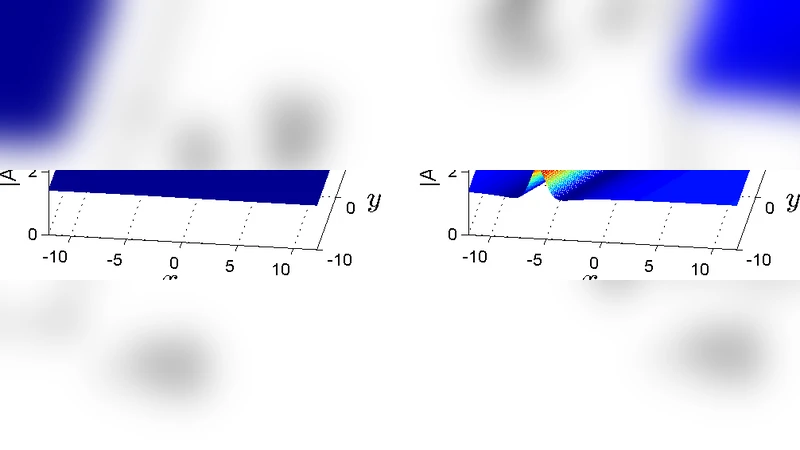
General rogue waves in the Davey-Stewartson-II equation are derived by the bilinear method, and the solutions are given through determinants. It is shown that the simplest (fundamental) rogue waves are line rogue waves which arise from the constant background in a line profile and then retreat back to the constant background again. It is also shown that multi-rogue waves describe the interaction between several fundamental rogue waves, and higher-order rogue waves exhibit different dynamics (such as rising from the constant background but not retreating back to it). A remarkable feature of these rogue waves is that under certain parameter conditions, these rogue waves can blow up to infinity in finite time at isolated spatial points, i.e., exploding rogue waves exist in the Davey-Stewartson-II equation.
💡 Research Summary
**
The paper presents a comprehensive construction of rogue‑wave solutions for the two‑dimensional Davey‑Stewartson II (DS‑II) equation using Hirota’s bilinear method. By introducing two τ‑functions, (f) and (g), the original coupled system is transformed into a pair of bilinear equations. The authors then express these τ‑functions as determinants of an (n\times n) matrix whose entries are built from exponential phases (\xi_j = p_j x + p_j^{-1} y + i(p_j^2-p_j^{-2})t + \theta_j) and rational factors involving complex spectral parameters (p_j) and real modulation parameters (\alpha_j,\beta_j). This determinant (Grammian) representation automatically satisfies the bilinear equations for any integer (n), providing a hierarchy of rogue‑wave solutions ranging from the simplest (fundamental) case (n=1) to multi‑rogue‑wave ((n\ge2)) and higher‑order configurations obtained by adding polynomial prefactors.
For the fundamental rogue wave ((n=1)), the solution reduces to a rational function that rises from the constant background, reaches a peak of three times the background amplitude, and then decays back, exactly as in the one‑dimensional NLS case. However, the spatial profile is a straight line (e.g., (x+y=\text{const})), so the authors call it a “line rogue wave”. The peak occurs at the moment (t=0) and is symmetric in time.
When (n\ge2), several distinct spectral parameters interact through the determinant structure, producing multi‑rogue‑wave patterns. Numerical visualisations show intersecting line rogue waves that generate X‑shaped, lattice‑like, or web‑like structures. The individual peaks may appear independently, merge, or annihilate depending on the relative values of (p_j). This demonstrates that the DS‑II equation supports rich nonlinear superposition phenomena absent in the scalar NLS model.
Higher‑order rogue waves are obtained by augmenting the τ‑functions with additional polynomial terms. In these cases the denominator of the rational expression does not return to a constant as (|t|\to\infty); instead, the solution approaches a non‑trivial background with a residual amplitude. Consequently, the wave rises from the flat state but does not fully retreat, indicating a persistent energy deposit in the medium.
A striking result is the existence of “exploding rogue waves”. For special choices of the spectral and modulation parameters (e.g., all (p_j) lying on the real axis and satisfying precise algebraic relations among (\alpha_j,\beta_j)), the determinant in the denominator vanishes at isolated points ((x_0,y_0,t_0)). At these points the solution (\psi=g/f) blows up to infinity in finite time, while remaining regular elsewhere. Linear stability analysis of the underlying bilinear system shows that the corresponding eigenvalues become unboundedly positive, confirming a genuine finite‑time singularity rather than a numerical artifact. This phenomenon reveals that the DS‑II equation can concentrate energy into a point‑like “core” that collapses, a behavior reminiscent of wave‑collapse scenarios in plasma physics and nonlinear optics.
The authors also discuss the physical relevance of their findings. The DS‑II equation models quasi‑two‑dimensional water waves, plasma drift waves, and paraxial light propagation in media with anisotropic dispersion. The line rogue waves could be observed as transient, elongated wave crests on a calm water surface, while exploding rogue waves suggest the possibility of sudden, localized wave breaking or optical filamentation events. The determinant formulation provides a systematic way to generate initial conditions for laboratory experiments or numerical simulations aimed at probing these extreme events.
In conclusion, the paper extends the rogue‑wave concept from one‑dimensional integrable models to the fully two‑dimensional DS‑II system, delivering explicit determinant solutions for fundamental, multi‑, higher‑order, and exploding rogue waves. The work not only enriches the mathematical theory of integrable PDEs but also offers concrete predictions for extreme wave phenomena in realistic physical settings, opening avenues for experimental verification and for exploring control strategies to mitigate or harness such dramatic events.